If you’re in the subscription business, you know that recurring revenue is your lifeblood. But what happens when that flow gets interrupted? That’s where a dunning management system comes in. It’s the software that automatically steps in to recover revenue from failed customer payments, helping you keep the money—and the customer.
What Is a Dunning Management System?

Think of it this way: your business is a high-performance engine, and your recurring revenue is the fuel. A dunning management system is the sophisticated fuel injection system ensuring a smooth, uninterrupted flow. It’s an automated strategy for reaching out to customers and fixing payment issues before they turn into lost subscribers.
The word “dunning” might sound a bit old-fashioned—it comes from the verb “to dun,” which means to persistently ask for a debt. Historically, this meant sending increasingly stern letters. But in today’s subscription world, the goal isn’t to be aggressive; it’s to be helpful and customer-focused.
This kind of system shifts your team from putting out fires to proactively protecting both your revenue and your customer relationships. For any subscription company, where even a small percentage of failed payments can add up to huge losses, this is absolutely essential.
The Shift from Manual to Automated Collections
Without a proper system, dealing with failed payments is a soul-crushing manual chore. A team member has to spot the failed charge, dig up the customer’s info, write an email, and then remember to follow up. It’s slow, full of potential for human error, and completely impossible to manage as you grow.
An automated dunning management system changes the game entirely. It takes over the entire workflow, systematically handling failed payments and preventing involuntary churn (when customers leave due to a technical snag, not because they’re unhappy). All of this is done with timely, on-brand communication that keeps you looking professional.
A good dunning system isn’t just a collections tool; it’s a customer retention tool. By smoothly resolving payment problems, you stop losing perfectly happy customers for no good reason. This directly protects the Monthly Recurring Revenue (MRR) you’ve worked so hard to build.
Manual vs. Automated Dunning
Let’s be clear: the difference between handling failed payments by hand versus with an automated system is like night and day. Automation brings efficiency, consistency, and intelligence to what is otherwise a chaotic and unreliable process.
Here’s a look at how the two approaches stack up.
| Feature | Manual Process Without a System | Automated Dunning Management System |
|---|---|---|
| Response Time | Slow and delayed. It could be days before anyone notices a failed payment, depending on staff availability. | Instantaneous. Communication and retry attempts are triggered the moment a payment fails. |
| Communication | Inconsistent. Manual emails can vary in tone and timing, which can create a confusing and poor customer experience. | Consistent, on-brand messaging delivered automatically through personalized email and even SMS campaigns. |
| Payment Retries | Manual and often based on guesswork. This leads to low success rates and can even trigger penalties from card processors. | Intelligent, scheduled retries based on the specific error codes from the payment gateway, maximizing recovery chances. |
| Scalability | Not scalable at all. The process breaks down fast as your customer base and number of failed payments grow. | Highly scalable. It can handle thousands of failed payments without needing any extra human effort. |
As you can see, an automated system isn’t just a nice-to-have. For any growing subscription business, it’s a fundamental piece of the puzzle for maintaining healthy cash flow and a happy customer base.
The Core Components of an Effective Dunning Strategy
A solid dunning strategy is much more than just sending a generic “payment failed” email. It’s an automated, intelligent system with several key parts all working together. To effectively recover revenue, you need to think beyond simple notifications and build a process based on smart retries, personalized communication, and customer segmentation.
This is what separates a basic tool from a true revenue recovery engine.
At its heart, a good dunning management system is fantastic at one thing: automatically retrying failed payments with logic. This isn’t just about hammering a customer’s card over and over. A smart system looks at why the payment failed. For instance, a temporary decline like “Insufficient Funds” might be retried in a couple of days, while a hard decline like “Invalid Card Number” should stop all retries and kick off a process to get updated info from the customer.
This intelligent scheduling makes a huge difference in your success rate. Instead of annoying customers or racking up fees from your payment processor for useless attempts, the system adapts. It’s a foundational piece of modern dunning.
Smart Communications Across Multiple Channels
How you talk to your customers is just as critical as when you retry their payment. A one-size-fits-all email blast is practically guaranteed to be ignored. A truly effective strategy uses multiple channels to make sure your message gets seen and acted on.
- Email Notifications: This is the standard. It gives you space to explain the situation clearly and provide direct links for customers to update their payment details.
- SMS Alerts: Perfect for cutting through the noise. A short, urgent message like, “Your subscription payment failed. Please update your card to avoid service interruption” is hard to miss.
- In-App Messages: This is a powerful way to get a user’s attention right when they’re using your product. The context makes the request feel natural.
By mixing these channels, you meet customers where they are and seriously increase the odds of getting a quick response. The key is to be helpful, not confrontational, and guide them toward a simple solution.
Automated and Intelligent Payment Retries
The retry logic is where a sophisticated system really proves its worth. A good dunning management system will let you set up multiple, configurable retries over time to maximize recovery without hurting the customer relationship. Many platforms, for example, allow merchants to automate anywhere from two to four retry attempts.
We’ve seen that smart, automated retries alone can boost successful collections by 20-30% compared to just manually following up.
This infographic breaks down how all the pieces of a dunning system fit together, from the different notification channels to the escalation process.
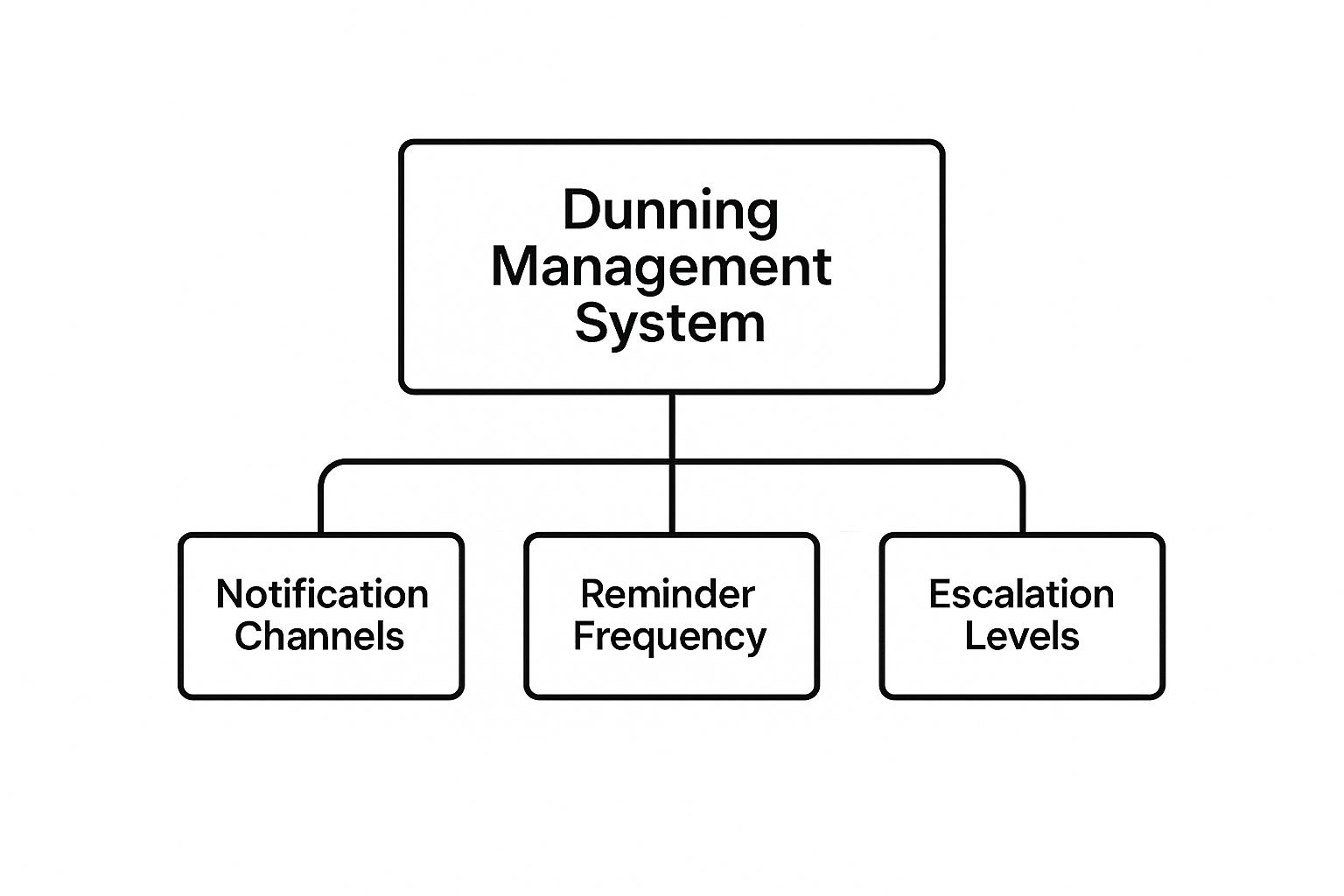
It really clarifies how a central system coordinates everything to create a single, cohesive strategy.
The Power of Customer Segmentation
Finally, the most advanced dunning strategies don’t treat every customer the same. Why should they? Customer segmentation lets you customize your approach based on who the customer is.
By segmenting customers, you can prioritize high-value accounts with a more hands-on approach while letting automation handle lower-value ones, ensuring your resources are spent where they matter most.
For example, you could create completely different dunning schedules for:
- High-LTV Customers: These accounts might get a more personal, “white-glove” touch. Maybe even a phone call from your team early on.
- New Customers: A brand-new subscriber should get gentler, more educational reminders to make sure their first renewal is a good experience.
- At-Risk Customers: Customers who have had payment issues before could be put on a faster, more aggressive dunning schedule.
This kind of customization turns your dunning process from a blunt instrument into a precision tool. When you combine smart retries, multi-channel communication, and thoughtful segmentation, you get a system that not only recovers lost money but also helps build customer loyalty.
How Dunning Management Directly Impacts Your Bottom Line
A dunning management system isn’t just another tool in your admin panel—it’s a direct driver of financial health. It’s easy to think of it as just sending payment reminders, but a smart system does so much more, connecting automated actions to a healthier, more predictable bottom line.
The biggest, most immediate impact is on a problem that quietly bleeds revenue from every subscription business: involuntary churn. This is the silent killer. It’s when you lose customers not because they’re unhappy, but because of a simple technical glitch like an expired credit card or a temporary bank issue.
This kind of churn is almost entirely preventable, and every customer you save is pure, retained profit. A good dunning system’s main job is to put effective strategies to reduce churn rate on autopilot, plugging the leaks that drain your revenue.
Protecting Your Recurring Revenue
Every single failed payment that you don’t recover is a direct hit to your Monthly Recurring Revenue (MRR). A dunning system acts like a shield, systematically going after these failures before they become lost customers.
Think about it. If you have a 5% payment failure rate and don’t recover any of it, you’re constantly losing revenue you worked hard to secure. An effective dunning platform can claw back a huge chunk of those failures, turning would-be losses back into cash in the bank.
By automatically recovering even a fraction of failed payments, you kickstart a compounding effect on your revenue growth. This recovered money not only boosts your MRR this month but also dramatically increases the Customer Lifetime Value (LTV) of your entire subscriber base.
Recovering that payment isn’t just a one-off win. It keeps a customer active, ensuring they contribute to your MRR month after month. This leads to a much more stable and reliable financial forecast, giving you the confidence to invest in growing your business.
Creating More Stable and Predictable Cash Flow
Chasing down payments manually is chaotic. Money comes in whenever your team finds a spare moment to send an email, creating a spiky, unpredictable cash flow that makes budgeting a nightmare.
Automating the process with a dunning system completely smooths out those peaks and valleys.
- Consistent Follow-up: The system never gets distracted or forgets to retry a payment, ensuring a steady, predictable flow of recovered revenue.
- Faster Recovery Times: Automated retries and reminders resolve issues in days, not the weeks it can take a human, getting cash in the door faster.
- Predictive Insights: Good dunning dashboards show you exactly what’s working, helping you forecast your cash flow with far greater accuracy.
This stability is a game-changer for managing payroll, paying your bills, and funding new projects.
Driving Operational Efficiency and Cost Savings
Beyond the direct revenue, a dunning system saves a ton of money by boosting your team’s efficiency. Just think about the “soft costs” of doing this by hand:
| Manual Task | Cost Implication |
|---|---|
| Identifying Failures | An employee digging through payment reports instead of helping customers or improving your product. |
| Manual Communication | Hours spent writing and sending awkward emails, often with inconsistent messaging or typos. |
| Tracking Follow-ups | Using spreadsheets and sticky notes to remember who to call and when, which inevitably leads to missed opportunities. |
Automating all of this frees up your team to work on what actually matters—talking to customers, improving the product, and growing the business. This shift from repetitive busywork to high-value strategic work is a massive, often-overlooked cost saving. The system handles the grind so your people can handle the growth.
Choosing the Right Dunning Management System

Picking the right dunning management system isn’t a decision to take lightly. It’s a choice that hits your revenue and customer relationships right where it counts. The market is crowded with options, from simple add-ons to powerhouse platforms, and it’s easy to get lost in the marketing noise.
Your real job is to find a system that actually fits your business—your tech stack, your customers, and where you plan to be in a few years.
Think of it like buying a new vehicle. A two-seater sports car is fun, but it’s useless if you need to haul equipment. A cargo van gets the job done but won’t win any races. You need the right tool for your specific journey. The perfect system for a bootstrapped startup will look very different from what a large enterprise needs.
So, how do you make the right call? You need a clear checklist of what matters most.
Evaluate Core Integration Capabilities
This is the big one. If a dunning platform doesn’t play nicely with your existing software, it’s going to create more headaches than it solves. You’ll end up with data silos, manual data entry, and a mess of workarounds. The goal is for it to feel like a natural extension of your financial toolkit.
Before you even look at demos, map out your core technology. Your potential dunning system absolutely must connect with these key pieces:
- Payment Gateway: This is non-negotiable. It needs to talk to your payment processor (like Stripe or Subbly) in real-time. This is how it instantly knows a payment failed and can trigger the right recovery steps.
- CRM Platform: Does it sync with your Customer Relationship Management software? This is crucial for personalizing dunning emails and giving your support team a full picture of a customer’s payment history.
- Accounting Software: A solid link to your accounting platform ensures that every dollar you recover is properly logged. This keeps your books clean and your financial reports accurate.
When these systems are deeply integrated, data flows freely. You get a single, reliable source for all things payment-related. Global payment processors often offer their own dunning tools that tie into billing and CRM systems, which is something to consider. They provide real-time dashboards for tracking recovery rates and other key metrics, helping businesses scale. You can review how major payment platforms handle dunning to see this in action.
Assess Scalability and Customization
Your business isn’t static, and your dunning system shouldn’t be either. The tool that works when you have 100 subscribers might buckle when you hit 10,000. You need to ask vendors how their platform handles growth, from the early startup days to complex enterprise-level operations.
But scalability isn’t just about handling more customers. It’s about handling more complexity. As you grow, your one-size-fits-all dunning strategy will need to get a lot smarter. That’s where customization comes in.
A great dunning management system should empower you to fine-tune every aspect of the recovery process. Generic, unchangeable templates and retry schedules will yield mediocre results. You need control.
Here’s what that control looks like in practice. Look for flexibility in these areas:
- Retry Logic: Can you change the timing and number of retry attempts based on why the payment failed?
- Communication Templates: Can you completely rewrite emails, SMS alerts, and in-app notifications to match your brand’s voice? Can you A/B test different messages?
- Customer Segmentation: Does the platform let you build different dunning campaigns for specific customer groups, like new sign-ups versus your high-value legacy customers?
This level of control is what separates a basic, reactive process from a strategic one that brings in the most revenue while keeping your customers happy.
Feature Checklist for Evaluating Dunning Systems
To help you compare apples to apples, we’ve put together a checklist of what to look for when you’re evaluating different dunning solutions. Use this table to ask vendors the tough questions and see how they stack up.
| Feature Category | Key Questions to Ask | Importance Level (High/Medium/Low) |
|---|---|---|
| Integrations | Does it connect with our specific payment gateway, CRM, and accounting software? How deep is the integration? | High |
| Retry Logic | Can we create custom retry schedules based on the decline code (e.g., insufficient funds vs. generic decline)? | High |
| Communication | Are all communication templates (email, SMS, in-app) fully customizable? Can we A/B test subject lines and content? | High |
| Customer Segmentation | Can we build unique dunning campaigns for different customer segments (e.g., by plan, LTV, or geography)? | Medium |
| Reporting & Analytics | What specific metrics does it track? Does it offer a clear dashboard for recovery rate, churn, and campaign effectiveness? | High |
| User Experience | Is the customer-facing payment update page simple and intuitive? Can we customize it with our own branding? | Medium |
| Scalability | How does the system handle significant increases in transaction volume? What are the pricing tiers as we grow? | Medium |
| Support | What kind of customer support is offered? Is there a dedicated account manager or just email/chat support? | Low |
This checklist isn’t exhaustive, but it covers the essentials. The “Importance Level” is a general guide—your own business needs might shift these priorities. The key is to go into your evaluation process with a clear understanding of what will make the biggest impact on your bottom line.
Best Practices for Your Dunning Strategy
Having a powerful dunning management system is like owning a top-of-the-line tool kit—it’s only as good as the person using it. Simply turning on the automation and hoping for the best isn’t a strategy. To really move the needle on revenue recovery and keep your customers happy, you need a thoughtful approach built on what actually works.
The goal here is to transform dunning from a dreaded collections call into a positive customer service moment. A smart strategy doesn’t just get you paid; it can actually build loyalty and protect your brand’s reputation by being helpful instead of demanding.
This means you have to go beyond the default settings and carefully craft every interaction. It’s all about building a system that assumes the best of your customers. After all, most failed payments are accidents, not someone trying to dodge a bill.
Start with Empathy in Your Communication
Your tone is everything. Let’s be honest, nobody likes getting aggressive or robotic payment reminders. That kind of message immediately puts people on the defensive and can turn a simple credit card issue into a reason to cancel. The best approach? Lead with empathy and a helpful, understanding tone.
You’re talking to people, not account numbers. Frame your messages as helpful nudges, not demands.
- Assume Positive Intent: Your copy should always come from a place of assuming the customer wants to pay, but something just went wrong. Try phrases like, “It looks like your card on file has expired,” or “We had a little trouble processing your payment.”
- Offer a Clear Solution: Always, always include a simple, direct link for customers to update their payment info. The easier you make it for them to fix the problem, the more likely they are to do it.
- Maintain Brand Voice: Your dunning emails are still a reflection of your brand. They shouldn’t sound like they came from a different company. Keep the same personality and voice you use in your marketing.
For a deeper dive, check out our complete guide on how to write dunning emails that get results. It’s packed with templates and tactics for writing messages that are both effective and human.
Test and Optimize Everything
A “set it and forget it” mindset is a surefire way to leave money on the table. The most successful dunning strategies are constantly being tweaked and improved based on real data. Your dunning system should give you the analytics you need to run experiments and make smart decisions.
A/B testing isn’t just for landing pages and email campaigns. Applying it to your dunning process can uncover huge opportunities to boost your recovery rate. You’d be surprised how much of an impact small changes in timing or wording can have on what customers do next.
Here are the key things you should be testing all the time:
- Timing: What’s the best time of day to send a notification? How many days should you wait after a payment fails to send the first message? Test it!
- Channels: Do your customers respond better to email, SMS, or in-app notifications? You’ll probably find a mix works best, but testing will show you the perfect sequence.
- Copy: Experiment with different subject lines, button text, and body copy. Does a more direct tone get better results, or does a softer approach work better for your audience?
Monitor Your Key Performance Indicators
You can’t improve what you don’t measure. A solid dunning management system will have a dashboard with the critical KPIs that give you a clear, honest look at how you’re doing. Watching these numbers is the only way to know what’s working and where you need to make changes.
Keep your eyes on these core metrics to see how healthy your dunning strategy really is:
- Revenue Recovery Rate: This is the big one. It tells you exactly what percentage of failed payments you’re successfully getting back. It’s the ultimate measure of success.
- Churn from Dunning: This number tracks how many customers cancel their subscription while they’re in the dunning process. If this number is high, it’s a major red flag that your messaging might be too aggressive or confusing.
- Customer Engagement: Look at the open and click-through rates on your dunning messages. If engagement is low, your messages aren’t cutting through the noise or giving customers a good reason to act.
- Payment Method Update Rate: This shows how many customers are actually updating their billing info after you reach out. A high rate here is a great sign that you’ve made the process smooth and user-friendly.
Common Dunning Management Questions
Even after you get the hang of what a dunning management system is supposed to do, a lot of practical questions pop up. It’s one thing to know the theory, but another to figure out when to pull the trigger on a system and how to run it without frustrating your customers.
Let’s walk through some of the most common questions we hear. My goal is to give you clear, no-fluff answers that will help you build a solid strategy.
When Should a Business Invest in a Dunning System?
This is a big one. It’s a classic mistake to wait until failed payments have snowballed into a five-alarm fire. The right time to invest isn’t when you hit a certain customer count—it’s about being proactive from the get-go to protect your revenue.
Think about it this way: if your team is already manually chasing down more than a few failed payments each month, you’re bleeding time. Every minute spent on that busywork is a minute you could have spent improving your product or talking to happy customers.
Investing early sets up smart financial habits from day one. It means you can scale up your business without suddenly hitting a wall where you’re losing money left and right. It’s like preventative care for your revenue stream—way better than emergency surgery later on.
If you wait until you have a major churn problem, you’ve already lost a ton of revenue you could have easily saved. An early investment plugs that leak and builds a foundation for healthy, sustainable growth.
Can a Dunning System Hurt Customer Relationships?
This is a totally fair question. We all have a mental image of aggressive, old-school collection calls, and nobody wants to put their customers through that.
But here’s the thing: a modern, well-configured dunning system should actually improve your customer relationships. The key is to shift your mindset. Today’s systems aren’t about demanding money; they’re about enhancing the customer experience.
Sure, a badly managed system that sends harsh or generic messages can do real damage. But a good dunning management system is built for empathetic, personalized communication. It assumes the best of your customers.
For example, a friendly nudge like, “Hey, it looks like your card on file has expired. You can update it here to keep your service running smoothly,” is helpful, not hostile. It gives customers an easy, frictionless way to fix the problem themselves. This approach avoids awkward follow-ups and keeps every interaction professional and on-brand, building trust instead of breaking it.
What Key Metrics Should I Track for Dunning Success?
To know if your dunning strategy is actually working, you need to track the right Key Performance Indicators (KPIs). These numbers tell the full story, showing not just how much money you’re getting back, but how smoothly the whole process is running.
Here are the essential metrics to keep an eye on:
- Revenue Recovery Rate: This is your north star metric. It’s the percentage of revenue from failed payments that you successfully collect through your dunning process.
- Reduction in Involuntary Churn: This KPI shows you exactly how many customers you’re saving from churning because of a simple payment issue. This is the core purpose of a dunning system.
- Customer Touchpoint Efficiency: How many emails, texts, or other notifications does it take to fix a failed payment? A lower number here means your process is efficient and not annoying your customers.
- Payment Method Update Rate: What percentage of customers actually update their billing info when you ask? A high rate is a great sign that your emails are clear and your update process is dead simple.
By tracking these, you get a complete picture of your financial recovery and the health of your customer interactions. Noticing a dip in these numbers can be an early warning. It’s always best to read about how to spot these pre-churn signs so you can tackle issues before they turn into lost customers.
How Does a Dunning System Handle Different Failure Reasons?
A smart dunning platform isn’t a blunt instrument. It intelligently reads the specific response codes from your payment gateway and tailors its actions based on the problem. This is where the real magic of automation comes in.
After all, not all failed payments are created equal, and your response shouldn’t be, either.
| Failure Type | Common Reason | System’s Smart Action |
|---|---|---|
| Soft Decline | Insufficient Funds, Temporary Hold | The system will retry the payment automatically a few days later, giving the customer time to fix the issue on their end. |
| Hard Decline | Invalid Card Number, Stolen Card | Retrying is pointless. The system immediately stops and triggers a message asking the customer to update their payment info. |
This kind of intelligent routing ensures you aren’t pointlessly retrying a dead card or, even worse, canceling a subscription over a temporary glitch. It matches the action to the problem, which dramatically boosts your recovery rate and keeps customers happy.
Are you tired of losing revenue to failed payments? Stunning automates the entire payment recovery process for Stripe and Subbly businesses, recovering 20–80% more revenue while keeping your customers happy. Start your free trial today and see how much more you can earn.