
Why Are My Subscribers Leaving?
Losing subscribers is a frustrating reality for any subscription business. Understanding the root causes of churn is crucial for implementing effective retention strategies. This listicle explores eight common subscription cancellation reasons, offering actionable insights to help you proactively address these issues. From pricing and value perception to technical glitches and competitive pressures, we’ll cover the key factors driving subscriber churn. By understanding these reasons, you can develop targeted strategies to keep your customers engaged and subscribed. To further improve customer loyalty and reduce churn, explore different customer retention strategies. We’ll delve into specific scenarios, providing practical tips and examples to help you improve customer satisfaction and ultimately reduce your churn rate. This knowledge will empower you to create a more sustainable and profitable subscription model.
1. High Cost or Poor Value Perception
High cost or poor value perception is a leading cause of subscription cancellation reasons. Customers churn when the perceived value of a service doesn’t justify its price. This isn’t always about the absolute cost; it’s about the relative cost compared to the benefits received. Price sensitivity is influenced by factors like demographics, economic conditions, and the availability of competitive alternatives. For example, younger demographics (18-25) might be more price-sensitive than older groups (45-60). Cancellations often occur when users realize they’re paying for unused features or when a cheaper alternative enters the market. Think Netflix subscribers dropping their subscriptions due to price hikes, or Adobe Creative Suite users switching to Canva or Figma for a more budget-friendly option.
The following infographic visualizes key data points about the impact of perceived high cost on subscription cancellations, including the percentage of cancellations attributed to cost, typical usage patterns before cancellation, and a comparison of price sensitivity across different age groups.
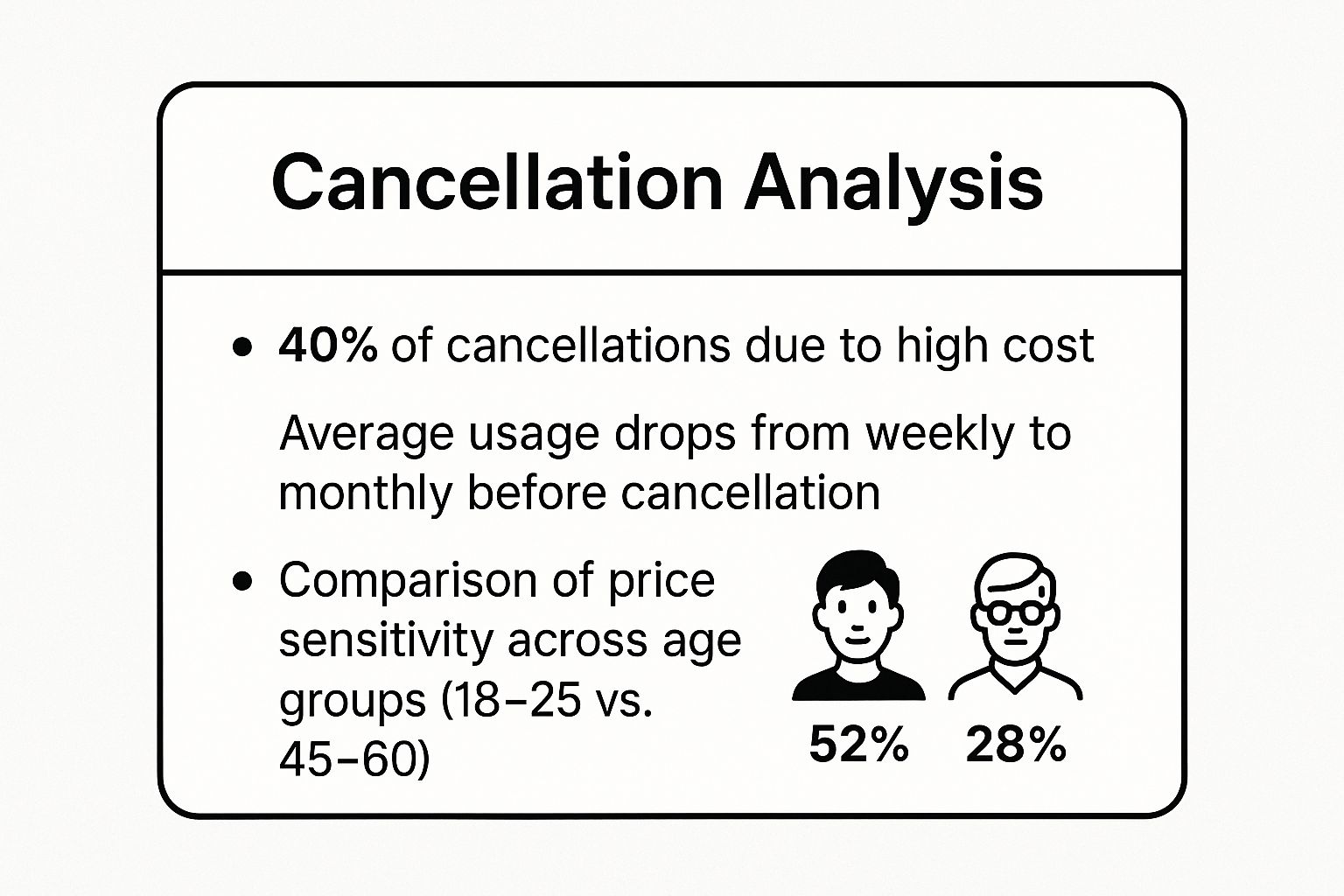
As the infographic highlights, a significant portion of cancellations (40%) are directly related to perceived high cost, with usage often declining before cancellation. The infographic also underscores the varying levels of price sensitivity across different demographics, a crucial factor to consider when setting pricing strategies and targeting specific customer segments.
Actionable Tips to Combat Cost-Driven Cancellations:
To mitigate cost-driven churn, businesses need to demonstrate clear value and offer flexible pricing options. Here’s how:
- Implement usage-based pricing: Align cost with actual usage. This allows customers to only pay for what they consume, increasing perceived value.
- Offer granular pricing tiers: Provide various subscription levels with different feature sets and price points to cater to diverse needs and budgets.
- Conduct regular competitive pricing analysis: Stay informed about competitor pricing and adjust your strategy accordingly to remain competitive.
- Provide clear value demonstrations: Showcase the benefits of your service and highlight its value proposition compared to alternatives.
- Consider retention pricing for at-risk customers: Offer discounts or incentives to retain valuable customers who are considering cancellation due to cost concerns. This can help win back customers and reduce churn.
2. Lack of Usage or Engagement
Lack of usage or engagement is a major driver of subscription cancellations. Customers churn when they realize they aren’t actively using a service or when their engagement drops significantly. This often stems from poor onboarding, overwhelming feature complexity, or the service not becoming integrated into the user’s daily routine. Low engagement typically precedes cancellation, often by several weeks or months, providing a window of opportunity for intervention. For example, fitness apps are frequently canceled after initial enthusiasm wanes, language learning apps like Duolingo are abandoned when users lose motivation, and productivity tools are dropped when users revert to familiar workflows. This highlights the importance of continuous engagement and demonstrating value throughout the customer lifecycle.
Successful companies like Spotify, with personalized playlists and Discover Weekly, Slack with its integrated ecosystem, and Notion with its vast template library have mastered the art of driving consistent engagement. They provide ongoing value and make their services indispensable to their users. You can learn more about increasing SaaS customer engagement in this helpful guide.
Actionable Tips to Combat Usage-Driven Cancellations:
To combat usage-driven churn, businesses should focus on fostering engagement and integrating their service into the customer’s routine. Here are some effective strategies:
- Implement robust onboarding sequences: Guide new users through key features and demonstrate value quickly.
- Create habit-forming features and notifications: Encourage regular usage through personalized recommendations and timely reminders.
- Use engagement scoring to identify at-risk users: Proactively reach out to users showing signs of declining engagement.
- Provide progressive feature discovery: Introduce new features gradually to avoid overwhelming users.
- Send re-engagement campaigns to dormant users: Offer incentives or personalized content to rekindle interest and encourage active usage.
3. Poor Customer Service Experience
Poor customer service experiences are a major driver of subscription cancellations. Negative interactions with support, including slow responses, unhelpful representatives, or unresolved issues, can quickly erode customer loyalty. In today’s digital landscape, customers expect prompt, knowledgeable, and empathetic support across various channels. Poor service often amplifies other frustrations, pushing customers to seek alternatives. Examples include cable companies losing subscribers due to poor technical support, SaaS platforms hemorrhaging customers over mishandled billing disputes, and streaming services facing cancellations after account recovery failures.
Just as exceptional customer service can be a powerful differentiator and build brand loyalty, its inverse can significantly contribute to subscription cancellation reasons. When customers feel undervalued or ignored, they are much more likely to churn. For businesses relying on recurring revenue, prioritizing customer service is essential for long-term success. Learn more about customer service tips for startups.
Actionable Tips to Improve Customer Service and Reduce Churn:
Investing in robust customer service infrastructure is crucial for mitigating churn. Here’s how to enhance your support strategy:
- Implement comprehensive agent training programs: Equip your support team with the knowledge and skills to handle diverse customer inquiries effectively.
- Use AI chatbots for common issues: Automate responses to frequently asked questions, freeing up human agents to address more complex problems.
- Create escalation procedures for complex problems: Ensure a smooth process for escalating difficult issues to specialized agents or managers.
- Monitor and respond to support metrics actively: Track key metrics like response times, resolution rates, and customer satisfaction scores. Use this data to identify areas for improvement.
- Empower agents with decision-making authority: Enable agents to resolve issues independently, reducing customer frustration and improving efficiency.
4. Technical Issues and Poor User Experience
Recurring technical problems, bugs, slow performance, or confusing interfaces frustrate users and drive cancellations. In today’s competitive landscape, users have low tolerance for poor digital experiences and quickly switch to alternatives. Technical issues often compound, creating mounting frustration that leads to churn. For example, a video streaming service plagued by buffering issues might see a surge in cancellations, especially if competitors offer smoother streaming. Similarly, banking apps with poor mobile experiences or project management tools with constant sync problems risk losing customers to more reliable alternatives.
Companies like Apple, with its intuitive design principles, Google, known for its fast and reliable search, and Stripe, with its developer-friendly APIs, have demonstrated the importance of prioritizing user experience. These companies have set a high bar for user expectations, making it crucial for businesses to address technical issues promptly and proactively. Failing to do so directly impacts subscription cancellation reasons.
Actionable Tips to Combat Technical Issue-Driven Cancellations:
To minimize churn due to technical problems, focus on proactive measures and responsive solutions:
- Invest in robust testing and QA processes: Thorough testing throughout the development lifecycle identifies and resolves bugs before they impact users.
- Implement comprehensive monitoring and alerting: Real-time monitoring allows you to detect and address performance issues quickly, minimizing disruption.
- Prioritize mobile-first design approaches: Ensure a seamless experience across all devices, especially mobile, as mobile usage continues to grow.
- Create user feedback loops for UX improvements: Actively solicit and incorporate user feedback to identify and address usability issues.
- Maintain technical documentation and standards: Clear documentation helps ensure consistency and facilitates faster troubleshooting.
5. Better Competitive Alternative Available
Better competitive alternatives are a major driver of subscription cancellation reasons. Customers switch when competitors offer superior features, better pricing, or a more compelling overall value proposition. This is especially prevalent in saturated markets where differentiation is minimal. The switching decision often involves comparing multiple factors, including features, price, user experience, and brand reputation. For example, Zoom gained significant market share from Skype during the pandemic by offering a more seamless and user-friendly experience. Similarly, some Slack users switched to Microsoft Teams, drawn by its tighter integration with other Microsoft products.
Technical issues and a poor user experience are major reasons for subscription cancellation. Addressing problems related to the user experience, as highlighted in guides on what is UX design, can help reduce churn. This resonates with Shopify merchants who sometimes move to competitors offering better transaction fees or more specialized features. Such shifts demonstrate the importance of not just acquiring customers, but also retaining them by consistently providing superior value. When a competitor raises the bar, customers are often quick to re-evaluate their options.
Actionable Tips to Combat Competitor-Driven Cancellations:
To minimize competitor-driven churn, businesses must prioritize differentiation and strengthen customer relationships.
- Conduct regular competitive analysis: Stay informed about competitor offerings, pricing strategies, and marketing campaigns. This knowledge helps you anticipate market shifts and proactively adapt your strategy.
- Focus on unique value propositions: Clearly articulate what sets your service apart from the competition. Highlight your unique strengths and cater to specific niche needs.
- Build switching costs: Integrate your service deeply into customer workflows through data, integrations, and exclusive features. This makes it less appealing for customers to migrate to a competitor.
- Monitor competitor pricing and feature releases: Stay ahead of the curve by tracking competitor activity. This allows you to react quickly to market changes and maintain a competitive edge.
- Emphasize your strengths: Rather than trying to match every competitor feature, focus on excelling in areas where you have a clear advantage. This creates a stronger brand identity and attracts customers who value those specific strengths.
6. Changed Needs or Life Circumstances
Changed needs or life circumstances are a significant driver of subscription cancellation reasons. Life events like job changes, relocation, financial shifts, or evolving personal priorities often necessitate adjustments to spending, including subscriptions. This churn type, while often unavoidable, is somewhat predictable based on customer lifecycle patterns and external factors like economic downturns or industry-specific trends. Understanding these patterns allows businesses to better forecast churn and develop targeted retention strategies. For example, students frequently cancel services after graduation, while business tools are often dropped after job transitions. Similarly, family-oriented services might see cancellations as children grow older.
The following examples illustrate how life changes influence subscription cancellations: students canceling streaming services after graduation, professionals canceling project management tools after job changes, families canceling childcare subscriptions as children age out, and individuals canceling fitness memberships due to relocation. Analyzing these trends can reveal valuable insights into customer behavior and inform retention strategies.
Actionable Tips to Combat Life-Change-Driven Cancellations:
While some life-change churn is inevitable, businesses can mitigate its impact by offering flexibility and anticipating customer needs:
- Create flexible pause and resume options: Allow customers to temporarily pause subscriptions during transitional periods, reducing the likelihood of complete cancellation.
- Develop lifecycle-aware communication strategies: Tailor messaging based on customer lifecycle stage. For example, offer graduating students discounted alumni plans.
- Offer family or group plan transitions: Provide options for customers to downgrade or transition to different plans that better suit their changed circumstances.
- Build win-back campaigns for different scenarios: Target former subscribers with tailored offers based on their reason for cancellation.
- Monitor external factors affecting customer base: Stay informed about economic trends, industry shifts, and other external factors that could influence customer behavior and subscription cancellations. This proactive approach allows businesses to anticipate potential churn and adapt their strategies accordingly.
7. Privacy and Security Concerns
Privacy and security concerns are increasingly significant subscription cancellation reasons. Growing awareness of data breaches and misuse fuels customer anxiety about online safety. When trust in a company’s data handling practices erodes, cancellations often follow. This isn’t just about major breaches; unclear privacy policies or perceived excessive data collection can also trigger cancellations. Regulations like GDPR and increasing media coverage of privacy issues amplify these anxieties. For example, Facebook users deleted accounts after the Cambridge Analytica scandal, and WhatsApp users switched to Signal following privacy policy changes. Cloud storage service cancellations also spike after security breaches.
This concern is particularly relevant in today’s digital landscape where data is a valuable commodity. Customers are more discerning about who they entrust their information to, and a single misstep can lead to significant reputational damage and lost revenue. Companies prioritizing privacy and security are more likely to retain customers and build a stronger brand reputation.
Actionable Tips to Address Privacy and Security Concerns:
Building and maintaining customer trust requires proactive measures and transparent communication:
- Implement privacy-by-design principles: Integrate data protection into every stage of product development.
- Provide clear, understandable privacy policies: Avoid jargon and clearly explain data collection and usage practices.
- Offer granular data control options: Empower users to choose what data they share and how it’s used.
- Regularly audit and update security measures: Proactively identify and address vulnerabilities.
- Communicate transparently about data usage: Inform customers about data practices and any incidents promptly and honestly. This builds trust and demonstrates accountability.
8. Billing and Payment Issues
Billing and payment issues are a frequent source of frustration for subscribers, often leading to cancellations. Problems range from unexpected charges and failed payments to confusing billing cycles and opaque pricing. This isn’t just about the money; it’s about the erosion of trust and the perception of unfairness. For example, gym memberships are often canceled due to complex cancellation processes, while software subscriptions might end after unexpected overage charges. Similarly, streaming service cancellations can stem from failed payment recovery attempts. These seemingly small issues can significantly impact customer retention.
It’s crucial to be transparent about data handling, as detailed in some sample privacy policies. Clear communication about billing practices builds trust and reduces the likelihood of disputes. Subscription businesses should prioritize clear, transparent pricing, multiple payment options, and user-friendly billing portals.
Actionable Tips to Combat Billing-Related Cancellations:
To minimize billing-related churn, businesses need to streamline their billing processes and prioritize transparency. Here’s how:
- Implement clear, transparent pricing structures: Avoid hidden fees and clearly outline all costs associated with the subscription.
- Provide multiple payment method options: Offer various payment methods, including credit cards, debit cards, and digital wallets, to cater to different customer preferences.
- Create proactive payment failure recovery systems: Implement automated email notifications and retry logic to recover failed payments and prevent involuntary churn. Learn more about avoiding billing mistakes.
- Make cancellation processes simple and transparent: Provide a straightforward cancellation process, avoiding complicated procedures that might frustrate customers.
- Send clear billing notifications and receipts: Provide detailed invoices and receipts that clearly outline all charges and payments.
Subscription Cancellation Reasons Comparison
| Reason for Cancellation | Implementation Complexity 🔄 | Resource Requirements ⚡ | Expected Outcomes 📊 | Ideal Use Cases 💡 | Key Advantages ⭐ |
|---|---|---|---|---|---|
| High Cost or Poor Value Perception | Medium – requires pricing analysis and tier setup | Moderate – market research and billing system updates | Reduce churn by aligning price with value | Price-sensitive markets, subscription tiers | Clear pricing feedback, drives product value |
| Lack of Usage or Engagement | High – needs tracking, analytics, notification systems | High – analytics platforms and engagement tools | Improved retention via re-engagement campaigns | SaaS, apps with strong user interaction | Early churn warning, better UX insights |
| Poor Customer Service Experience | High – requires multi-channel support systems | High – training, staffing, and AI integration | Customer satisfaction improvement, churn reduction | Any subscription with active support needs | Competitive advantage, creates promoters |
| Technical Issues and Poor User Experience | High – demands technical upgrades and monitoring | High – dev resources for QA, monitoring, and UX design | Lower churn through smoother UX and uptime | Digital platforms, apps, software products | Clear dev priorities, measurable impact |
| Better Competitive Alternative Available | Medium – ongoing competitive analysis required | Moderate – market intelligence and product updates | Benchmarking and innovation pressure | Highly competitive markets with similar offerings | Drives innovation, market positioning |
| Changed Needs or Life Circumstances | Low to Medium – lifecycle communication setup | Low to Moderate – CRM and marketing automation | Forecastable churn, targeted retention campaigns | Services linked to life stages or career changes | Understandable churn, lifecycle insights |
| Privacy and Security Concerns | High – compliance and security overhaul | High – security tech, audits, communication | Trust retention, reduced cancellations | Privacy-sensitive markets, regulated industries | Builds trust, attracts privacy-conscious users |
| Billing and Payment Issues | Medium – billing system improvements needed | Moderate – payment systems, communications | Reduced cancellations due to payment friction | Any subscription with recurring billing | Operational fixes, cash flow improvements |
Keeping Your Subscribers Happy: Turning Insights into Action
Understanding why subscribers cancel is crucial for any business relying on recurring revenue. This article explored eight key subscription cancellation reasons, ranging from perceived value and engagement issues to technical problems and competitive pressures. We’ve also highlighted actionable strategies to mitigate each of these churn drivers. By addressing these pain points proactively, you can significantly improve customer retention and build a more sustainable business.
Key Takeaways and Actionable Next Steps
Let’s recap the most critical takeaways and translate them into actionable steps:
- Value Perception: Regularly assess your pricing and ensure it aligns with the value you deliver. Consider offering different tiers to cater to varying customer needs and budgets.
- Engagement: Implement strategies to keep subscribers actively engaged with your product or service. This might include personalized onboarding, targeted content, or exclusive community features.
- Customer Service: Prioritize exceptional customer service. Provide multiple support channels and empower your team to resolve issues quickly and efficiently.
- Technical Issues: Invest in a robust and reliable platform. Regularly test for bugs and address technical issues promptly.
- Competition: Continuously monitor the competitive landscape. Differentiate your offering by focusing on unique features, superior customer service, or specialized niche markets.
- Changing Needs: Offer flexible subscription options to accommodate evolving customer needs. Consider pausing subscriptions or offering discounted upgrades.
- Privacy & Security: Communicate your commitment to data privacy and security transparently. Implement robust security measures and comply with relevant regulations.
- Billing and Payment Issues: Simplify the billing process and offer multiple payment options. Implement a system for proactively managing failed payments and recovering lost revenue.
The Power of Proactive Churn Prevention
Mastering these concepts is essential for long-term success in the subscription economy. By proactively addressing potential churn triggers, you’re not just reducing customer loss; you’re building stronger customer relationships, fostering loyalty, and creating a more predictable revenue stream. This translates to a healthier bottom line and greater business stability.
Involuntary churn due to failed payments is a significant contributor to overall churn rates. Stunning helps you minimize this revenue loss by automating the complexities of payment recovery and dunning management. Want to reduce churn and boost your bottom line? Explore how Stunning can help you recover failed payments and keep your subscribers happy.