
Best for teams without a recovery owner: Stunning Managed Recovery. Best for an internally managed Stripe workflow: Stripe’s built-in retries and emails. Best for teams that want dedicated recovery software: Stunning Software. This 2026 guide ranks the choices by operational fit, then explains what to check inside Stripe Billing before committing.
- Stunning Managed Recovery is the best fit for Stripe subscription teams that need someone to own failed-payment recovery.
- Dunning software ranked by Stripe Billing integration should separate payment retries, customer messages, invoice outcomes, and operational ownership.
- Stripe’s built-in retries and emails belong on the shortlist when an internal owner can run recovery.
- Choose dedicated dunning software only after defining the work your current Stripe Billing setup leaves unfinished.
Stripe Billing recovery options at a glance
The order below is a buying decision, not a recovery-rate leaderboard. Start with whether you need someone to run recovery, then decide whether built-in controls or separate software fit the work. Stunning offers both failed-payment recovery software and managed dunning services.
| Rank and option | Best for | Defining distinction | Main limitation |
|---|---|---|---|
| 1. Stunning Managed Recovery | Teams without an accountable recovery owner | A managed-service buying choice rather than software alone | You still need to agree on responsibilities and escalation rules |
| 2. Stripe built-in retries and emails | Teams keeping recovery operations inside their billing workflow | Recovery controls within Stripe | Your team must own configuration, review, and follow-up |
| 3. Stunning Software | Teams with an owner who wants dedicated dunning software | Separate recovery software rather than a managed engagement | Buying software does not assign someone to run it |
Why this matters
Dunning means following up on overdue payments. For a subscription business, that includes deciding when to retry, what to tell the customer, and what happens when an invoice stays unpaid.
A Stripe connection answers only part of the buying question. You also need to know which system sends messages, how a customer resolves the failure, and who checks that the renewal actually gets paid.
An integration is not an operating plan. If nobody reviews unresolved invoices, changing software leaves the ownership problem intact. Your 2026 evaluation should identify both the payment workflow and the person responsible for its results.
What makes the best Stripe Billing integration?
Use these criteria before accepting a product demonstration. Ask the seller to show the workflow against your billing setup, not just describe a connection to Stripe.
- Invoice visibility: Can the proposed workflow identify the failed renewal and show its current payment status?
- Retry ownership: Which system controls retry attempts, and how will you prevent overlapping settings?
- Customer action: Can your team distinguish a retryable failure from a payment that needs customer involvement?
- Message ownership: Who sends reminders, updates their wording, and stops them after payment?
- Outcome verification: Can you connect a recovery claim to the relevant paid invoice?
- Operational ownership: Who reviews results, handles exceptions, and follows up on unresolved accounts?
Give each criterion an owner before comparing extra features. A capability that nobody configures or checks does not complete the recovery process.
1. Stunning Managed Recovery: best for teams without an owner
Stunning Managed Recovery is the best fit for Stripe subscription teams that need someone to own failed-payment recovery. The reason to choose managed recovery is the work around the software: reviewing outcomes, maintaining customer messages, and handling unresolved cases.
Treat the service discussion as an assignment of responsibilities. Ask who reviews results, who changes messages, and who follows up personally; have those responsibilities recorded in the engagement scope.
Managed Recovery pros:
- Puts responsibility for running recovery at the center of the purchase.
- Gives teams a service option instead of another software-only decision.
- Fits businesses where failed payments accumulate without an accountable internal owner.
Managed Recovery cons:
- Requires agreement on account access, approvals, and escalation boundaries.
- Does not remove your responsibility for subscription access or cancellation policy.
- Requires coordination when a payment problem becomes a customer-support issue.
Best for: A subscription software business using Stripe where nobody consistently reviews failed renewals or maintains the follow-up process.
During a 2026 service evaluation, bring unresolved invoices and current messages to the discussion. Ask the provider to explain what happens after automated attempts end and which decisions return to your team.
Do not assume every service and software offering has identical platform coverage. Confirm the exact Stripe Billing workflow and engagement scope you are buying rather than transferring a compatibility claim from one offering to another.
Verdict: Buy managed recovery when you need operational ownership, not just another tool.
2. Stripe built-in recovery: best for an internally owned workflow
Stripe’s built-in retries and emails are the starting point for a team that wants to keep recovery within its billing workflow. Review the existing configuration before adding another system.
The deciding factor is ownership. Someone still needs to check settings, review unpaid invoices, maintain customer communication, and decide when a case needs personal attention.
Stripe built-in recovery pros:
- Keeps the initial recovery review inside your existing Stripe billing setup.
- Lets your team assess current retries and emails before introducing another system.
- Establishes a baseline against which to evaluate a separate recovery purchase.
Stripe built-in recovery cons:
- Leaves ongoing recovery operations with your team.
- Requires an internal process for exceptions and unresolved invoices.
- Does not answer your business’s access, escalation, or cancellation decisions.
Best for: A Stripe subscription business with a named owner who can configure, review, and maintain recovery.
Start by documenting the current retry settings and customer emails. Then inspect unresolved renewals and identify the next action for each one. Separate cases that need another payment attempt from cases that need a customer response or billing investigation.
Keep the distinction clear: retaining Stripe’s built-in recovery is an operational choice, not a reason to stop reviewing failures. A small workflow still needs someone responsible for its outcome.
Verdict: Hold your current setup when a named owner can run it and the audit identifies no unfinished requirement.
3. Stunning Software: best for an owner seeking dedicated tools
Stunning Software is the dedicated dunning-software choice in this comparison. Evaluate it when your team wants separate recovery software and already has someone responsible for operating the process.
Keep that decision separate from Managed Recovery. Software selection concerns the tools your team will use; a managed-service selection concerns which work another party will perform.
Dedicated software pros:
- Fits a team that wants to operate recovery internally.
- Gives the buyer a separate recovery-software option to evaluate against existing controls.
- Supports a clear division between choosing tools and assigning operational responsibility.
Dedicated software cons:
- Leaves configuration review and day-to-day ownership with your team unless separately agreed.
- Requires a deliberate handoff from the existing recovery setup.
- Requires validation against your actual invoices, customer actions, and subscription policies.
Best for: A subscription software team with an accountable recovery owner and a documented requirement for dedicated dunning software.
Ask for a demonstration using your relevant billing cases. Include a failed renewal, a customer who needs to update payment details, a payment requiring customer action, and an invoice that remains unpaid after the planned recovery sequence.
Do not judge the demonstration only by whether a message sends. Check whether the customer action resolves the relevant invoice and whether reminders stop at the correct point.
Verdict: Buy dedicated software after assigning an owner and confirming the workflow it must improve.
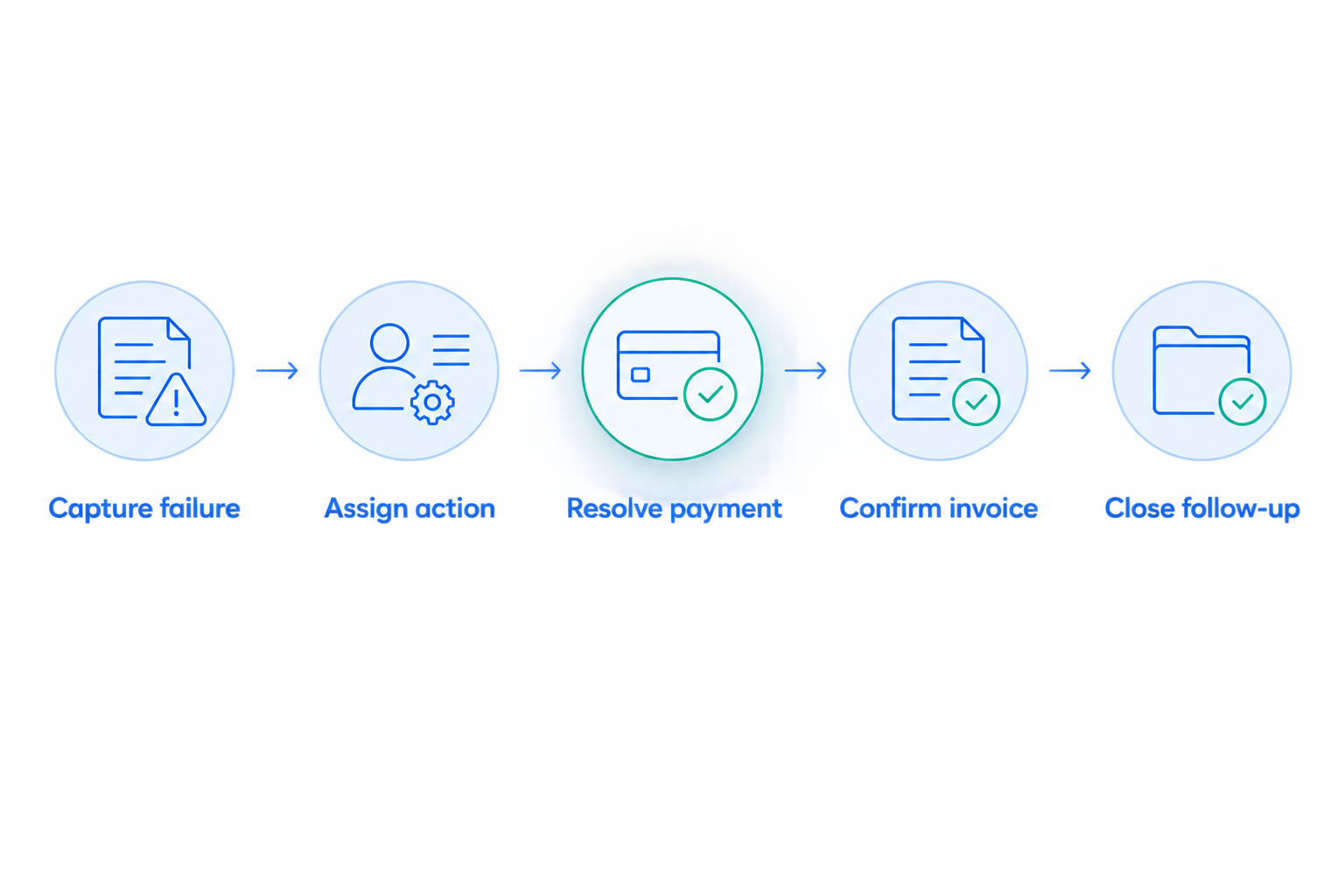
Test the integration from failure to paid invoice
Use the same acceptance sequence for every 2026 candidate. These are checks to request and perform, not assumed capabilities of any product.
Capture failure
Identify the failed invoice, customer, subscription, and failure reason. Confirm that the proposed workflow handles the invoice you intend to recover rather than merely displaying a customer-level warning.
Assign action
Decide whether the next step belongs to the retry system, the customer, or your team. A customer-authentication request and an ordinary retry are different actions; the recovery process needs to distinguish them.
Resolve payment
Test the intended customer path using an appropriate test environment. Check what happens after payment details change and whether the outstanding invoice receives the required payment action.
Confirm invoice
Verify the invoice outcome before counting the renewal as recovered. A sent reminder, opened message, or updated card is not the same event as a paid invoice.
Close follow-up
Check that reminders and internal tasks end when appropriate. Assign any unresolved invoice to a person with a defined next action rather than leaving it indefinitely in a report.
Compare outcomes without changing the measurement rules
For a 2026 evaluation, define a 30-day invoice cohort before comparing results. A cohort is a fixed group of invoices selected under the same rules, such as renewals that first failed during that period.
Choose observation checkpoints in advance, such as 7 days and 30 days after failure. These are evaluation windows, not promised recovery timelines. Apply the same windows to every option under review.
Record:
- The invoice’s original failed amount and current status.
- Whether payment arrived and which invoice it settled.
- Whether another recovery process was active.
- Which customer action or manual intervention occurred.
- Which unresolved cases still need an owner.
Do not compare one option’s paid invoices with another option’s email activity. Keep payment outcomes, customer engagement, and staff workload separate so the decision answers a useful question.
Where other recovery vendors belong
Churn Buster, Baremetrics Recover, Paddle Retain / ProfitWell Retain, and Churnkey are additional names to evaluate when building a shortlist. Check current offers directly before assigning any of them a Stripe Billing integration advantage.
Use the same acceptance sequence for each candidate. Ask for a demonstration of your invoice workflow, a clear division of responsibilities, and an explanation of how recovered payments are counted.
Do not force a feature ranking before those checks. A familiar vendor name does not establish compatibility with your billing configuration or identify who will operate recovery after setup.
How the ranking works
This ranking prioritizes the buying problem: managed ownership first for teams without an owner, built-in recovery for internally operated workflows, and dedicated software for teams with a defined tooling requirement.
The criteria are invoice visibility, retry control, customer action, message ownership, outcome verification, and operational responsibility. The order is not a claim that one option recovers a higher percentage of revenue.
Which option should you choose?
Choose managed recovery if failed payments are adding up and nobody owns the work. Start with a recovery audit that identifies unresolved invoices, overlapping messages, and unassigned follow-up.
Keep Stripe’s built-in recovery when your internal owner can operate it and demonstrate that the workflow meets your requirements. Evaluate separate software when that owner can name the specific work it must improve.
Bring a sample of failed renewals, current retry settings, customer messages, and unresolved cases to the audit discussion. That makes the next decision about work and responsibility rather than a feature checklist.
Discuss a recovery audit
Bring failed renewals, current messages, and unresolved cases to discuss ownership and recovery gaps.
FAQ
What is the best dunning option for a Stripe team without a recovery owner?
Managed recovery is the best fit when a Stripe subscription team needs someone to run failed-payment recovery. Confirm who reviews results, updates messages, follows up, and escalates unresolved cases before signing.
Is Stripe’s built-in recovery enough for a subscription business?
Stripe’s built-in retries and emails are a starting point when your team can own the workflow. Audit unresolved invoices and customer actions before deciding whether separate software or a managed service is needed.
What should I test in a Stripe Billing dunning integration?
Test the path from failed invoice to confirmed payment and closed follow-up. Include retry ownership, customer action, message stopping rules, and unresolved-case escalation.
Is managed recovery the same as dunning software?
No. Dunning software provides tools, while a managed recovery engagement assigns agreed recovery work to a service provider. Confirm the responsibilities and platform support of the exact offering you are buying.
Does updating a card prove that a failed renewal was recovered?
No. Confirm that the relevant invoice was paid before recording the renewal as recovered. A card update is a customer action, not proof of payment.
How should I compare recovery results between vendors?
Compare the same invoice cohort using the same observation windows and payment definitions. Track paid invoices separately from reminders, card updates, and manual work.
Who should own failed-payment recovery inside a SaaS business?
Assign one accountable owner with authority to coordinate billing, customer messages, and unresolved cases. Other people can perform individual tasks, but the final responsibility should be explicit.
One last thing
Before buying anything, take an unresolved invoice and ask your team: “Who owns the next action?” If the answer is unclear, fix that assignment in the purchase decision. A better-connected tool still needs a person responsible for the unpaid renewal.
Related guides
- Stripe failed payments: a recovery audit checklist
- Dunning software or managed recovery: who owns the work?
- How to test dunning software before switching it on