

For any subscription business, monthly recurring revenue (MRR) is the single most important number to watch. It’s the predictable, reliable income you can count on every single month from your active customers.
Think of it as the financial pulse of your company. It strips away all the one-time fees and extra charges to give you a crystal-clear picture of your core business health and momentum.
Why Monthly Recurring Revenue Matters

Unlike the roller coaster of one-time sales, monthly recurring revenue gives you a stable financial floor to stand on. This predictability is the bedrock of any successful subscription company. It signals a fundamental shift away from simply making transactions and toward building long-term customer relationships. If you want to dig a bit deeper, there are some great guides on what MRR means for your business.
This isn’t just a small trend—it’s a massive economic shift. The subscription economy has ballooned by an incredible 435% in the last ten years and is on track to hit $1.5 trillion by 2025. This explosion shows a real change in how companies sell and how customers want to buy.
The Strategic Value of Tracking MRR
Really understanding your MRR is about more than just accounting. It’s about making smarter decisions with confidence. When you have a firm grasp on this number, you can:
- Forecast Future Income: With a reliable income baseline, you can finally create realistic budgets for hiring new people, launching marketing campaigns, or developing that next big feature.
- Allocate Resources Effectively: Knowing what’s coming in each month means you can invest in growth without stretching your finances too thin. It takes the guesswork out of spending.
- Measure Business Health: Is your MRR growing? That’s a fantastic sign that your customers are happy, your product is hitting the mark, and your business is stable.
A consistent MRR stream is one of the most powerful signals you can send to investors and stakeholders. It demonstrates a scalable model, reduces perceived risk, and directly contributes to a higher business valuation.
Ultimately, getting a handle on MRR is the first step to building a company that can weather any storm. It gives you the insight you need to run your operations, from fine-tuning your pricing to figuring out how to properly accept recurring payments as a SaaS business.
How to Calculate Your MRR Accurately
Getting your monthly recurring revenue (MRR) right isn’t just a “nice-to-have” — it’s a non-negotiable for knowing where your business truly stands. A solid MRR figure is your compass for making smart decisions. Get it wrong, and you could be steering your company straight into a storm.
At its core, the calculation is pretty straightforward. You just take your total number of paying customers for the month and multiply it by what they’re paying you, on average.
MRR = (Number of Customers) x (Average Monthly Recurring Fee per Customer)
So, if you have 100 customers and each one pays $50 a month, your MRR is a clean $5,000. Of course, it gets a bit messier once you start adding different plans and pricing tiers, but the principle is the same. The key is that it must be predictable, recurring income.
What to Include and Exclude
The single biggest mistake people make when calculating MRR is including revenue that isn’t actually recurring. Getting this right demands discipline. You have to draw a hard line between your steady, predictable subscription fees and all the other one-off payments and variable charges.
This is critical. Making that distinction is what gives you a true picture of your company’s stability and predictable growth.
To keep your numbers clean and honest, here’s a simple breakdown of what goes in and what stays out.
MRR Calculation: What to Include vs. Exclude
| Include in MRR | Exclude from MRR |
|---|---|
| All recurring subscription fees (monthly, quarterly, and annual plans normalized to a monthly value). | One-time setup or installation fees that aren’t charged every month. |
| Recurring add-ons and upgrades that are part of the monthly bill. | Variable usage or consumption fees that change based on customer activity. |
| Account-level discounts that are consistently applied every month. | Short-term, one-off discounts or promotional credits that will expire. |
| Processing fees from your payment gateway (calculate MRR before these are deducted). |
Think of it this way: if you can bet on that dollar showing up from that customer again next month without anyone having to lift a finger, it belongs in your MRR. Everything else, like a one-time consulting gig or a sudden spike in usage, is just transactional revenue.
Keeping these two buckets separate is what makes your MRR a trustworthy metric you can actually build a business on.
The Three Engines of MRR Growth
Your monthly recurring revenue isn’t a number you calculate once and forget about. It’s a living, breathing metric that changes constantly based on what your customers are doing. I like to think of it as a bucket you’re trying to fill with water. New customers are the water pouring in, which is fantastic. But there are always a few holes in the bottom—customers who leave—letting water leak out.
To grow, you just need to pour water in faster than it leaks.
This whole process is driven by three key forces. I call them “engines” because they’re what power your revenue growth (or decline) each month. When you understand these engines, you can get a really clear picture of your business’s health and figure out exactly what’s working and what’s not.
This infographic shows how these pieces all fit together.
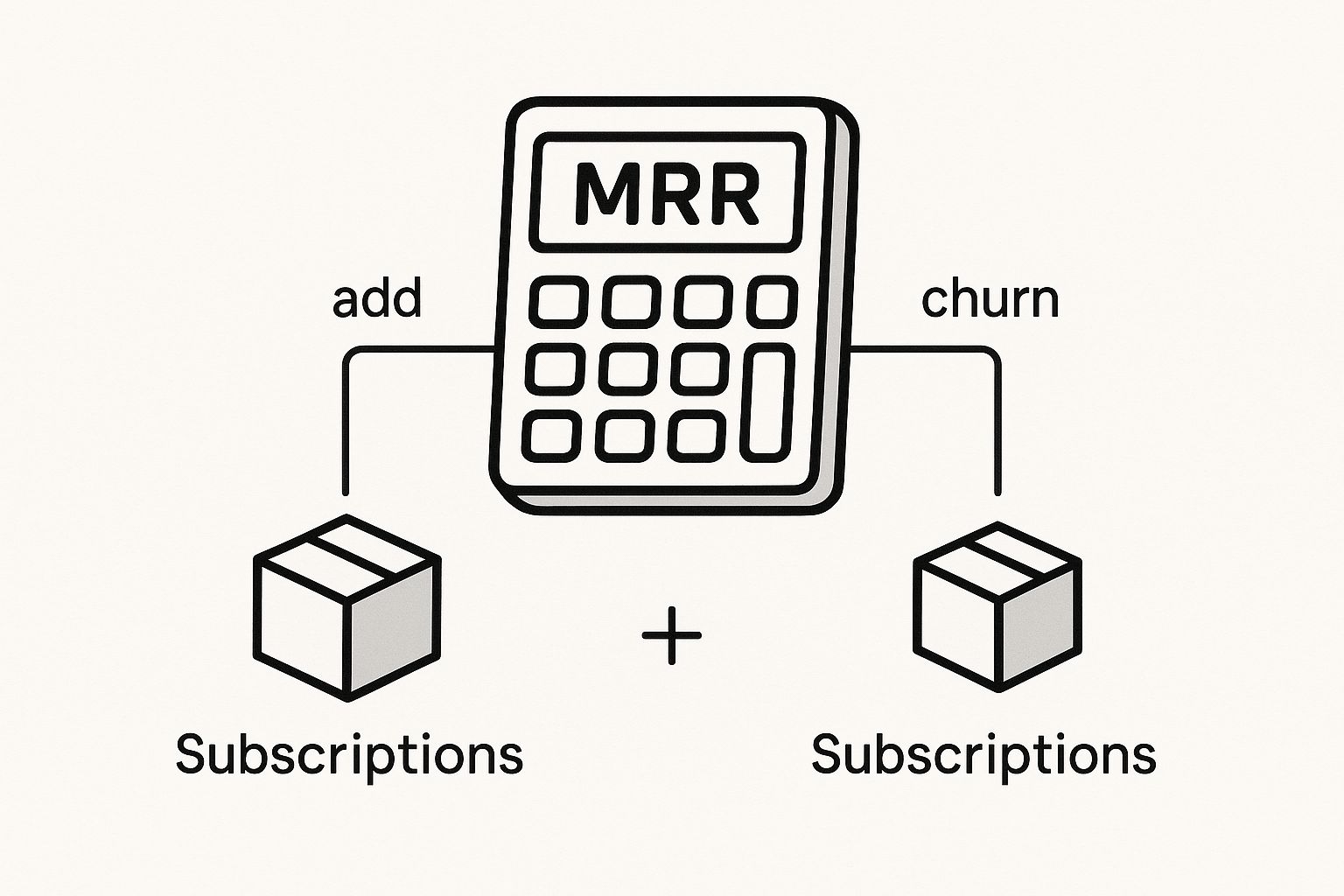
As you can see, it’s a simple push and pull. New and expansion revenue add to your total, while churn takes away from it.
The Forces Shaping Your Revenue
Each of these engines plays a make-or-break role in your growth story. Let’s look at them one by one:
- New MRR: This one’s the most straightforward. It’s all the recurring revenue you bring in from brand-new customers. This is the water flowing directly from your sales and marketing tap.
- Expansion MRR: This is your secret weapon, and it’s shocking how often it gets overlooked. Expansion MRR is the additional recurring revenue you get from people who are already paying you. Think upgrades to a bigger plan, buying recurring add-ons, or adding more seats to their account.
- Churn MRR: This is the painful one—the revenue you lose every month. It’s the water leaking out of your bucket. Churn happens when customers cancel their subscriptions entirely (that’s customer churn) or when they downgrade to a cheaper plan (downgrade MRR).
Your Net New MRR is the result of these three forces combined: (New MRR + Expansion MRR) – Churn MRR. If the number is positive, congratulations, you’re growing. If it’s negative, your business is shrinking.
This way of thinking is absolutely critical in industries like Software-as-a-Service (SaaS), where the entire business model is built on predictable income. With the global SaaS market projected to hit a staggering $390.5 billion by 2025, the companies that thrive will be the ones that master these three MRR engines. You can discover more statistics about the SaaS market and see just how deeply it depends on recurring revenue.
Actionable Strategies to Increase MRR

Knowing your monthly recurring revenue is a great start, but the real magic happens when you start making that number grow. There’s no single secret to boosting MRR. Instead, real momentum comes from a smart mix of winning new customers, getting more from your current ones, and—most importantly—keeping them from walking away.
A solid acquisition plan often starts with your pricing. Tiered plans are a classic for a reason; they let people jump in at a level that feels right for their budget, which naturally opens the door for future upgrades. A freemium model can also work wonders, acting as a pipeline that turns happy free users into paying subscribers once they can’t live without your product.
Boosting Expansion and Reducing Churn
While new customers are exciting, your biggest growth opportunity is often hiding in plain sight: with the people who already use and love your product. This is where Expansion MRR becomes your best friend.
- Value-Based Upselling: Don’t just push for an upgrade. Show customers how a bigger plan solves a bigger problem for them. Tie it directly to their success, and the upgrade feels like a no-brainer.
- Cross-Selling Add-ons: Got a feature that makes your main product even better? Offer it as an add-on. If your product saves them time, maybe an analytics add-on can show them exactly what to do with all that extra time.
The most effective way to grow your total MRR is by focusing on keeping the customers you already have. It’s often 5 to 25 times more expensive to acquire a new customer than it is to retain an existing one.
This really hammers home how crucial it is to fight churn. For any subscription business, keeping customers happy is the foundation of your revenue. You’ll want to dig into some proven subscription retention strategies to keep your customer base strong.
Finally, you absolutely need a system for handling involuntary churn from failed payments. This is low-hanging fruit. A simple heads-up before a card expires or a smart retry system for failed charges can make a huge difference. In fact, you can drastically reduce SaaS churn with the right automated tools, which directly protects your MRR month after month.
How MRR Drives Valuation and Attracts Investors
For a subscription business, a healthy monthly recurring revenue (MRR) isn’t just an internal report card—it’s your most powerful signal to the outside world. When investors, lenders, or potential buyers look at your company, MRR is what they see. It’s the clearest proof you’ve built a stable, scalable, and valuable business.
A solid, growing MRR tells investors you’ve accomplished something incredibly hard: you’ve found product-market fit. It shows you have real, loyal customers who value your service enough to pay for it every single month. This predictability takes a lot of the guesswork and risk out of the equation for them. It’s concrete evidence that your business model actually works.
Because of this, a company’s valuation is often a direct multiple of its MRR. It’s not unusual to see valuations calculated at 26x to 46x the monthly revenue figure, all because it represents predictable, future cash flow.
Tapping into Revenue-Based Financing
This focus on predictable revenue has also paved the way for modern funding options. One of the biggest is Revenue-Based Financing (RBF), a model built entirely on the strength of your company’s MRR. Unlike traditional VC funding, RBF lets you get the capital you need to grow without giving away equity or losing control of your company.
It’s pretty straightforward: lenders give you capital, and in return, you pay them back with a small percentage of your future monthly revenue until the loan is settled. This approach is exploding in popularity. The RBF market jumped from $3.38 billion in 2023 to an estimated $5.78 billion in 2024—a massive 70.9% growth rate.
This powerful link between MRR and funding means that tracking your revenue is more than just an accounting chore; it’s a core part of your growth strategy. A healthy MRR builds a tough, resilient business and unlocks the cash you need to scale. Keeping it healthy takes work, especially when payments fail, so it’s worth reviewing some key lessons learned from recovering failed payments to protect your hard-earned revenue.
Got Questions About Monthly Recurring Revenue?
Even when you feel like you have a handle on the basics, a few tricky details about monthly recurring revenue can still trip you up. Let’s walk through some of the most common questions that pop up for business owners.
The biggest point of confusion is usually the difference between MRR and total revenue or profit. It helps to think of it this way: your total revenue is every single dollar that comes into your business, including things like one-time setup fees or special consulting projects. MRR, on the other hand, only counts the predictable, recurring income from subscriptions.
Profit is what’s left after you subtract all of your expenses. MRR is a top-line metric—it’s all about your growth potential and stability. It’s not a bottom-line metric that tells you if you’re actually profitable today.
A business can have a sky-high MRR and still be losing money if its costs are out of control. That’s why you have to look at MRR alongside other key metrics like customer acquisition cost (CAC) and customer lifetime value (LTV).
MRR or ARR: Which One Should I Use?
Another frequent question is whether to track MRR or its yearly sibling, ARR (Annual Recurring Revenue). The right answer really just depends on your business.
- Track MRR if: Your business is built around monthly plans. This is the go-to for most SaaS companies, subscription boxes, or membership sites where customers value flexibility and sales cycles are on the shorter side.
- Track ARR if: Your business is focused on long-term, annual contracts. This is much more common for enterprise software companies where sales take longer and customers commit for a full year or more.
Big Mistakes to Avoid
Finally, let’s talk about accuracy. A few simple mistakes can completely throw off your monthly recurring revenue calculation, which can lead you to make some bad decisions. Be sure to sidestep these common pitfalls:
- Counting trial users: Never include users who haven’t started paying you yet. They don’t become part of your recurring revenue until they officially convert to a paid plan.
- Forgetting to subtract discounts: Always deduct recurring discounts from your numbers. This ensures you’re looking at the actual cash you expect to collect, not an inflated figure.
- Including one-time charges: Mistaking a one-off setup fee for a recurring payment is a classic mistake. It temporarily bloats your MRR and gives you a false sense of security.
Are failed payments silently killing your MRR? Stunning automatically recovers 20-80% more of your failed payments from Stripe and Subbly, protecting your hard-earned revenue. Start your free 15-day trial and see how much you can recover at Stunning.co.