

At its core, monthly recurring revenue (MRR) is the predictable, reliable income your business can count on from all active subscriptions each month. It’s the grand total of all the recurring payments from your customers, smoothed out into a monthly number. Think of it as your business’s regular paycheck—the steady foundation you need for real, sustainable growth.
What Is Monthly Recurring Revenue Really?

If you owned a classic retail shop, your income would be all over the place. It would swing with foot traffic, holidays, and whatever promotion you were running that week. Some months would be fantastic; others, terrifyingly quiet. That kind of rollercoaster revenue makes it incredibly tough to plan for the future.
Now, imagine you run a subscription box service instead. Rather than chasing one-off sales, you have a base of customers who have agreed to pay you a specific amount, every single month. That consistent, predictable stream of cash is your Monthly Recurring Revenue. It’s the absolute lifeblood for any subscription company, whether you’re a SaaS platform, a membership site, or a streaming service.
The Power of Predictability
The real magic of MRR is its predictability. One-time sales create revenue spikes and dips, but MRR gives you a clear, steady picture of your financial momentum. This stability is a total game-changer for a few key reasons:
- Financial Forecasting: When you have a reliable income baseline, you can actually forecast future revenue, manage your cash flow with confidence, and make smart budget decisions. No more guesswork.
- Strategic Planning: Knowing your MRR lets you plan for new hires, marketing campaigns, and product updates without just crossing your fingers and hoping for the best.
- Investor Confidence: For any investor or stakeholder, MRR is one of the first things they look at. It’s a powerful signal of your company’s health, growth potential, and scalability.
In short, MRR shifts your entire focus from hunting down single transactions to building valuable, long-term relationships with customers. It’s a direct measure of the ongoing value you provide and the loyalty you’ve earned.
What MRR Represents
Monthly Recurring Revenue is a non-negotiable metric for any subscription business, especially in the Software-as-a-Service (SaaS) world. It bundles up the monthly value of all your customer subscriptions, giving you a clean look at your revenue trends over time.
For instance, if you have 1,000 customers each paying you $50 per month, your MRR is a solid $50,000. While it’s not a formal accounting term under GAAP or IFRS, its power to signal financial health has made it the go-to metric for evaluating a subscription business. You can dive deeper into its industry significance by checking out what experts on subscription metrics have to say.
How to Accurately Calculate MRR

Figuring out your Monthly Recurring Revenue is more than just a quick math problem—it’s about getting an honest picture of your business’s health. The basic formula looks simple, but getting it right is all about knowing what to count and, just as importantly, what to leave out.
At its simplest, the calculation looks like this:
MRR = Total Number of Customers × Average Revenue Per User (ARPU)
So, if you have 200 customers and they each pay you an average of $50 per month, your MRR is $10,000. This number gives you a solid baseline for your predictable monthly income. But in the real world of subscriptions, things are rarely that clean, which is why you need a clear monthly recurring revenue definition to guide your math.
Normalizing Different Billing Cycles
One of the first hurdles you’ll run into is dealing with customers on different plans, especially those who pay quarterly or annually. The trick here is to normalize these payments into a monthly figure. If a customer pays you $1,200 for a one-year plan, you don’t just dump that full amount into the month they paid. That would throw everything off.
Instead, you divide that total by 12. In this case, that one customer adds $100 to your MRR for every single month of their contract. This approach keeps your MRR stable and predictable, not a metric that jumps all over the place because of big annual payments.
What to Include and Exclude for Accuracy
To keep your MRR calculation legit, you have to be super disciplined about what you consider “recurring.” If you start tossing in one-time fees, you’re just inflating your numbers and defeating the whole purpose of the metric, which is to track predictable, ongoing income.
It’s crucial to get this part right, so let’s break down exactly what should and shouldn’t make its way into your MRR calculation.
What to Include vs Exclude in Your MRR Calculation
This table should clear up any confusion about which revenue sources count towards your true MRR.
| Revenue Component | Include in MRR? | Reasoning |
|---|---|---|
| Recurring Subscription Fees | Yes | This is the heart of MRR—the fixed fees customers pay month after month. |
| Recurring Add-Ons & Upgrades | Yes | If a customer adds a feature with a recurring cost, that gets added to MRR. |
| Recurring Discounts | Yes (as a deduction) | A permanent 10% discount on a plan reduces that customer’s MRR contribution. |
| One-Time Setup Fees | No | These are not recurring. They’ll artificially spike your MRR for one month only. |
| Consulting or Training Fees | No | These are one-off charges for a service, not a predictable subscription payment. |
| Usage or Transaction Fees | No | Because these charges are variable and unpredictable, they don’t belong in pure MRR. |
Sticking to these rules is absolutely essential. A clean MRR calculation is the bedrock for reliable financial forecasting, smart strategic planning, and building investor confidence. You’re trying to measure the true, predictable pulse of your business, month after month.
Decoding the Different Types of MRR
Your total Monthly Recurring Revenue (MRR) gives you a great snapshot of your business’s size, but it doesn’t tell the whole story. To truly understand your company’s health and momentum, you need to break that number down into its core components. A single MRR figure tells you what you’re earning, but deconstructing it tells you why and how.
Think of your total MRR as the final score of a game. It’s an important number, but it doesn’t reveal how many points came from offense, defense, or special teams. To build a winning strategy, you need to know which parts of your team are performing well and which need improvement. In the world of subscriptions, that means looking at the different types of MRR that contribute to your overall growth—or decline.
This infographic breaks down the primary components that make up your total monthly recurring revenue.
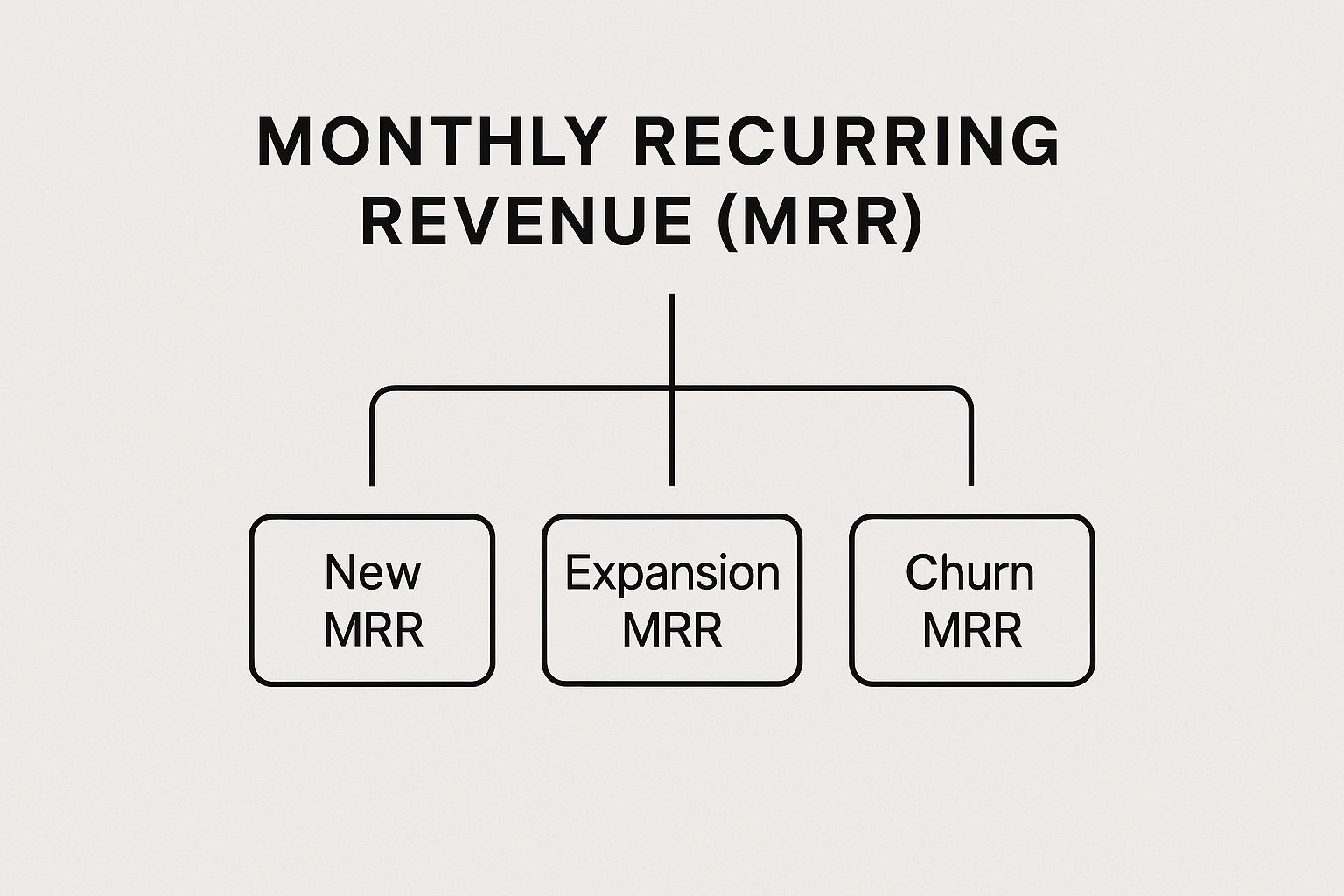
As the diagram shows, MRR isn’t a single, static number. It’s a dynamic metric influenced by new customers, existing customer growth, and cancellations.
The Three Core MRR Components
To get a clear picture, let’s look at the three primary streams that feed into your overall MRR calculation. Each one tells a unique part of your business’s story.
- New MRR: This is the most straightforward component. New MRR represents the total monthly recurring revenue generated from brand-new customers who signed up during a specific period. It’s a direct reflection of your customer acquisition efforts, showing how effective your sales and marketing strategies are at bringing fresh revenue into the business.
- Expansion MRR: Often considered the holy grail of SaaS growth, Expansion MRR is the additional monthly revenue from your existing customers. This growth comes from upgrades, cross-sells, or add-ons. For instance, when a customer on a “Basic” plan moves to a “Pro” plan, the difference in price becomes Expansion MRR. This metric is a powerful indicator of customer satisfaction and the value your product delivers over time.
- Churned MRR: This is the revenue you lose. Churned MRR represents the monthly recurring revenue lost from customers who cancel their subscriptions or downgrade to a free plan. Tracking this number is critical, as high churn can silently erase all the hard-won gains from your new and expansion MRR.
By separating these streams, you move beyond a simple monthly recurring revenue definition and start diagnosing your business’s engine. A high New MRR shows strong acquisition, while a healthy Expansion MRR proves you’re building loyalty and increasing customer lifetime value. Conversely, a rising Churned MRR is an urgent signal to focus on retention.
Putting Your MRR Calculation into Practice
Theory is great, but watching the numbers move is what really makes the idea of monthly recurring revenue click. Let’s walk through a real-world scenario with a fictional SaaS company, “InnovateSphere,” to see how different customer moves can shape its MRR over a single month.
Imagine InnovateSphere kicks off the month with $15,000 in MRR. Over the next 30 days, all sorts of things happen that will nudge this number up or down. To get an accurate picture at the end of the month, you have to track every single event. Having the right systems in place is a huge part of this, which is why it’s so important to understand how to accept recurring payments as a SaaS from the get-go.
Tracking Customer Lifecycle Events
Let’s break down InnovateSphere’s activity for October. To get the full picture, we need to look at everything—new customers, upgrades, discounts, and cancellations.
- New Sign-Ups: Three new customers jump on the $100/month “Growth” plan. That’s a simple $300 added to the New MRR.
- Annual Contract: One bigger client signs a $2,400 annual deal for the “Pro” plan. To figure out its MRR contribution, we just divide that yearly amount by 12. That adds another $200 to our New MRR.
- Customer Upgrade: An existing customer on the $100/month plan decides they need more and upgrades to the $200/month Pro plan. This is great news, creating $100 in Expansion MRR.
- Recurring Discount: A non-profit signs up for the Growth plan but gets a permanent 20% discount. So instead of adding $100, this customer brings in $80 of New MRR ($100 – $20).
- Customer Churn: It happens. One customer on the $100/month plan cancels their subscription. This gives us -$100 in Churned MRR.
Calculating the Final MRR
By keeping tabs on all these little events, you can see that MRR is way more than just a static number. It’s a living metric that gives you a ton of insight into how your customers are behaving. You can see growth from new business, loyalty through upgrades, and of course, losses from churn. This is the whole point of standardizing payments into a single monthly figure.
So, let’s tally up InnovateSphere’s final MRR for October:
Starting MRR: $15,000
New MRR: +$300 (monthly) +$200 (annual normalized) +$80 (discounted) = +$580
Expansion MRR: +$100
Churned MRR: -$100
End of Month MRR: $15,000 + $580 + $100 – $100 = $15,580
This step-by-step breakdown really shows how dynamic MRR is. It perfectly reflects the real-time health and momentum of your subscription business.
Why MRR Is the North Star for Subscription Businesses

Knowing how to calculate your monthly recurring revenue is one thing. But the real magic happens when you start using it as your business’s strategic compass—its North Star—to guide every single major decision. It’s so much more than a vanity metric; it’s a direct line to the health and momentum of your company.
Think of MRR as the foundation of your financial house. Because it’s predictable, you can forecast future income with a surprising amount of confidence. This stability is what lets you budget effectively, plan new hires, and invest in growth without just guessing.
For investors, MRR is often the very first KPI they look at. Consistent MRR growth is a huge signal of market traction, customer loyalty, and a business model that can actually scale. It proves you’ve built something people are willing to pay for over and over again.
This reliability gives you the clarity to make smarter, data-driven choices across your entire business.
A Health Monitor for Strategic Decisions
A clear monthly recurring revenue definition shows that MRR isn’t just a number for your finance team—it’s an operational tool. It directly informs and validates your strategic planning by giving you the vital signs you need for long-term success.
Here’s how it shapes your strategy in the real world:
- Pricing and Packaging: Is your Expansion MRR looking a little low? That might be a sign to revisit your pricing tiers or roll out valuable add-ons that encourage customers to upgrade.
- Product Roadmap: When you track MRR growth (or decline) after a new feature release, you see what your customers truly value. This helps you prioritize what to build next.
- Customer Retention Efforts: A rising Churn MRR is a massive red alert. It tells you to immediately focus on customer success and figure out what’s causing cancellations. In fact, many companies don’t realize how fast revenue can leak out, which is why understanding that passive churn is the silent killer of growth is so important.
Ultimately, every move you make—from a new marketing campaign to a customer support initiative—should be measured by its impact on MRR. For any subscription business, it’s the single most important metric for steering the ship toward sustainable growth.
Actionable Strategies to Grow Your MRR
Knowing your MRR is the easy part. The real work is making that number climb month after month. Growing your MRR isn’t about finding one magic trick; it’s about a balanced attack focused on getting new customers, keeping the ones you have, and finding ways to increase their value.
I like to think of MRR growth like a three-legged stool. If any one leg is wobbly—customer acquisition, customer retention, or monetization—the whole thing becomes unstable. To build a solid business, you need to give all three the attention they deserve.
Pillars of MRR Growth
To create a strategy that actually works, you have to push forward on all fronts. Being amazing at one area while letting another slide will only get you so far. For example, what good is incredible customer acquisition if you’re losing just as many customers out the back door?
Here are the core areas to focus on:
- Acquire New Customers: This is the most obvious path to growth. Smart, targeted marketing and sales efforts bring in a steady stream of New MRR. This covers everything from content marketing and SEO to paid ads that deliver qualified leads right to you.
- Reduce Revenue Churn: You’ve got to plug the leaks in your bucket. Dropping your churn rate by even a small amount can have a huge impact on your MRR down the line. This means getting proactive with customer success, creating a smooth onboarding process, and solving problems before they turn into cancellations.
A classic mistake is to pour all your energy into acquisition while ignoring retention. But consider this: studies consistently show that bringing in a new customer can cost five times more than keeping an existing one. A solid retention plan isn’t just a nice-to-have; it’s a direct investment in your MRR’s health.
- Increase Expansion MRR: Your happiest customers are your single biggest growth opportunity. This is where upselling and cross-selling come into play. By designing compelling upgrade paths with tiered pricing or offering valuable add-on features, you can generate more revenue from the customers who already trust you. Frankly, this is often the most efficient way to give your MRR a serious boost.
Common Questions About MRR Answered
As you get more comfortable with MRR, you’ll inevitably run into some tricky edge cases. These are the details that separate a surface-level understanding from the kind of confidence you need to make smart decisions for your business. Let’s walk through some of the most common questions that pop up.
First up: free trials. Do you include someone on a free trial in your MRR? The answer is a hard no. MRR is all about predictable, recurring revenue from paying customers. Someone in a trial hasn’t paid you a dime yet, so they’re still a prospect, not a contributor to your recurring revenue stream.
Another gray area is failed payments. What do you do when a customer’s card gets declined? Do you kick them out of your MRR calculation right away? Not so fast. A failed payment isn’t always a lost customer.
It’s often just a temporary hiccup, like an expired card or a bank being overly cautious. The best move is to keep that customer in your MRR for a short grace period while your systems try to recover the payment.
Navigating Discounts and Billing Cycles
What about discounts? How do those factor in? You should always subtract any recurring discounts from a customer’s MRR contribution. If you have a customer on a $100 plan but they have a permanent 20% discount, they only add $80 to your MRR, not the full $100. This keeps your financial picture grounded in reality.
And what happens if a customer pauses their subscription? During that pause, they should be completely removed from your MRR. They only count again if and when they reactivate their account, which you would then track as Reactivation MRR. These situations show just how crucial it is to have a smart system for handling payment issues. A solid dunning management strategy can save a ton of revenue from these temporary blips and stop preventable churn in its tracks.
Failed payments shouldn’t mean lost revenue. Stunning recovers 20–80% more failed payments by automating the entire recovery process, from smart retries to personalized customer emails. See how much revenue you can get back with a free 15-day trial.