
Annual SaaS renewal dunning management software coordinates payment retries, billing messages, and follow-up to recover failed subscription payments. Annual billing puts a full renewal at stake on one invoice, so your process must distinguish a payment problem from a customer’s decision not to renew.
- Choose dunning management software for annual SaaS renewals around invoice resolution, customer action, and clear ownership.
- Stunning offers software and managed dunning services; choose based on who will run recovery.
- Separate retryable failures from cases requiring authentication, a different card, or billing-contact help.
- Count recovered annual invoices separately from monthly recurring revenue, and confirm payment before closing each case.
Why dunning management matters for annual SaaS renewals
Dunning is the process of collecting an overdue payment through reminders, retries, and follow-up. For annual SaaS renewals, the job extends beyond sending another email: the account owner, billing contact, and person authorized to update payment details can be different people.
An annual subscription covers 12 months, but its renewal invoice arrives as a single collection event. Treating that invoice as just another failed charge hides the account context that determines the next action.
For your 2026 recovery review, start with a failed-payment recovery audit checklist. Establish whether failures remain unresolved because payment attempts cannot succeed, customer messages miss the right person, or nobody follows up.
Choose recovery software around the work your team must complete, not the number of automated messages it can send. Automation helps execute a process. It does not decide whether an unpaid renewal reflects a card problem, a procurement delay, or an intentional cancellation.
Build an annual renewal recovery process
1. Identify the invoice and renewal decision
Start manually with your billing dashboard and a spreadsheet. Record the failed annual invoice, its current status, the associated subscription, and the latest payment outcome. Review account notes before sending a collection message.
A declined payment does not establish that the customer wants to cancel. Equally, a renewal invoice does not establish that the account owner has approved continued service. Keep payment recovery separate from renewal negotiations so customers receive the right conversation.
Use your 2026 renewal register to preserve those distinctions. A billing specialist needs the payment details; an account manager needs the commercial context. Neither should have to reconstruct the case from an email thread.
- Record the invoice identifier and outstanding balance.
- Identify the billing contact and account owner separately.
- Check for an existing cancellation or renewal discussion.
- Record the latest failure reason without interpreting it as cancellation intent.
- Assign one person to decide the next action.
2. Separate retries from customer-required actions
Inspect the payment failure before scheduling another attempt. Some failures warrant a later retry; others require the customer to authenticate a payment or replace the payment method. Repeating the same action does not address every failure type.
For Stripe subscriptions, review the existing retry and email configuration before adding another system. Write down which system schedules payment attempts and which system sends each message. This gives you a manual baseline and exposes overlapping automation.
Authentication and a card update are different tasks. The customer message should describe the required action rather than asking everyone to update a card regardless of the actual problem.
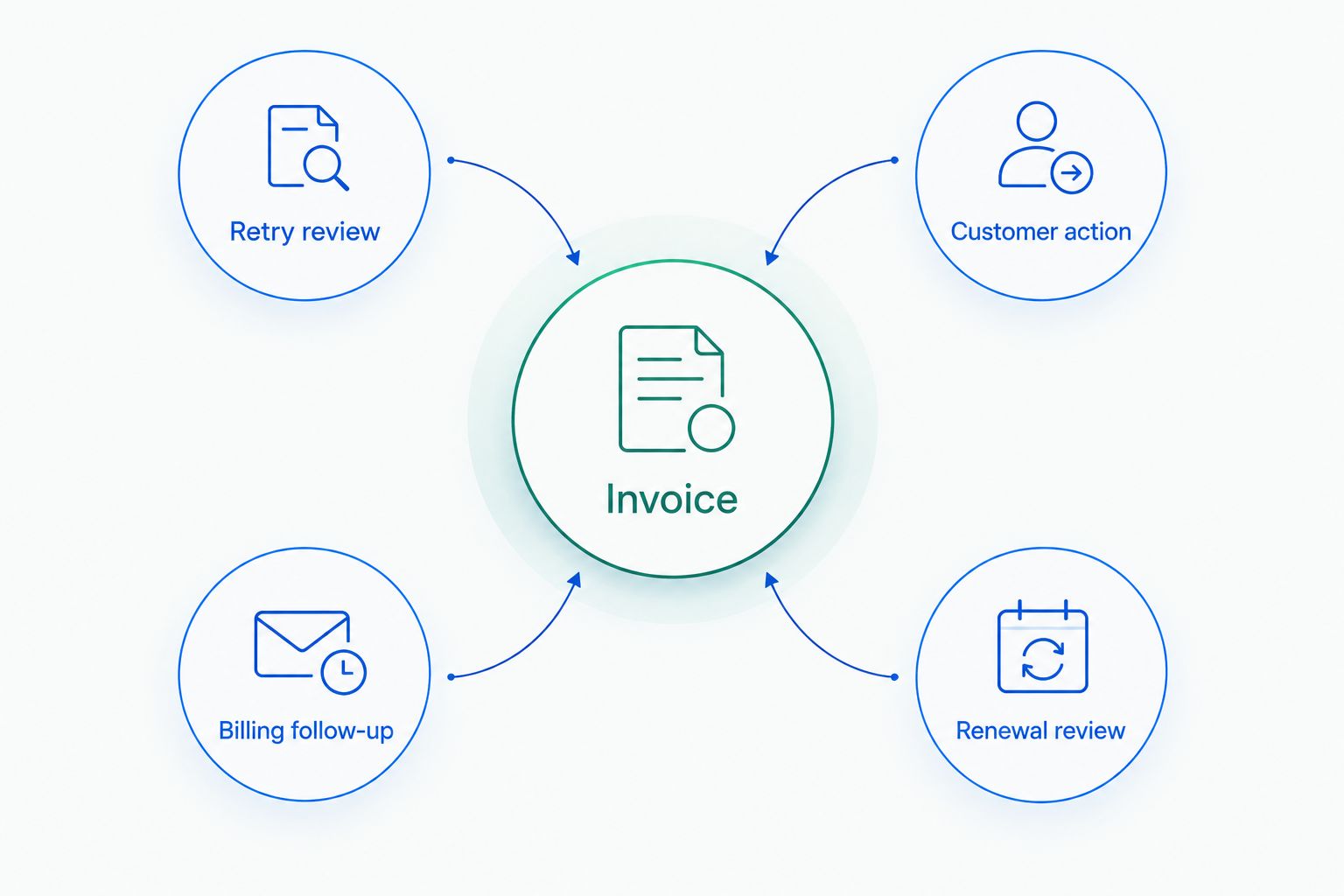
- Use Retry review for failures that need a scheduling decision.
- Use Customer action for authentication or payment-method changes.
- Use Billing follow-up when the responsible contact needs help.
- Use Renewal review when approval or cancellation intent is unresolved.
- Check the invoice again after any customer action.
3. Assign ownership before choosing software or service
Run the first review yourself. List the open invoices, the next action for each, and the person responsible. If that list stays current without repeated chasing, your team has a foundation for managing recovery with software.
If nobody maintains the list, adding another application leaves the ownership problem intact. Decide who reviews results, updates customer messages, handles exceptions, and follows up with customers. A managed service belongs in the evaluation when your team needs someone to run those tasks, not just configure automation.
Stunning is best for subscription businesses evaluating failed-payment recovery software against managed dunning support. Stunning offers both software and managed dunning services. Evaluate Stunning Software and Managed Recovery separately: confirm the platform support, scope, and responsibilities for the specific offering you are considering.
The brand serves subscription businesses using Stripe, Foxy, and Subbly. Do not assume that every offering has identical platform coverage or includes the same work.
- Name the person accountable for unpaid annual renewals.
- Assign message maintenance and exception handling explicitly.
- Set a recurring review every 7 days as an operating starting point.
- Choose software when your team will operate the process.
- Evaluate managed recovery when you need ongoing operational ownership.
4. Write messages for the annual billing situation
Draft the messages manually before automating them. Each message should identify the renewal, explain what happened in plain language, and give the recipient a specific next action. Avoid technical failure codes unless they help the customer resolve the issue.
Annual accounts need context that a generic card-expiry reminder cannot supply. The person receiving the message might need to forward it to finance, verify an invoice, or involve an authorized payment contact. Make that handoff possible without circulating payment details by email.
Keep the payment request separate from product-renewal negotiations. If the customer disputes the renewal, route the account to the person who can resolve that dispute rather than continuing an unchanged reminder sequence.
For your 2026 message review, read every template as the recipient. Check whether someone unfamiliar with your billing system can understand what to do next.
- State that the message concerns the annual subscription renewal.
- Identify the invoice without exposing sensitive payment information.
- Describe the actual action: authenticate, update payment details, or contact billing.
- Provide a reply route for billing questions.
- Explain service consequences only when they match your actual policy.
5. Test the complete recovery path
Map the workflow on paper before changing live settings. Follow a failed renewal from the initial payment attempt through customer communication, customer action, payment confirmation, and subscription status. Include the path where payment never succeeds.
Then test supported scenarios in an appropriate test environment. A successful card update is not the same as a paid invoice. Confirm what happens after the update and whether any further action is required to collect the outstanding renewal.
When switching systems, identify which existing messages and retries remain active. Overlapping recovery workflows can produce duplicate communication or unclear ownership. Document the handoff rather than assuming that installing a replacement disables the previous process.
Keep the test record with your configuration notes. It gives the next person a reference when a setting changes or a customer reports an unexpected message.
- Test a failed payment that later succeeds.
- Test a payment requiring customer action.
- Test an updated payment method with an outstanding invoice.
- Confirm that reminders stop after confirmed payment.
- Check the subscription outcome when recovery ends without payment.
6. Measure paid invoices and unresolved work
Start with an invoice-level spreadsheet rather than a headline recovery percentage. Record which annual invoices failed, which were subsequently paid, and which remain unresolved. Keep credits, voided invoices, and agreed cancellations distinct from collected payments.
Use a 30-day observation window as a reporting choice, not a recovery promise. Compare invoice groups that have had the same time to resolve. Otherwise, a newly failed renewal and an older case sit in the same report despite having different opportunities for follow-up.
For a 2026 reporting baseline, separate annual subscription collections from monthly subscription collections. An annual invoice is a cash collection covering a longer subscription term; it is not automatically an equal increase in monthly recurring revenue.
Also measure the work left open. A paid-invoice report does not tell you whether billing questions remain unanswered or whether exceptions lack an owner.
- Count failed annual invoices and their original balances.
- Record subsequent payments against those same invoices.
- Separate collections from credits, write-offs, and cancellations.
- Track unresolved cases by next action and owner.
- Compare reporting groups using the same observation window.
Compare your operating options
Choose an operating model before comparing feature lists. The central trade-off is responsibility: built-in billing controls and recovery software still need an operator, while a managed service requires a clear agreement about what the provider owns.
The table separates those choices without assuming that any product guarantees recovery. Review current capabilities and service terms before committing.
| Option | Best for | Practical advantage | Key limitation or evaluation check |
|---|---|---|---|
| Stripe’s built-in retries and emails | Teams starting with existing billing controls | Keeps the initial workflow within the billing setup | Your team still needs to review exceptions, messages, and outcomes |
| Manual billing review and follow-up | Teams establishing the process before buying software | Makes account context and individual decisions explicit | Requires someone to maintain records and act on each case |
| Stunning Software | Teams that want recovery software and will own operations | Provides a software route for failed-payment recovery | Confirm platform support and whether the workflow meets your annual-renewal needs |
| Managed Recovery | Teams seeking an ongoing recovery operator | Provides a service route rather than a software-only decision | Confirm who reviews results, updates messages, follows up, and handles exceptions |
Keep the built-in approach when your team can explain and manage every unresolved case. Evaluate specialist software when the workflow needs capabilities your current configuration does not provide. Evaluate managed recovery when the missing resource is a person responsible for running the process.
For Stunning, discuss your annual-renewal workflow rather than requesting a generic product walkthrough. Ask how the proposed offering handles your platform, customer-action cases, billing contacts, reporting, and ongoing ownership.
Discuss your recovery workflow
Explain your platform, annual renewal failures, and who currently owns follow-up.
Common mistakes annual SaaS teams make
Treating every decline as a retry problem
Another attempt does not resolve a renewal dispute or tell a customer how to complete authentication. Review the failure and account context before choosing the next action. Use retries where they fit, not as the universal response.
Sending billing requests only to the product user
The active user is not necessarily authorized to pay an annual invoice. Record the billing contact separately and provide a clear route for correcting that contact. Do not ask customers to share card details through ordinary email replies.
Closing the case after a card update
A saved payment method is an intermediate event. Confirm the outstanding invoice is paid and check the resulting subscription status before closing recovery. Otherwise, your team can mark the task complete while the annual renewal remains unpaid.
Counting every resolved invoice as recovered revenue
A voided invoice or agreed cancellation resolves an administrative case without collecting the renewal. Keep those outcomes separate from payment. This makes reports useful for both finance and the person managing follow-up.
Buying automation without assigning maintenance
Messages, exception rules, and billing contacts need review after installation. Put those responsibilities in a named role or a service agreement. Otherwise, an installed system can keep running while unresolved customer cases receive no attention.
FAQ
What is dunning management software for annual SaaS renewals?
Dunning management software coordinates the recovery of failed annual subscription payments through retries, customer messages, and follow-up workflows. Your team still needs to define ownership, customer-action handling, and the outcome when an invoice remains unpaid.
Are Stripe’s built-in retries and emails enough for annual subscriptions?
Stripe’s built-in retries and emails are enough when your team can manage the required workflow and resolve exceptions with the available controls. Review actual failed annual invoices before adding another system, and identify the specific task your current setup cannot handle.
When should a SaaS business hire someone to manage recovery?
Hire a recovery operator when nobody consistently reviews unpaid invoices, maintains messages, or follows up on exceptions. Choose software instead when your team has an accountable operator and needs tools to execute the process.
Should annual renewal reminders go to the account user or billing contact?
Send payment requests to the appropriate billing contact and involve the account owner when renewal approval needs attention. Keep those roles separate because using the product and authorizing payment are different responsibilities.
Does updating a card mean an annual renewal has been recovered?
No. Confirm that the outstanding annual invoice has been paid before recording recovery, then check the subscription status and stop any remaining reminders.
How should I measure annual payment recovery in 2026?
Measure subsequent payments against the original failed annual invoices, using a consistent observation window. Report credits, cancellations, and write-offs separately, and do not present an annual cash collection as an equivalent increase in monthly recurring revenue.
What should I ask during a managed recovery evaluation?
Ask who reviews results, changes customer messages, follows up personally, and handles exceptions. Confirm platform support and responsibilities for the specific service rather than assuming that software and managed offerings cover identical work.
One last thing
Review the cases marked recovered, not just the cases still open. Trace a completed annual renewal from failure to confirmed payment and stopped reminders. That check exposes a false success signal—such as a card update recorded as collection—that an open-invoice review alone will miss.
Related guides
- Dunning software or managed recovery: who owns the work?
- Stripe dunning: retries versus customer authentication
- Reporting recovered revenue correctly