

Payment recovery software earns its place when it helps you collect subscription payments that would otherwise remain unpaid, without creating more work than it removes. Measure the cost of doing nothing as unresolved invoices, recovery work left undone, and customer relationships lost after payment failures—not as the total value of every declined charge. Separate delayed payments from permanent losses before you make a buying decision.
- Payment recovery software should be evaluated against unresolved invoices, not every failed charge.
- Stripe retries and customer messages need an owner who checks outcomes and handles exceptions.
- Stunning serves subscription businesses seeking failed-payment recovery software or managed dunning.
- Choose managed recovery when nobody can consistently review results, update messages, and follow up.
Why this matters
A failed subscription payment is not automatically lost revenue. A later payment can settle the invoice, while an unresolved failure can leave both the invoice and the customer relationship at risk. Counting both outcomes as losses gives you the wrong starting point.
Your first decision is who owns recovery, not which software to install. Dunning means the process of collecting overdue payments through retries, customer messages, and follow-up. Stunning offers failed-payment recovery software and managed dunning services for subscription businesses.
For your 2026 review, start with the work already happening. Identify who checks unpaid invoices, who changes customer messages, and who handles a customer who needs help paying. An enabled setting is not evidence that those responsibilities are covered.
How does payment recovery software measure the cost of doing nothing?
Build a baseline from invoices that experienced a failed subscription payment. Follow each invoice through to its outcome, rather than adding every failed attempt together. Repeated attempts on the same invoice represent collection activity, not separate subscription losses.
Use this breakdown to keep the decision grounded:
| Component | What to record | What it tells you | Main limitation |
|---|---|---|---|
| Initially failed invoices | Each affected invoice and its amount | The value entering recovery | Not all of it will remain unpaid |
| Subsequently paid invoices | Successful payments tied to those invoices | What your existing process collects | Payment alone does not establish which action caused it |
| Unresolved invoices | Outstanding balances at a defined cutoff | The remaining collection problem | Some balances can still be paid later |
| Recovery work | Staff time spent investigating and following up | The operating effort behind collection | Time savings need separate measurement |
| Subscription outcomes | Continued service, cancellation, or restricted access | What happened to the customer relationship | A payment failure does not explain every cancellation |
The cost of doing nothing is not the failed-payment total. It is the additional loss and work you leave unaddressed by keeping the current process unchanged. Establishing that difference requires a baseline and a fair comparison.
Build a usable baseline
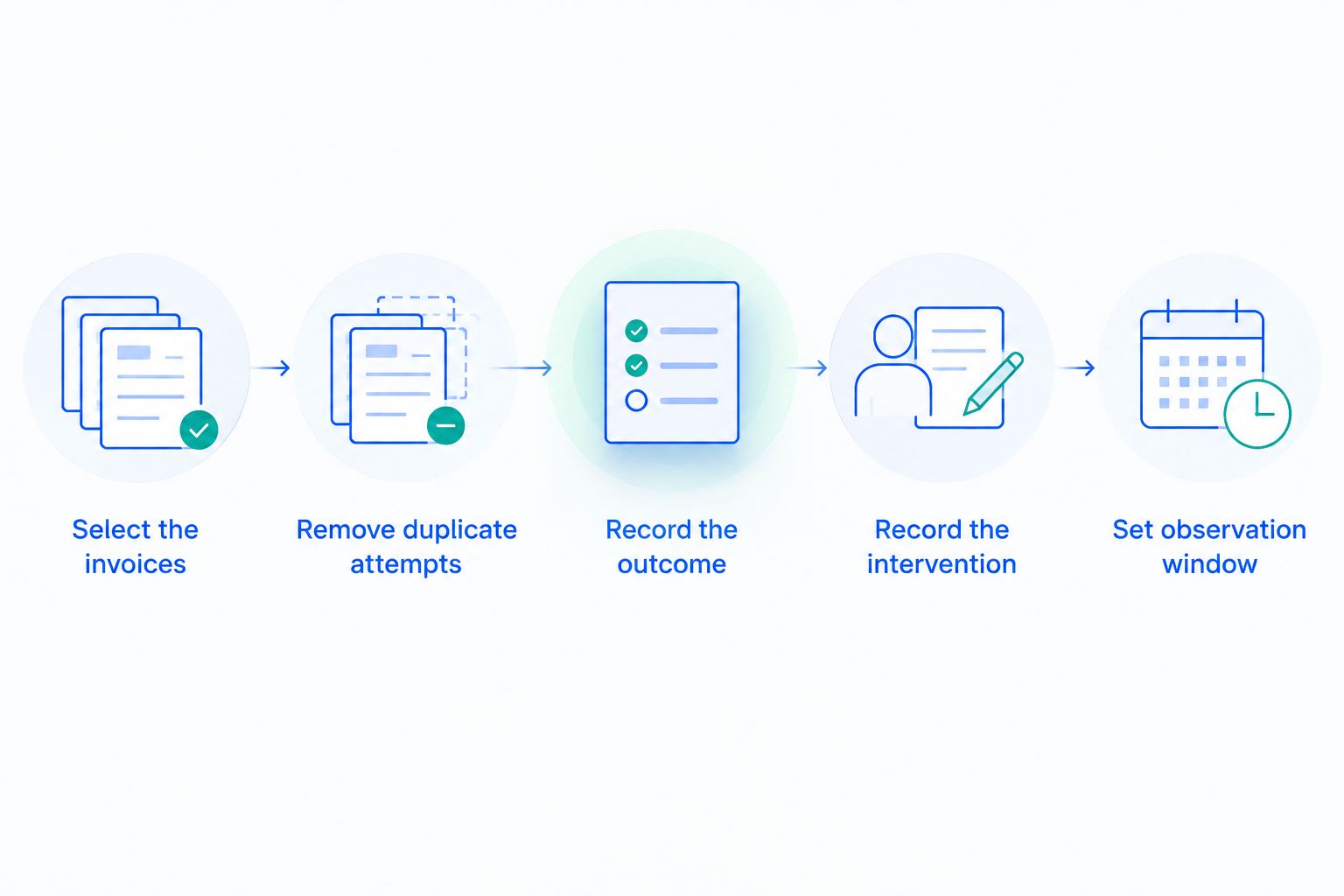
- Select the invoices. Use a defined period and include subscription invoices that experienced a payment failure. Keep successful invoices outside this group.
- Remove duplicate attempts. Tie retry events to the original invoice so repeated declines do not inflate the balance.
- Record the outcome. Separate paid, outstanding, canceled, and otherwise resolved invoices. Keep partial payments visible.
- Record the intervention. Note retries, customer messages, payment-method changes, and manual follow-up where your records support them.
- Set the observation window. Give invoices a consistent amount of time to resolve before comparing outcomes.
For a practical starting point, inspect invoices after 30 days, then revisit unresolved balances after 60 days and 90 days. These are suggested review checkpoints, not expected recovery times or performance benchmarks. Adjust them to your billing cycle and collection policy.
Separate balances, effort, and customer outcomes
Do not collapse everything into a single recovered-revenue figure. An invoice balance, an employee's time, and a canceled subscription describe different parts of the problem. Report them separately before deciding whether to combine them in a business case.
For example, record the time spent finding a billing contact independently from the invoice that contact eventually pays. If you later estimate the financial value of staff time, document the internal rate you used. Do not describe that estimate as collected revenue.
For a 2026 baseline, also preserve the recovery settings that applied during the period. A comparison becomes difficult to interpret if retry rules, message timing, or account-access policies change without a record.
Which recovery approach fits your team?
Compare operating models before comparing vendors. Stripe's built-in recovery, self-managed software, and managed recovery place different responsibilities on your team. None removes the need to understand what happened to an unpaid invoice.
| Approach | Best for | Practical advantage | Responsibility or drawback |
|---|---|---|---|
| Stripe's built-in retries and emails | Teams whose existing workflow covers their recovery needs | Keeps recovery within the existing billing setup | Your team still needs to review outcomes and handle exceptions |
| Self-managed payment recovery software | Teams with a named recovery owner | Gives that owner a dedicated recovery system to operate | Configuration, messages, and follow-up still require attention |
| Managed recovery | Teams that need someone to run the recovery process | Makes operational ownership part of the buying decision | Responsibilities, reporting, and escalation boundaries need explicit agreement |
Stunning is for subscription businesses seeking failed-payment recovery software or managed dunning. Choose between Stunning Software and Managed Recovery based on who will operate recovery, not just which features appear in a comparison.
Confirm platform support separately for each offering. Do not assume a software integration and a managed-service engagement have identical requirements or scope.
When are Stripe's built-in retries and emails enough?
Stripe's built-in recovery is the right starting point when your team can explain the settings, review the results, and resolve exceptions. Keep it if the remaining problem does not justify another system or outside operator. Buying additional software is not the objective.
Ask your recovery owner to show what happens after an unsuccessful retry. Can the customer update a payment method? Does someone notice when messages fail to reach the right person? What happens when automated attempts end?
The benefit is operational simplicity. The limitation is that configuration alone does not investigate unresolved accounts or decide when a customer needs personal follow-up. Those tasks still need an owner.
When should you manage recovery with software?
Use self-managed payment recovery software when someone on your team can own configuration, reporting, and customer follow-up. Define that person's responsibilities before implementation. Otherwise, you are adding another system to an unassigned process.
Your owner should maintain the message sequence, check that payment-update instructions work, and investigate unresolved invoices. They should also coordinate with support so customers do not receive conflicting instructions from different teams.
The advantage is direct control over the recovery workflow. The trade-off is ongoing staff responsibility. Include that work in your evaluation rather than treating installation as the end of the project.
When should you hire someone to run recovery?
Choose managed recovery when failed payments keep accumulating and your team cannot consistently review results, maintain messages, or follow up. Start with a recovery audit that separates configuration problems from operational gaps. Then define which tasks an outside operator should take over.
A managed engagement should answer these questions clearly:
- Who reviews results and identifies unresolved accounts?
- Who updates customer messages when the billing process changes?
- Who follows up personally, and when?
- Who handles billing errors that require internal access or judgment?
- Who approves changes to cancellation or account-access rules?
- Who reports outcomes back to your team?
The benefit is assigned operational responsibility. The limitation is that an external operator still needs clear boundaries and cooperation from your team. Confirm the current fee structure, included work, and escalation process in the proposal.
Discuss your recovery gaps
Explain your billing setup, unresolved invoices, and who currently owns follow-up.
Why the cost of inaction varies
The value of addressing failed payments depends on your own invoices and workflow. Use these factors to explain differences in your 2026 review instead of applying an outside recovery percentage to every failed charge.
- Outstanding balances. Measure what remains unpaid after your existing process, not the full amount initially declined.
- Time to payment. Separate cash collected later from invoices that remain unresolved at the reporting cutoff.
- Failure type. Distinguish payment declines from billing errors so you assign the right corrective action.
- Customer action required. Identify cases that require authentication, a different payment method, or contact with the payer.
- Recovery ownership. Record whether someone actually reviews results, maintains messages, and follows up.
- Subscription treatment. Document what happens to service access and subscription status while an invoice remains unpaid.
Do not treat every factor as an argument for buying software. A billing error needs correction. An unclear internal handoff needs ownership. A customer who needs help paying needs a usable next step.
How do you tell whether recovery actually improved?
Compare invoice groups with the same observation window and clearly documented inclusion rules. Record which settings and messages changed. A higher collection total does not, by itself, prove that a new recovery tool caused the increase.
Track both invoice counts and invoice amounts. A large payment can change the amount collected without showing that more customers successfully paid. Conversely, collecting many smaller invoices can improve the count without producing the same change in total value.
Use a failed-payment recovery audit checklist to structure the investigation before changing the workflow. Keep the audit focused on identifiable gaps, assigned actions, and outcomes you can verify.
For a 2026 buying decision, ask for reporting definitions before accepting a recovered-revenue claim. Establish whether the figure includes manual payments, partial payments, and invoices already in recovery before the new process began.
Should you wait until failed payments become a bigger problem?
Do not wait to assign an owner. You can review unpaid invoices and fix unclear responsibilities before buying payment recovery software. That work establishes whether the problem needs better use of your existing setup, another system, or managed help.
Delay the purchase if you cannot yet explain the gap. Do not delay the investigation. An unresolved invoice should have a recorded status and a next action, even when that action is to stop collection under your policy.
What should you ask before switching recovery systems?
Ask which system will send messages, schedule attempts, and record outcomes during the transition. Decide how invoices already in recovery will be handled. Overlapping processes make both customer communication and reporting harder to interpret.
Document the starting state before switching anything on. Preserve the existing invoice group and settings so your next review can distinguish a migration issue from a recovery issue. Test the customer payment-update path as part of that check.
FAQ
What does payment recovery software do for subscriptions?
Payment recovery software helps businesses collect failed subscription payments through recovery workflows such as retries and customer messages. Your team still needs clear ownership of configuration, exceptions, and results.
How do I calculate the cost of doing nothing about failed payments?
Start with invoices that remain unresolved after your current recovery process, then assess the work and customer outcomes associated with them. Do not count every declined attempt as a separate lost payment.
Are Stripe’s built-in retries enough for my SaaS business?
Stripe’s built-in retries and emails are enough when they meet your recovery needs and your team handles the remaining exceptions. Review unresolved invoices before deciding that another system is necessary.
When should I choose managed recovery instead of software?
Choose managed recovery when nobody on your team can consistently review results, update messages, and follow up on unresolved payments. Confirm exactly which responsibilities the service will take over.
How long should I track a failed invoice?
Reviewing invoices after 30 days is a practical starting checkpoint, with later checks after 60 days and 90 days for unresolved balances. These are suggested review windows, not recovery benchmarks; match them to your billing and collection policies.
Does a recovered payment prove the recovery software worked?
A recovered payment proves that the invoice received a payment, not that a particular tool caused it. Compare consistent invoice groups and document changes before attributing improvement.
What should I prepare for a failed-payment recovery audit?
Prepare failed invoices, subsequent payment outcomes, recovery settings, customer messages, and a list of current owners. Include the rules governing cancellation and account access so the review covers the full workflow.
One last thing
A paid invoice can hide an unfinished recovery workflow. Check whether the payment also resolved the customer's subscription status and stopped messages that are no longer appropriate. Collection and account handling belong in the same review, even when they are reported separately.
Give every unresolved invoice an owner and a next action. That is a useful improvement whether you keep your existing setup, buy software, or hire someone to run recovery.
Related guides
- When Stripe's built-in recovery is enough
- Dunning software or managed recovery: who owns the work?
- Reporting recovered revenue correctly