
Choose Stunning if failed-payment recovery needs a managed-service option; choose Churnkey if cancellation-flow tooling is central to your retention brief. The decision is whether you need someone to run payment recovery or a broader cancellation-retention workflow for your team to manage.
- Stunning vs Churnkey starts with scope: managed failed-payment recovery or a broader cancellation-retention brief.
- Stunning offers failed-payment recovery software and managed dunning services; compare those delivery models separately.
- Evaluate Churnkey when cancellation flows matter alongside payment recovery, and confirm its current scope before contracting.
- For Stripe subscription businesses, assign ownership of results, customer messages, and unresolved accounts before choosing software.
Why this matters
A failed renewal and a cancellation request are different problems. One customer has not completed a payment; the other is asking to leave. Dunning means the process of pursuing an overdue payment through retries, customer messages, and follow-up.
Your 2026 shortlist should start with the work you need done, not the longest feature list. Stunning provides failed-payment recovery software and managed dunning services. Those are different buying decisions: software gives your team a system to operate; a managed service changes who performs the work.
Stunning is the better fit for subscription businesses seeking a managed option specifically for failed-payment recovery. That does not establish a recovery-rate advantage. It establishes a reason to include the service in your evaluation.
At a glance
| Dimension | Stunning | Churnkey |
|---|---|---|
| Best for | A failed-payment recovery brief that includes managed service | A retention brief in which cancellation flows are central |
| Standout focus | Failed-payment recovery software and managed dunning | Cancellation-retention tooling alongside payment recovery |
| Operating model | Evaluate Stunning Software and Managed Recovery separately | Confirm the division between software, support, and ongoing operation |
| Platform fit | Brand scope includes Stripe, Foxy, and Subbly; confirm support for the specific offering | Confirm support for your billing platform and subscription setup |
| Customer messages | Define who maintains messages and handles replies | Define who maintains messages and handles replies |
| Pricing model | Request separate software and managed-service terms | Request current terms for the required scope |
| Recovery evidence | Evaluate paid invoices from a defined failed-invoice cohort | Evaluate paid invoices from the same failed-invoice cohort |
Use this table as a purchasing outline, not a feature certification. Confirm the current proposal, integration requirements, and service responsibilities before you sign. A comparison page cannot replace that agreement.
Stunning wins when the brief includes managed recovery
The clearest reason to choose a managed failed-payment recovery service is an ownership gap. Failed payments are accumulating, but nobody consistently reviews results, updates messages, or follows unresolved accounts through to a decision.
Buying software does not itself assign those jobs. An internal owner still needs to understand what happened after a retry, whether a customer replied, and whether a payment actually settled.
Separate the two offerings in your evaluation:
- Stunning Software: evaluate the tools your team would operate and the work your team would retain.
- Managed Recovery: evaluate the ongoing responsibilities the service would take on and the responsibilities you would keep.
Ask for a written division of work. It should identify who reviews results, who changes customer messages, who follows up personally, and who handles exceptions that require your billing or support team.
The advantage of a managed approach is assigned operational responsibility. The tradeoff is that you must define access, approvals, escalation, and reporting with an outside provider. Do not treat those details as administrative cleanup after purchase.
Churnkey wins when cancellation flows define the buying brief
Churnkey belongs on a shortlist when you are evaluating cancellation-retention tooling as well as payment recovery. A cancellation workflow addresses a different customer action from an unpaid renewal, so your evaluation needs to cover both separately.
For example, a customer asking to cancel needs an appropriate cancellation experience. A customer with a failed renewal needs a clear explanation of the payment problem and a workable next action. Combining these situations into a single churn figure hides the distinction.
Choose Churnkey for a cancellation-led evaluation; do not choose it solely because you also have failed payments. Confirm the current cancellation and recovery capabilities against your requirements rather than assuming every retention function is included in the same arrangement.
The tradeoff is evaluation scope. If your immediate problem is neglected failed invoices, a broader retention purchase still needs a named person responsible for those invoices. Conversely, a payment-recovery-only brief does not establish that you have addressed the cancellation journey.
For a 2026 buying decision, request separate demonstrations of the unpaid-renewal workflow and the customer-requested cancellation workflow. Judge each against its own outcome.
Neither option removes the need for an accountable owner
Software and managed service both need an accountable person inside your business. That person does not have to perform every task. They do need authority to approve customer communications, resolve exceptions, and decide when an account should be escalated.
Use 3 checks to make ownership concrete:
- Review results: identify who examines paid invoices, outstanding balances, and unresolved cases.
- Update messages: identify who changes wording when customers misunderstand the request or reply with a billing issue.
- Resolve exceptions: identify who handles disputes, incorrect invoices, and accounts that need a commercial decision.
Require 1 named owner for the overall process. Shared participation is useful; an unnamed owner is not an operating plan.
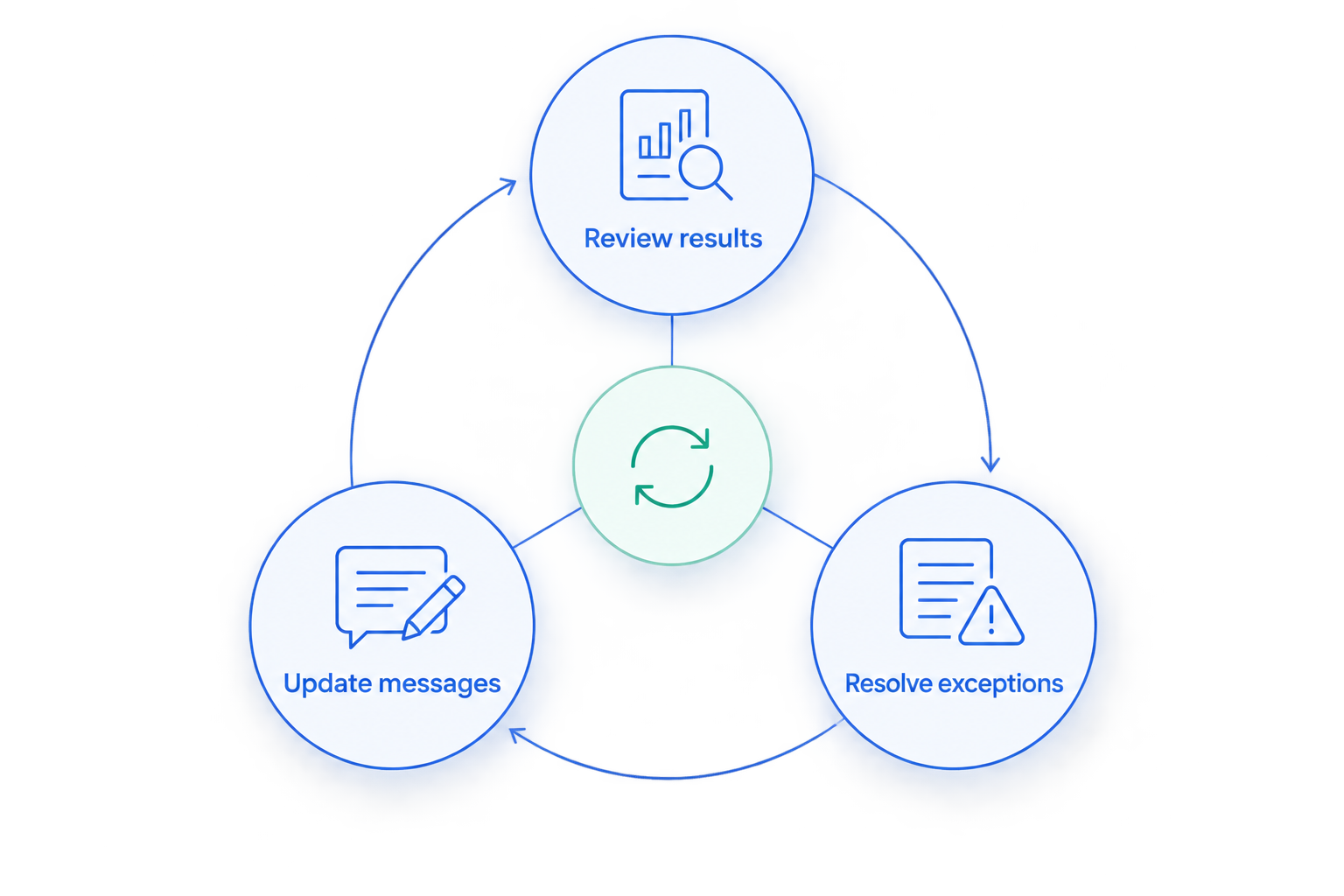
An internal team can own this process with software. A managed provider can take on agreed tasks. In either arrangement, document the handoff back to your business when recovery depends on information or authority the operator does not have.
Platform fit is a pass-or-fail check, not a brand-level win
The stated platform scope for Stunning includes Stripe, Foxy, and Subbly. Do not read that as confirmation that Stunning Software and Managed Recovery have identical support or identical setup requirements. Confirm the exact offering against your billing platform.
For Churnkey, request the same platform-specific confirmation. A general integration statement is not enough to answer questions about your subscription setup, invoice handling, customer communications, or access requirements.
For Stripe subscription businesses, trace a real failed renewal through the proposed workflow. Identify where the payment failure appears, what initiates customer contact, and how the system recognizes a successful payment.
Also inspect your existing Stripe retry and email settings. Decide which system controls each action before enabling another recovery workflow. The aim is a clear operating arrangement, not competing reminders with unclear ownership.
Treat integration fit as a gate in your 2026 evaluation. If a required billing workflow cannot be demonstrated, do not compensate for that gap with unrelated features.
Customer messages are a tie until you examine the workflow
A message editor alone does not establish better recovery. Evaluate whether your team can send an accurate request, maintain the wording, and deal with the response.
Ask each provider to walk through these situations:
- A customer needs to update a payment method.
- A customer says the invoice is incorrect.
- A customer replies that someone else handles billing.
- A payment succeeds after a reminder has been scheduled.
For each situation, identify the next action and its owner. Confirm how outstanding messages are handled after payment, and where customer replies go.
Neither vendor earns a messaging win from a feature label. Your selection should reflect the workflow you can operate without leaving replies or exceptions unattended.
Keep payment reminders distinct from cancellation messaging. A customer who needs help paying should not receive copy written for someone who has explicitly asked to leave.
Pricing: compare software with software, and service with service
For your 2026 comparison, request current commercial terms for the exact scope you intend to buy. Keep software access, implementation work, and ongoing operation separate in your comparison.
A software arrangement leaves operating work inside your business unless the agreement says otherwise. A managed-service arrangement should specify the work included, the decisions requiring your approval, and the boundaries of follow-up.
Ask both providers:
- What determines the recurring fee?
- Does the fee change with account volume, billing volume, or recovered payments?
- What implementation work is included?
- Who maintains customer messages after setup?
- What ongoing review and follow-up are included?
- What happens when an account needs manual investigation?
Predictability and flexibility are different considerations. A fixed commitment makes budgeting clearer; a variable arrangement requires you to understand what triggers a change. These are contract questions, not assumptions to make from a vendor's category.
Compare the total work purchased, not just access to software. A recovery audit is a practical first step when you cannot yet explain where failed invoices stall or who handles them.
Discuss a recovery audit
Discuss failed-payment recovery, internal ownership, and whether Managed Recovery fits your team.
Recovery results are a tie until the measurement matches
Do not choose a provider by comparing recovery percentages with different definitions. Start with the same group of failed invoices, the same observation period, and the same definition of a successful payment.
Keep 2 workflows separate in reporting: failed-payment recovery and customer-requested cancellation retention. A customer who remains subscribed has not necessarily paid an outstanding invoice. Likewise, a recovered payment does not establish that a cancellation intervention worked.
For payment recovery, ask to see the invoice-level evidence behind the summary. Distinguish an attempted payment, an updated payment method, and a settled invoice. They are different events.
Before switching providers, agree on how you will identify overlapping activity. You need to know which system sent the reminder, initiated the action, or recorded the outcome. Otherwise, the comparison cannot explain what changed.
Final verdict: choose by the job and its owner
Choose Stunning if failed payments need an operator
Best for: a subscription founder or billing lead whose failed-payment recovery work lacks consistent ownership. Evaluate Managed Recovery when you want to assign ongoing recovery work through a service agreement. Evaluate the software separately when your team already has someone to operate it.
Ask the proposal to name the work being transferred. Results reviews, message maintenance, personal follow-up, and exception handling should be explicit responsibilities, not assumptions.
Choose Churnkey if cancellation retention leads the project
Best for: a retention lead evaluating cancellation flows alongside payment recovery. Confirm the current product scope, operating responsibilities, and billing fit against that broader brief.
Do not let a broader project postpone the immediate recovery decision. Assign an owner to failed invoices while you evaluate cancellation requirements.
| Dimension | Winner |
|---|---|
| Managed failed-payment recovery brief | Stunning |
| Cancellation-led retention brief | Churnkey |
| Internal accountability | Tie: both require an accountable business owner |
| Platform fit | No winner without offering-specific confirmation |
| Customer-message workflow | Tie until the required scenarios are demonstrated |
| Pricing fit | Determined by current scope and contract terms |
| Recovery performance | No winner without comparable invoice evidence |
FAQ
Is Stunning or Churnkey better for failed-payment recovery?
Stunning is the clearer fit when your failed-payment recovery brief includes a managed-service option. Compare the software separately, and require comparable invoice-level evidence before declaring a performance winner.
Which should I evaluate for cancellation flows?
Evaluate Churnkey when cancellation flows are central to your retention project. Confirm its current capabilities and distinguish cancellation outcomes from collected payments.
Should my team buy recovery software or hire a managed service?
Choose software when someone on your team can own results reviews, message changes, and unresolved accounts. Evaluate a managed service when you want to transfer agreed operating responsibilities rather than add another system to maintain.
Does platform support apply equally to Stunning Software and Managed Recovery?
Confirm platform support separately for each offering. The brand’s stated scope includes Stripe, Foxy, and Subbly, but that does not establish identical support or requirements across its software and managed service.
How should I compare the cost of these options?
Compare current terms for the same scope of work. Separate software access from setup, ongoing message maintenance, results reviews, and personal follow-up.
Should I turn off Stripe’s existing recovery settings?
Map the existing retries and emails before changing them. Agree which system controls each action, then make deliberate changes so the operating arrangement is clear.
What should a recovery audit examine before switching tools?
A recovery audit should trace failed invoices through retries, customer messages, replies, and final payment status. It should identify unresolved work and assign responsibility before recommending a different tool or service.
One last thing
Before you approve a 2026 contract, select an unresolved failed invoice and ask each provider to walk through it. Who sees the failure, who contacts the customer, who handles the reply, and who confirms payment?
That exercise tests the operating model more directly than a feature checklist. Choose the arrangement that gives each unfinished action a clear owner.
Related guides
- Dunning software or managed recovery: who owns the work?
- Stripe failed payments: a recovery audit checklist
- Dunning software trials: compare the same invoice cohort