
Compare dunning software against the same defined population of failed invoices, using matched groups and the same observation window—not competing recovery sequences on the same live invoice. Keep eligibility, measurement, and ownership consistent so you can separate payment recovery from differences in invoice mix or staff effort.
- Compare dunning software using matched invoice groups, identical eligibility rules, and equal observation windows.
- Keep Stripe retries and customer messages under one coordinated recovery process for each invoice.
- Stunning fits subscription businesses seeking failed-payment recovery software or managed dunning.
- Choose managed recovery when nobody owns results, message updates, and unresolved-account follow-up.
Why this matters
A trial compares more than software. It also compares the invoices entering the process, the time allowed for recovery, and the work your team contributes.
An older backlog is not a fair comparison with newly failed renewals. Neither is a workflow receiving personal follow-up compared with an unattended workflow. Your 2026 evaluation should distinguish those differences before you judge the results.
Start with a written test plan. The guide to testing dunning software before switching it on provides a related starting point; the framework below focuses on making the comparison fair.
How do you compare dunning software with the same invoice cohort?
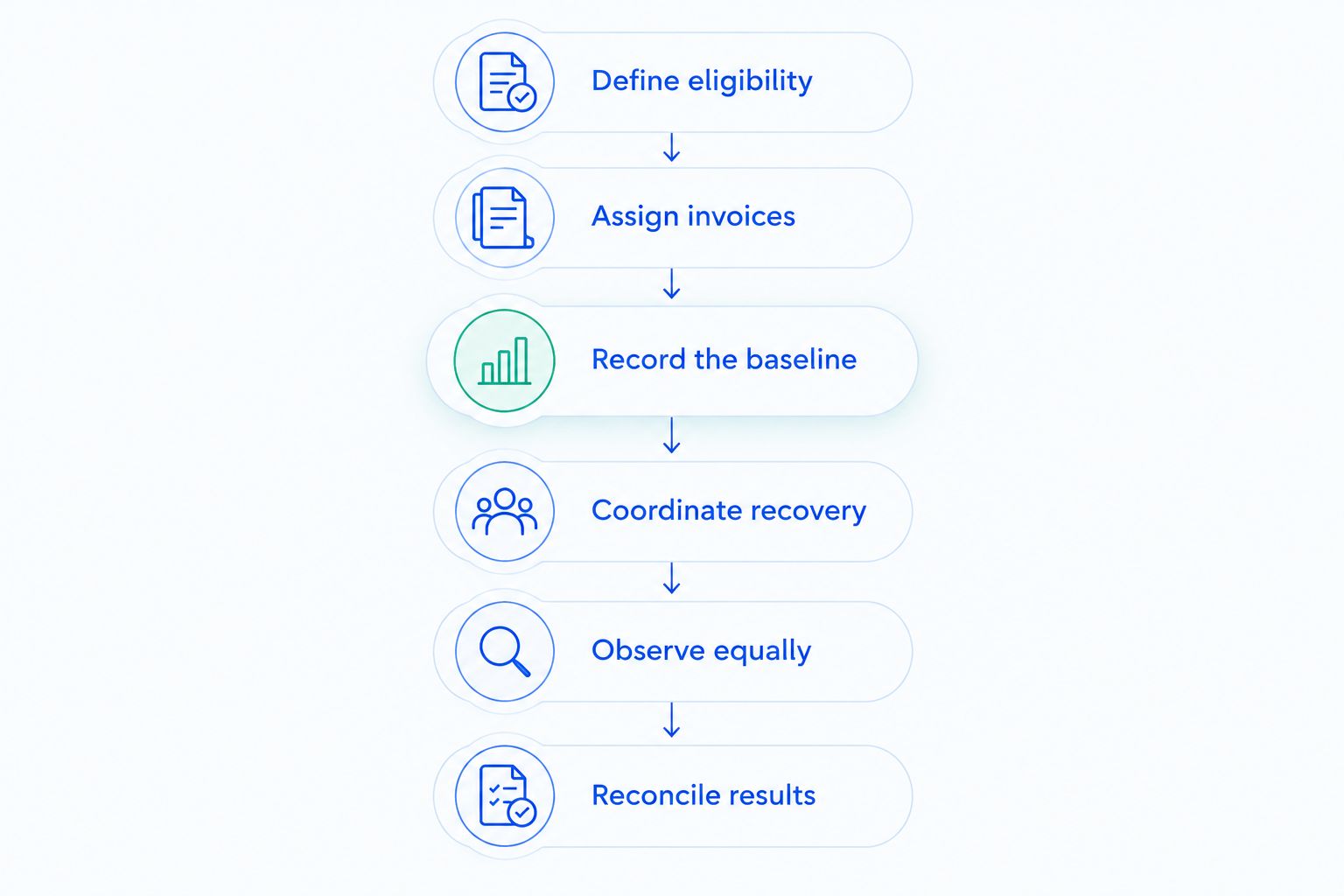
Use one eligibility definition, then assign comparable invoices to separate recovery workflows. A cohort is a defined group of invoices sharing a starting condition, such as subscription renewals that first failed during your enrollment window.
Do not interpret “same cohort” as permission to run multiple tools independently against every invoice. Each invoice needs a clear assignment, coordinated retries and messages, and an identifiable owner.
- Define eligibility. Specify the billing platform, invoice status, renewal type, currencies, and exclusions before enrollment starts.
- Assign invoices. Where your setup supports it, randomly assign eligible customers to separate groups. Keep each customer's invoices together to avoid conflicting messages.
- Record the baseline. Save the failed amount, first-failure timestamp, payment status, and recovery configuration at assignment.
- Coordinate recovery. Document which system controls retries, customer emails, payment-update requests, and escalation.
- Observe equally. Give each invoice the same elapsed time from its first eligible failure before comparing outcomes.
- Reconcile results. Check actual invoice payments against the original population and record staff work separately.
If your setup cannot support separate assignments, use a before-and-after evaluation with the same eligibility rules. Label it accurately: a sequential comparison does not control for changes in customer mix or timing.
Define the comparison before choosing the tool
Dunning means following up on failed payments to collect an outstanding balance. Software can run parts of that process, but your evaluation must also establish who maintains it.
Compare the operating models below before requesting demonstrations. The right model depends on whether your team will own recovery work, not just whether a tool sends messages.
| Approach | Best for | Advantage to evaluate | Limitation to account for |
|---|---|---|---|
| Stripe's built-in retries and emails | Teams evaluating their existing Stripe recovery setup | Establishes a baseline without introducing another recovery workflow | Your team still needs to review configuration, results, and unresolved accounts |
| Dedicated dunning software | Teams with someone assigned to run recovery | Lets you evaluate a separate recovery workflow against your baseline | Setup does not replace ongoing review or customer follow-up |
| Managed recovery | Teams seeking someone to operate recovery | Makes ownership and recurring work part of the evaluation | Requires a clear service scope, handoff process, and account-access boundaries |
Stunning offers failed-payment recovery software and managed dunning services for subscription businesses. Evaluate Stunning Software and Managed Recovery separately: ask which work each includes and confirm platform support for the specific offering you are considering.
For your 2026 shortlist, request a demonstration of the actual workflow you intend to test. A presentation about recovery features is not evidence that the provider will review your results or handle unresolved accounts.
Freeze the rules, not just the invoice list
Write an evaluation brief before the trial starts. The brief should explain which invoices enter, what counts as recovery, when measurement ends, and who can change the workflow.
Include these fields in your working record:
- Assignment: Customer identifier, invoice identifier, and assigned workflow.
- Starting condition: First eligible failure, outstanding balance, billing interval, and currency.
- Actions: Retry events, messages, payment-update requests, and personal follow-up.
- Outcome: Payments applied to the invoice, remaining balance, credits, refunds, and resolution status.
- Ownership: Person responsible for exceptions, message changes, and reporting.
Keep existing overdue invoices separate from newly failed renewals. A backlog has already experienced a different recovery history, including earlier retries and customer contact.
Record exclusions before seeing the results. Removing difficult invoices from one group after the trial begins changes the comparison rather than improving recovery.
Measure collected payments, not dashboard labels
Treat a paid invoice as a payment outcome, not proof that a particular message caused it. An account can pay after a retry, a customer update, a support conversation, or several actions together.
Use your billing records to reconcile the result. A provider's dashboard is useful for investigating activity, but your comparison needs the same accounting rules across every workflow.
| Measure | Definition for your trial | What it tells you |
|---|---|---|
| Invoice recovery rate | Eligible invoices fully paid divided by eligible invoices assigned | How broadly recovery reaches the invoice population |
| Amount recovery rate | Payments applied to eligible balances divided by eligible starting balances | How much of the original failed balance was collected |
| Time to payment | Elapsed time from first eligible failure to payment | How quickly invoices resolve |
| Unresolved balance | Eligible balance still outstanding at the measurement cutoff | What remains for follow-up |
| Staff effort | Logged time spent reviewing, changing messages, and contacting customers | What operating the workflow requires |
Specify how partial payments affect each measure. A partially paid invoice contributes collected funds without necessarily counting as a fully recovered invoice.
Keep currencies separate unless you document a consistent conversion method. Do not classify credits, write-offs, or cancellations as collected payments, and show later refunds separately.
A useful 2026 trial report shows the assigned population alongside its outcomes. A recovery percentage without its denominator hides the size and composition of the test.
Why dunning software trial results vary
A difference in results needs an explanation before it becomes a buying decision. Review these factors whenever one workflow appears to outperform another:
- Invoice age: Fresh failures and an old overdue backlog have different recovery histories. Compare like starting conditions.
- Billing interval: Separate monthly and annual renewals so a change in billing mix does not masquerade as a workflow improvement.
- Balance distribution: Report invoice counts and collected amounts together. A large balance can dominate an amount-based result.
- Required customer action: Distinguish invoices needing a payment-method update or authentication from those assigned to another retry.
- Workflow overlap: Record other retries, emails, support messages, and personal outreach affecting the same account.
- Observation time: Compare invoices at the same elapsed age. Late entrants must not receive less time merely because enrollment ended.
These factors belong in the test plan, not just the final explanation. If a factor differs between groups, show the difference alongside the result.
Do not combine unlike groups solely to produce a cleaner headline. Separate results are more useful when your next decision is which recovery process to use for each account type.
When should you manage dunning software yourself?
Manage recovery yourself when a named person can maintain the process and act on its exceptions. That person needs access to payment outcomes, customer messages, and the team handling account questions.
Before choosing self-managed software, assign responsibility for:
- Reviewing recovered and unresolved invoices.
- Updating messages when billing policies or customer questions change.
- Checking that payment-update requests lead to the intended account action.
- Following up when an automated sequence ends without payment.
- Coordinating account restrictions with your subscription policy.
Self-managed software keeps those decisions with your team. It also leaves the recurring work there. Include that work in the trial rather than evaluating a temporarily polished setup nobody will maintain.
Ask the trial owner to document each manual intervention. Otherwise, you cannot tell whether the workflow suits your normal staffing or depends on attention it will not receive after purchase.
When should you hire someone to run recovery?
Choose managed recovery when you want responsibility for recurring recovery work included in the engagement. State the work explicitly: results review, message maintenance, exception handling, and follow-up.
Stunning offers Managed Recovery as well as Stunning Software. Ask for the division of responsibilities in writing, including who changes messages, who contacts customers, and which unresolved accounts return to your team.
A managed engagement still needs an internal contact. Your business must decide account-access rules, approve billing policy, and resolve questions the provider is not authorized to answer.
For a 2026 evaluation, use the same invoice measurement rules for managed and self-managed workflows. Show provider work and internal work separately rather than treating either as invisible.
Discuss your recovery evaluation
Ask about a recovery audit, Managed Recovery responsibilities, and support for your billing platform.
Can I run two dunning tools on the same invoices?
Do not run independent recovery sequences on the same invoices when you are trying to compare tools. Overlapping retries and messages make responsibility unclear and prevent a clean interpretation of the outcome.
Assign each eligible customer to a defined workflow instead. Document any shared billing behavior that remains active underneath both groups.
How long should a dunning software trial run?
Run the trial long enough for every enrolled invoice to complete the observation window you chose before enrollment. Stop enrolling new invoices separately from the date you stop measuring outcomes.
A calendar end date alone is not a fair cutoff. An invoice entering near the end otherwise receives less recovery time than one entering at the beginning.
What if the trial does not show a clear winner?
Keep the result unresolved rather than declaring a winner from a small or uneven comparison. Report the invoice population, starting balances, workflow differences, and remaining uncertainty.
Use the trial to resolve operational questions too. Clear ownership, accurate reporting, and workable customer handoffs remain useful findings even when the payment outcomes do not establish a difference.
FAQ
What’s the fairest way to compare dunning software in 2026?
Compare dunning software using the same eligibility rules, separate invoice assignments, and equal observation windows. Reconcile collected payments against the original assigned balances, and record staff effort separately.
Should I send the same failed invoice through every trial?
No. Sending the same failed invoice through independent recovery workflows introduces overlapping actions and unclear attribution. Use matched groups of eligible invoices instead.
Is Stripe’s built-in recovery enough for my business?
Evaluate Stripe’s built-in retries and emails as your baseline before adding another workflow. Review unresolved balances, required customer actions, and whether someone owns follow-up rather than assuming another tool is necessary.
What’s the difference between dunning software and managed recovery?
Dunning software provides a workflow your team operates; managed recovery makes defined operating work part of a service engagement. Confirm who reviews results, updates messages, and handles unresolved accounts.
Does a higher recovery percentage prove a tool is better?
No. A higher recovery percentage needs the same eligibility rules, accounting definitions, and observation window to support a fair comparison. Check invoice counts, starting balances, and manual interventions alongside it.
Can Stunning help if nobody owns failed-payment recovery?
Stunning offers managed dunning services as well as failed-payment recovery software. Discuss Managed Recovery responsibilities and confirm platform support for that offering before choosing a service.
What should I ask for before starting a trial?
Ask for a written assignment plan, a map of active retries and messages, an exportable outcome record, and a named escalation owner. Agree on the measurement cutoff and unresolved-account handoff before recovery starts.
One last thing
Inspect the unresolved invoices before signing. Recovered payments show completed outcomes; unresolved invoices show the work your next process still needs to handle.
For your 2026 decision, ask the proposed owner to explain what happens next to each unresolved account. If nobody owns that answer, a software purchase alone does not fill the role.
Related guides
- Dunning software or managed recovery: who owns the work?
- Reporting recovered revenue correctly
- A migration plan without recovery overlap