
Understanding What Really Drives Subscription Churn
To get a real handle on reducing churn, the first thing to accept is that not all lost customers are the same. Lumping them all into one big “churn” bucket is a huge mistake. Churn really breaks down into two very different types: voluntary churn, where a customer makes the conscious choice to cancel, and involuntary churn, where a subscription lapses because of a technical snag, usually a failed payment.
This distinction is everything. Why? Because you can’t fix both problems with the same solution. They have different causes, different warning signs, and require completely different strategies.
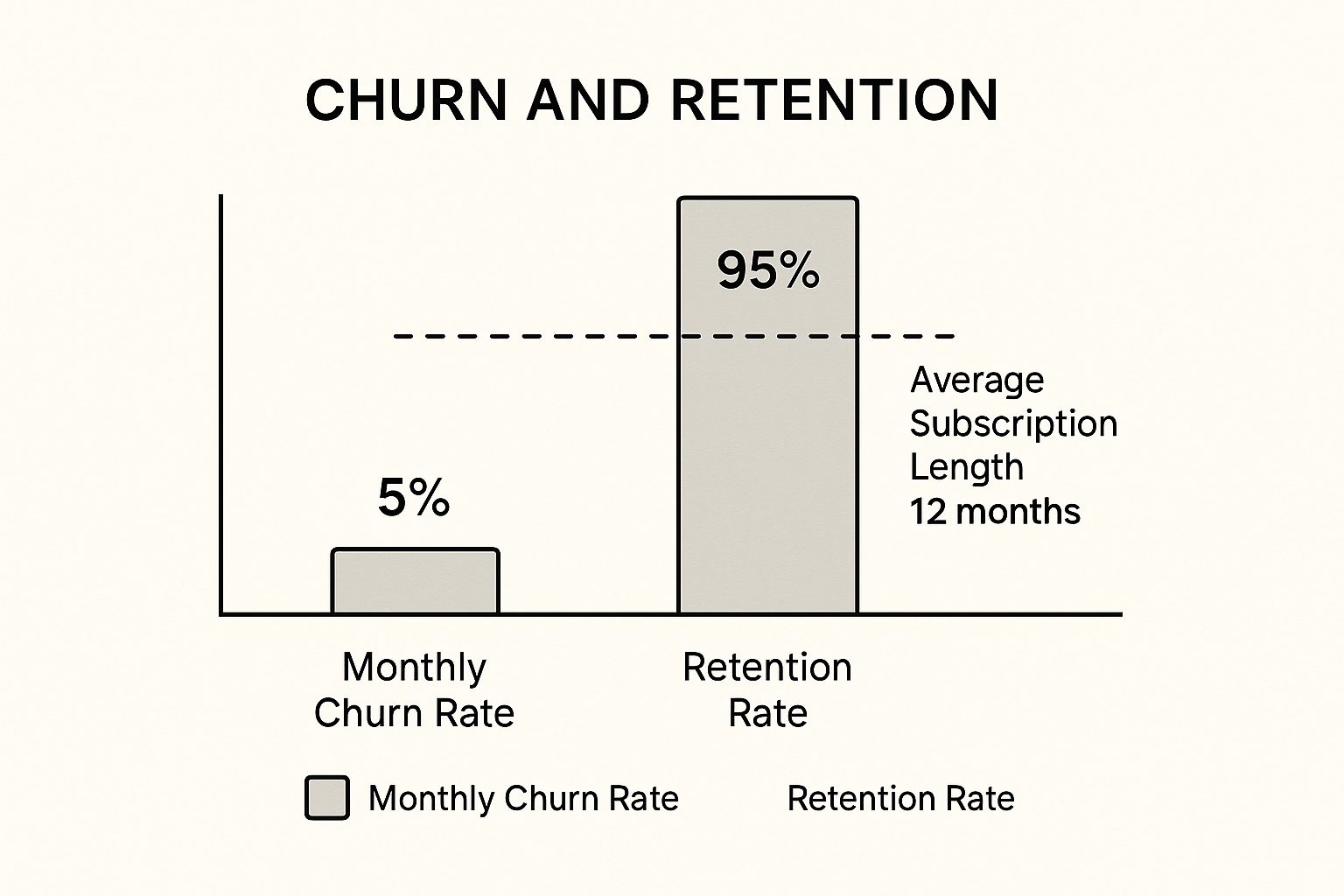
This chart really drives home how even a seemingly small monthly churn rate can drastically cut down your average customer relationship.
Most businesses pour their energy into preventing voluntary churn, thinking that’s where the real fight is. But what if that’s only half the battle? A recent analysis of over a thousand companies revealed something surprising for 2025: voluntary churn (at ~7%) and involuntary churn (also at ~7%) are expected to have a nearly identical impact.
This means you could be losing just as many customers to fixable payment failures as you are to actual dissatisfaction—a blind spot for many businesses.
Voluntary vs. Involuntary Churn: Key Differences and Solutions
To help you build a clear plan of attack, let’s break down the two types of churn side-by-side. This table maps out their causes, warning signs, and the specific strategies you’ll need to fight them effectively. Think of it as your roadmap to diagnosing the right problem so you can apply the right fix.
| Churn Type | Primary Causes | Warning Signs | Prevention Strategies | Recovery Timeline |
|---|---|---|---|---|
| Voluntary Churn (Active Cancellation) | Customers feel the service isn’t worth the cost. This often comes from a clunky onboarding experience, product bugs, a better competitor offer, or just mismatched expectations. | Keep an eye on login frequency and feature usage. A drop-off is a big red flag, as is a sudden increase in support tickets or negative feedback. | Build a fantastic customer journey from day one. This includes smooth onboarding, proactive support, and consistently providing value through content or new features. Actively ask for and act on customer feedback. | This is a long-term play. Recovery often happens weeks later through targeted “win-back” email campaigns that directly address the likely reason they left. |
| Involuntary Churn (Passive Failure) | This is almost always a technical payment problem. The usual suspects are expired credit cards, “soft declines” like insufficient funds, or “hard declines” where the bank blocks the charge. | The most obvious sign is a failed payment alert in your dashboard, whether you use Stripe or another processor like Subbly. High open rates on your dunning emails without any payment updates are another clue. | Automation is your best friend here. Use services that automatically update expired cards. Set up a smart dunning sequence with crystal-clear calls-to-action and offer backup payment options. | This is a sprint, not a marathon. Most involuntary churn can be fixed within a 7-14 day window using automated payment retries and well-timed communication. After that, your recovery chances plummet. |
The key insight here is the difference in approach. Tackling voluntary churn is about improving your product and the customer’s experience. In contrast, fighting involuntary churn is a technical and communication challenge that can largely be solved with the right automated systems.
Benchmarking Your Performance Against Industry Leaders
Before you declare an all-out war on churn, it helps to know what you’re up against. Is your churn rate a serious problem, or is it just a normal part of doing business in your industry? Without context, your churn percentage is just a number. With context, it becomes a roadmap for what to do next. This is why benchmarking is so important.
What’s a “Normal” Churn Rate?
The quickest way to check your company’s health is to see how you stack up against others. Churn rates vary a lot—a B2B SaaS company will have a very different “good” rate than a consumer subscription box. Still, having a general baseline is incredibly helpful.
Recent data shows the median churn rate for subscription-based businesses is about 7.44%. If you’re in that ballpark, you’re doing okay. If your rate is much higher, that’s a clear sign you need to investigate. You can see the full subscription data report here for a more detailed breakdown.
The idea isn’t just to match the average, but to understand your unique position. A fast-growing startup might accept higher churn, while an established business will prioritize stability. Your business model really sets the target.
Getting Your Numbers Straight
It’s surprisingly common for companies to miscalculate their own churn rate. A popular but flawed method is just dividing the number of customers lost by the number you started with. This approach doesn’t account for new customers gained during the same period, which can paint a misleading picture.
A much better way is to use cohort analysis, where you track groups of customers who all signed up around the same time. This gives you a crystal-clear view of when and why people are leaving. For example, you might discover that 30% of customers churn within their first month. That’s a massive red flag pointing directly at your onboarding experience. Without that detail, you’re just guessing at how to reduce subscription churn.
Looking Beyond the Single Metric
A single, company-wide churn rate is often a vanity metric. To find insights you can actually use, you have to dig deeper. The best-performing companies don’t fixate on one number; they analyze churn from multiple angles.
- Customer Segments: How does churn compare between free trial users, basic plan subscribers, and enterprise clients?
- Acquisition Channel: Do customers who find you through paid ads leave more quickly than those from organic search?
- Usage Patterns: Are users who don’t actively use your product churning at a higher rate? (The answer is nearly always yes).
Seasonality also plays a big part. A tax software company will naturally see more churn after tax season, just like a fitness app sees a surge in sign-ups every January. Understanding these patterns keeps you from overreacting to predictable changes and helps you put your retention efforts where they’ll count the most.
Mastering Payment Recovery Before It Becomes Churn
This is a spot where so many companies lose good customers by accident. A failed payment, often due to something as simple as an expired card, is a huge driver of involuntary churn. But instead of a lost customer, you should see this as a chance to show your value and deliver great service, turning a negative event into a positive one.
The Problem with a “One-Size-Fits-All” Retry Strategy
When a payment fails, the gut reaction is often to just try charging the card again every day. This isn’t just ineffective; it can also make banks flag your payment attempts as suspicious. A much better approach is to use intelligent retry logic that actually considers why the payment failed in the first place.
There’s a massive difference between a “soft decline” (like temporary insufficient funds) and a “hard decline” (like a stolen or canceled card). Trying to retry a hard decline is a waste of time and resources. For soft declines, however, your timing is key. Instead of a daily attempt, try retrying on different days of the week or at different times of the day, when your customer is more likely to have available funds. This one tweak can recover a surprising amount of revenue without you having to lift a finger.
To see how this fits into the whole subscription journey, let’s take look at Stripe’s documentation:
This visual represents the path a subscription takes, from active to past_due. A great recovery process is all about moving customers out of that past_due state before the subscription is canceled for good.
Dunning That Doesn’t Feel Like a Demand
Let’s be honest, the term “dunning” sounds intimidating, but your actual communication shouldn’t be. These messages are a critical customer service moment. A cold, robotic email can easily be the final push a customer needs to let their subscription go. A friendly, helpful one can actually make them feel better about your brand.
Here’s how to do it right:
- Lead with empathy: Start your message with a soft touch. Something like, “Heads up! We’re having a little trouble processing your payment,” works much better than a blunt “Your payment has failed.”
- Make it easy: Give your customer a direct, secure link to a pre-filled page to update their payment info. The fewer clicks they have to make, the better. In fact, over 50% of payment recovery happens when the customer can easily take action themselves.
- Use more than one channel: An important email can easily get buried. By combining email with a friendly SMS message or an in-app notification, you dramatically increase the odds that your customer will see it and respond.
Handling these payment hiccups with care is essential, as simple billing errors can lead directly to churn. You can read more about addressing these specific billing errors to really sharpen your process. Offering a strategic grace period or encouraging customers to add a backup payment method are also fantastic ways to reduce subscription churn before it even starts, building customer goodwill along the way.
Building Early Warning Systems That Actually Predict Churn
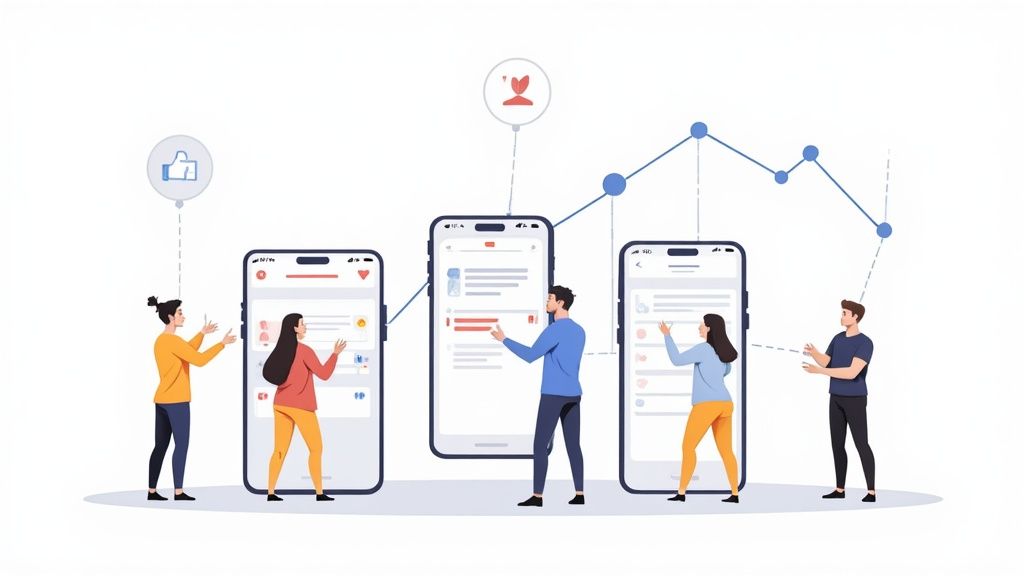
The best way to prevent churn isn’t by trying to win back a customer who’s already on the cancellation page. At that point, you’re playing defense with the clock running out. The real win comes from building an early warning system that spots at-risk customers based on how they use (or don’t use) your product, giving you a chance to step in while you can still make a difference.
Reading the Digital Body Language
Think of your customer engagement data as their “digital body language.” A user who was a daily power user and now only logs in once a week is sending a clear, if quiet, signal that something’s changed. This is where a customer health score becomes your most valuable tool. It isn’t just one metric; it’s a blended score that gives you a fuller picture of a customer’s satisfaction and churn risk.
A solid health score usually pulls from several key areas:
- Product Usage: Are they using the core features that deliver value? How frequently?
- Engagement Frequency: How many times did they log in this month compared to the last? Is the trend going up or down?
- Support Interactions: A sudden flood of support tickets can signal deep frustration with your product.
- Value Realization: Are they completing the key actions that help them achieve their goals? For example, are they running reports, inviting teammates, or finishing setup?
Tracking these signals is the first step toward a proactive strategy. There are many ways to spot these issues, and you can learn more about identifying churn risk in SaaS to develop a more complete model for your own business.
To make this more concrete, let’s break down what goes into a customer health score and how to interpret the signals. The table below outlines common metrics, their associated risk levels, and when to intervene.
Customer Health Score Components and Churn Risk Indicators
| Metric Category | Specific Indicators | Risk Level | Intervention Timing | Success Rate |
|---|---|---|---|---|
| Product Usage | Drop in core feature usage by >75% | High | Within 24-48 hours | ~60% |
| Engagement Frequency | Login frequency decreases by 50% over 30 days | Medium | Within 3-5 days | ~45% |
| Support Interactions | 3+ negative-sentiment support tickets in one week | High | Immediate (within hours) | ~70% |
| Value Realization | Key setup milestones incomplete after 14 days | High | Within first 2 weeks | ~55% |
| Account Activity | Team member invitations have stopped or slowed | Low | Monthly or quarterly check-in | ~30% |
As the table shows, the key is to tailor your response to the specific risk indicator. A quick, helpful response to a frustrated user is entirely different from a gentle nudge for a customer who is slowly drifting away.
From Data to Actionable Alerts
Simply collecting this data isn’t enough; you have to turn it into action. This is where automated alerts come in. Set up triggers for when a customer’s health score dips below a certain threshold. For instance, if a healthy score of 90 suddenly drops to a worrying 60, it should immediately ping your customer success team.
But the alert itself needs to be more than just a red flag. An alert that says “Customer at risk” is just noise. A truly useful alert provides context, like: “John Smith’s feature usage dropped by 50%, and he hasn’t logged in for 10 days.” Now your team has the information they need to personalize their outreach.
Proactive Intervention Strategies
Armed with these specific insights, your team can shift from putting out fires to preventing them. Instead of waiting for an angry email, they can start the conversation. If a customer has stopped using a key reporting feature, a success manager could send a personal email with a short video highlighting a new, time-saving update to that exact feature.
For a customer whose engagement has fallen off a cliff, a simple, non-salesy check-in can be incredibly effective. Something as straightforward as, “Hey, I noticed you haven’t been around as much lately. Is there anything we can help with?” often opens the door to addressing the root cause of the issue. This human touch is one of the most powerful tools you have to reduce subscription churn.
Creating Customer Experiences That Naturally Prevent Churn
Predictive analytics are great for sounding the alarm on churn, but the best strategy is to stop the fire before it even starts. Customers rarely cancel because of a single bad day. It’s usually a slow burn—a gradual erosion of value caused by unmet expectations and frustrating moments.
The road from a happy customer to a churned one is paved with these small gaps in their experience. It’s less about grand, sweeping gestures and more about getting the little things right where enthusiasm can fade.
Pinpoint the Leaks in Your Customer Journey
Think about it: the decision to cancel is never made on the cancellation page itself. That’s just the final click. The real choice was made weeks, or even months, earlier—during a confusing onboarding, a clunky feature interaction, or after a dead-end support ticket. These are the moments that truly matter.
For many SaaS businesses, the data tells a clear story. Users who fail to complete key setup tasks within their first 7 days are a staggering 80% more likely to churn in the first three months. That’s not a hunch; it’s a massive red flag pointing directly at your onboarding process. By mapping out the entire customer journey, from the first sign-up to their one-year anniversary, you can spot exactly where these enthusiasm-draining leaks occur.
Turn Customer Insights Into Action
Spotting the problems is just the first half of the puzzle. The real magic happens when you use those insights to make meaningful improvements. When customers see you actively fixing the things that frustrate them, you stop being just another service provider and become a genuine partner in their success.
It’s all about delivering value long after the initial sign-up excitement wears off. Instead of waiting for customers to run into trouble, get ahead of it with proactive support and smart personalization. You can even explore proven email strategies for re-engaging SaaS customers who are showing signs of drifting away.
Here are a few practical ideas:
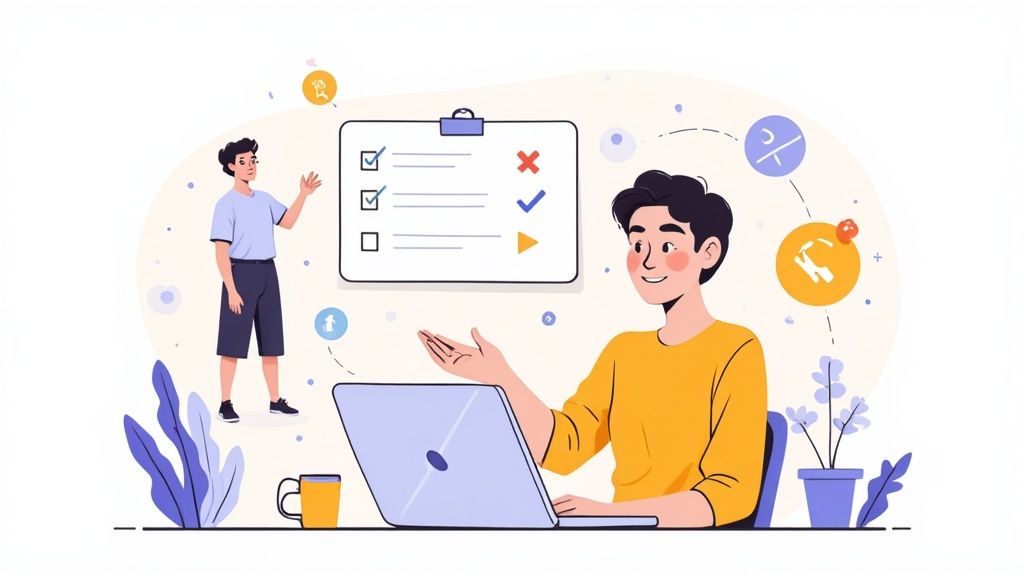
- Proactive Onboarding: Don’t just throw new users in the deep end. Guide them with a clear setup checklist or a short, personal welcome call to help them score an early win with your product.
- Continuous Value Delivery: Regularly ship small feature updates that directly address common user requests. Sharing useful content that helps them do their job better also goes a long way.
- Personalized Communication: Use customer behavior to make your outreach feel personal, not robotic. A simple message like, “Hey, we noticed you use feature X a lot. You might love this new update we just pushed for it,” shows you’re paying attention.
At the end of the day, building an experience that prevents churn isn’t a side project—it’s a fundamental part of your business. It’s the most reliable way to reduce subscription churn because it creates deep-seated loyalty that you don’t have to constantly fight to maintain.
Advanced Retention Tactics for High-Value Subscriptions
When you’re dealing with high-value B2B subscriptions, you can toss the standard consumer churn playbook right out the window. Losing a single enterprise client can punch a serious hole in your monthly recurring revenue. Retention stops being a numbers game about mass-market tactics and becomes all about building deep, strategic relationships.
It’s not enough to have a great product. You need to become a vital part of your client’s daily operations. This shift in thinking is the key to successfully reduce subscription churn when the stakes are this high.
Build Stickiness Through Account Expansion
One of the best ways to make your service “sticky” is to push for smart account expansion. This is more than just upselling them to a more expensive plan. It’s about getting your solution woven into the fabric of different departments across the client’s company.
Let’s say your reporting software is a big hit with their marketing team. That’s your foothold. Your next move is to find a champion within that team who can help you introduce the tool to the sales and operations folks.
Once you do that, you’re no longer just “the marketing team’s tool.” You become a central hub for their cross-functional work. The more people and departments rely on your service to get their jobs done, the harder it is for the company to even think about churning.
Create Meaningful (and Healthy) Switching Costs
As you build that stickiness, your goal is to create healthy switching costs. Let’s be clear: this isn’t about trapping customers with tricky contracts. It’s about making your service so essential that leaving would cause a major operational headache. This is especially important in the B2B SaaS space, where every account matters.
Recent data shows the average churn rate for B2B SaaS companies sits around 3.5%, with voluntary churn accounting for 2.6% of that. That might sound small, but every lost enterprise client represents a significant chunk of revenue. You can explore the full B2B churn benchmarks here to see how you stack up.
You can build these natural barriers to leaving by:
- Developing deep integrations with the other software they can’t live without.
- Becoming the single source of truth for their valuable historical data.
- Creating custom-built workflows that are perfectly matched to how their teams work.
When your platform holds years of project data or is the engine behind their custom financial reports, you’ve moved beyond being just another vendor. You’re a true partner. Retaining these high-value accounts means transforming the relationship from a simple service provider to an irreplaceable part of their success.
Think of it as building a moat around your service—one that’s filled with genuine, integrated value, not contractual obligations. When you succeed, it means that even if a competitor shows up with a lower price, the sheer hassle and operational cost of switching just isn’t worth it for your client.
Your Complete Implementation Roadmap
Knowing the theory behind churn is great, but putting a real plan into action is where you’ll see results. Instead of trying to fix everything at once, it’s better to tackle it in phases. This way, you can score some quick wins while you build toward a long-term, retention-focused culture. Your budget and team size will set the pace, but this framework is a solid starting point for any business.
Quick Wins to Implement This Week
Let’s start with the low-hanging fruit. These are actions that require little to no engineering time but can start plugging revenue leaks right away.
- Audit Your Dunning Emails: Pull up your automated payment failure emails and read them out loud. Do they sound helpful and human, or demanding and robotic? A simple shift in tone to be more empathetic can make a huge difference in how many customers update their card information.
- Implement a Simple Exit Survey: When a customer clicks the cancel button, ask them one single, open-ended question: “If you don’t mind sharing, what’s the main reason you’re leaving?” The honest feedback you’ll get is pure gold for figuring out what to fix first.
Medium-Term Improvements for Lasting Change
Once you’ve handled the most obvious issues, it’s time to dig into more strategic projects. These take a bit more planning but help create a stronger customer experience that encourages loyalty.
- Map the First 30 Days: Get your team together with a whiteboard and map out every single touchpoint a new customer has with your product and company. Where do they get confused? When do they have that first “aha!” moment? Your goal is to eliminate friction and highlight the value they get early on.
- Develop a Basic Health Score: You don’t need a complicated algorithm to get started. Begin by tracking just 2-3 key engagement metrics, like how often a user logs in or if they’re using your main features. This gives your customer success team a proactive list of people to reach out to before they become disengaged.
Long-Term Retention Optimization
This is the long game: weaving retention into the very fabric of your company. Real, sustainable churn reduction is a cultural shift, not just a checklist of tactics. It means making retention a shared goal for every department, from product and marketing to customer support.
It’s about building a product that solves a core problem so well that leaving feels like a major step backward for the customer. This vision is what turns a good business into a great one.
Don’t let manual payment recovery slow you down. Stunning automates the whole process, from smart retries to personalized dunning, so your team can focus on these bigger strategic goals. Start recovering more revenue today.
