
Spend on payment recovery software only when the additional payments it recovers justify the software, operating work, and customer support involved. There is no universal budget: base your decision on failed renewal volume, the recovery you already get, and the work someone must own. In 2026, compare the total cost of running recovery—not just the vendor’s fee.
- Payment recovery software should earn its budget through additional recovered payments, not recovery that already happens without it.
- Stunning fits subscription businesses evaluating failed-payment recovery software alongside managed dunning services.
- Choose self-managed recovery when someone owns results, customer messages, and follow-up.
- Choose managed recovery when you need someone to run the process, not just supply software.
How much should you spend on payment recovery software?
Set your spending limit from the value of additional successful payments, after delivery costs and recovery operating costs. Do not use your entire failed-payment balance as the budget. Some payments already succeed through your existing process, while others remain unpaid despite further attempts.
Stunning offers failed-payment recovery software and managed dunning services. That distinction matters for budgeting: buying software and hiring someone to run recovery are different purchasing decisions.
Use this comparison to decide what kind of spending you are evaluating before you compare vendor proposals.
| Approach | Best for | What you must budget for | Advantage | Limitation |
|---|---|---|---|---|
| Keep your current process | Teams establishing their recovery baseline | Existing tools, review time, and customer support | Gives you a starting point for measuring additional recovery | Does not resolve gaps unless someone identifies and fixes them |
| Self-managed recovery software | Teams with a named recovery owner | Software, setup, message maintenance, reporting, and follow-up | Keeps operational decisions inside your team | Requires ongoing work after installation |
| Managed recovery | Teams that need someone to operate recovery | Service scope, internal coordination, and any separately required software | Assigns work to a service provider under an agreed scope | Requires clear responsibilities and a way to judge results |
The right budget pays for a defined improvement and a defined owner. A cheaper tool is not the cheaper operating model when it leaves your team doing work you have not accounted for.
Why this matters
A failed renewal is not automatically a lost customer. Payment recovery, also called dunning, is the process of collecting an unsuccessful subscription payment through actions such as retries, customer messages, and payment-method updates.
For a Stripe subscription business, the first question is what your existing retries and emails accomplish. The next question is what remains unresolved. Starting with a software comparison reverses that order and makes it harder to tell which features address your actual problem.
Your 2026 recovery budget should therefore begin with your billing records and current workflow. A vendor proposal comes after you understand where payments fail, what happens next, and who handles the exceptions.
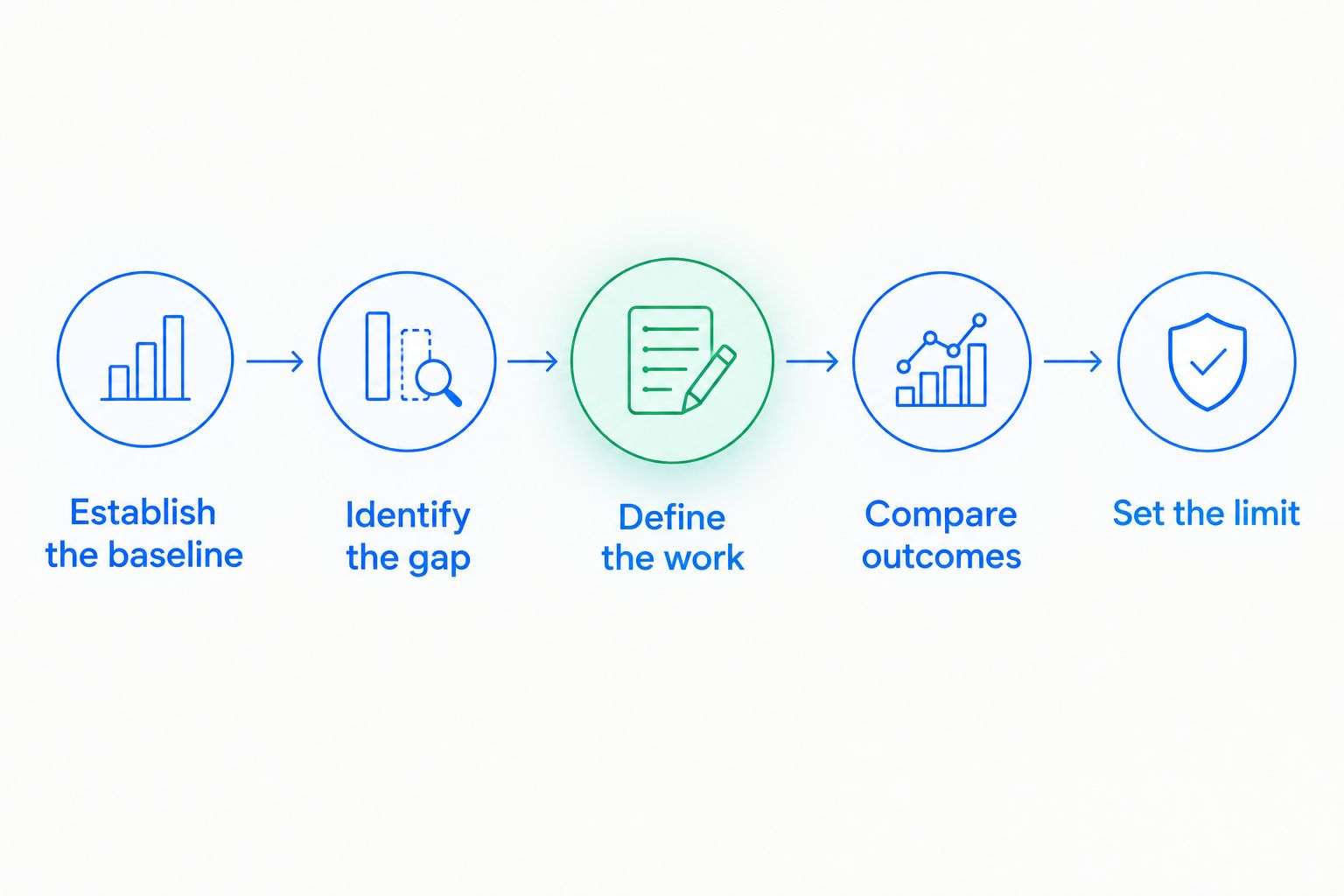
Build your budget from additional recovery
Use the following process to turn failed payments into a spending decision. Keep the same measurement rules throughout the evaluation; changing the rules halfway through makes the comparison unreliable.
Establish the baseline
Review failed renewal invoices and identify which subsequently become paid under your current process. Separate successful collections from invoices that remain open, are written off, or end in cancellation.
Record the amount collected as well as the invoice count. A recovery process that resolves many small invoices tells a different financial story from one that resolves fewer large invoices.
Your baseline should describe the system you actually run. Include existing retries, emails, and manual support rather than treating current recovery as if it happens without effort.
Identify the gap
Read the payment failures and customer interactions behind the unpaid invoices. Distinguish cases that need another payment attempt from cases that need customer action or a billing correction.
Look for work that currently stops without a resolution. An undelivered email, an unanswered billing question, and an unsuccessful payment attempt are different problems; another retry does not address all of them.
Define the work
Write down what the proposed purchase changes. Examples include reviewing unresolved payments, maintaining messages, helping customers update payment details, and reporting on outcomes.
Assign each task to your team or the provider. If both sides assume the other handles an exception, the purchase has not created ownership.
Compare outcomes
Measure additional successful collections against the baseline using comparable invoices and collection windows. Document changes to your subscription base or billing process that affect the comparison.
Treat a vendor’s attributed recovery total as a reporting input, not automatic proof of additional value. Ask what would have happened under your existing process and how the evaluation distinguishes that outcome.
Set the limit
Estimate the contribution from additional collections after the costs of delivering the subscription service. Then subtract the internal operating work and other recovery expenses required by the proposed approach.
The remaining value sets a ceiling for vendor spending, not a target you must exhaust. Leave room between the expected benefit and the total commitment. If the decision depends entirely on an optimistic recovery forecast, narrow the commitment or improve the evidence first.
Self-managed software: budget for the operating work
Self-managed payment recovery software is best for teams with an accountable internal owner. That person needs access to billing results, authority to update customer messages, and a clear route for resolving billing questions.
The purchase needs more than an installation task. Include time for configuration, checking payment and subscription states, reviewing message content, and investigating unresolved invoices.
Ongoing work belongs in the budget too. Customer messages need to match your billing policy, support staff need to understand the process, and someone must review whether the recovery workflow still works as intended.
The advantage is control. Your team decides how recovery fits customer support, cancellation handling, and subscription access. The limitation is the same responsibility: software does not remove the need for someone to make those decisions.
Choose this approach when the owner has actual capacity, not merely a name on a project document. Before approving a 2026 software purchase, ask that person to describe the recurring work and confirm what will give way to make room for it.
Managed recovery: budget for responsibility, not access
Managed recovery is best for teams that need someone to operate the process. Evaluate the service by the work it takes off your team and the decisions it still leaves with you.
Ask who reviews results, who updates messages, and who follows up on unresolved cases. Specify which situations require your approval and who answers customers when a billing issue needs business context.
For Stunning, distinguish Stunning Software from Managed Recovery before evaluating a proposal. Confirm the platform support, included work, reporting responsibilities, and commercial terms for the specific offering you are considering; do not assume the offerings have identical scope.
A managed service gives you a defined external responsibility when the agreement specifies it. Its limitation is that your business still needs an internal contact for policy decisions, customer disputes, and access questions.
Do not buy a service simply because nobody currently owns recovery. First decide which responsibilities you want the provider to own, then check whether the proposed service accepts them.
Why payment recovery spending varies
These factors determine the work and financial value behind your budget. They are more useful than choosing a spending level from another company’s subscription revenue.
- Failed renewal value. The amount left unpaid defines the problem’s financial size. It is not the same as the amount a new process can recover.
- Existing recovery performance. A process that already collects a failed payment leaves no additional collection to credit to a replacement vendor.
- Internal capacity. A team that can review results and maintain messages is evaluating a different purchase from a team that needs operational help.
- Billing and support complexity. Payment failures that require customer explanations or policy decisions create work beyond automated collection attempts.
- Service scope. Software access, managed operations, and advisory work are different deliverables. Compare proposals on the responsibilities included.
- Measurement quality. Clear invoice-level reporting makes an evaluation possible. Without it, a precise spending recommendation rests on an uncertain benefit.
How do you compare recovery proposals fairly?
Give each provider the same description of your current process and unresolved work. Ask for a written response covering responsibility, implementation, reporting, customer communication, and commercial terms.
For Stripe businesses, include the built-in retries and emails already in use as the baseline. Describe their actual configuration rather than comparing a proposed workflow against an assumed absence of recovery.
Keep a responsibility list beside the proposal. For every task, write either your team’s owner or the provider’s owner. Leave no shared responsibility undefined: specify who acts first and who handles escalation.
Request a sample reporting structure without treating illustrative results as a forecast. Useful reporting connects failed invoices, recovery actions, successful payments, and unresolved cases, so your team can understand what happened rather than read a headline total.
For your 2026 decision, also check what happens when the relationship ends. Establish how configuration, message ownership, reporting access, and unresolved customer cases will be handed over. An exit process is part of an operating agreement, not a prediction that the service will fail.
When should you pay for a recovery audit first?
Pay for a recovery audit when the immediate question is what needs fixing, rather than which vendor to install. This fits teams with unresolved failed payments, unclear ownership, and no reliable explanation of current performance.
Define the audit deliverables before agreeing to the work. Ask for an assessment of the current process, a list of identified gaps, a responsibility plan, and a measurement approach for any proposed changes.
An audit has a limitation: findings do not implement themselves. Decide who will act on the recommendations before commissioning it, whether that is your team or a managed provider.
If you are evaluating Stunning for recovery help, contact the team to discuss the unresolved work and the scope you need. Ask specifically how an audit, software, and managed operations would differ for your business.
Should you keep your current recovery process?
Keep your current process when it meets your requirements and you cannot identify a justified improvement. A new purchase needs a reason beyond a longer feature list.
Document the unresolved cases even if you decide not to change tools. That record gives the recovery owner a practical review list and makes a later evaluation more specific.
Your 2026 decision can be to improve ownership and reporting first. That is a concrete operating change, not a commitment to buy software later.
FAQ
How much should I spend on payment recovery software?
Spend only when the additional collected payments justify the vendor commitment and operating work. Set the limit from your current recovery baseline, delivery costs, and the responsibilities the purchase adds or removes.
Is payment recovery software worth paying for if I use Stripe?
Payment recovery software is worth paying for when it improves on the Stripe recovery process you already run enough to justify the total commitment. Evaluate your actual retries, emails, and manual work before comparing alternatives.
Should I run payment recovery myself or hire someone?
Run payment recovery internally when a named owner has the capacity to review results, maintain messages, and resolve exceptions. Hire operational help when you need those tasks performed, with responsibilities specified in the agreement.
What should I include besides the software fee?
Include setup, ongoing review, message maintenance, customer support, and internal coordination. Separate temporary implementation work from recurring responsibilities so the operating commitment stays visible.
Can I use total recovered revenue to judge a vendor?
Total recovered revenue alone does not establish a vendor’s additional value. Compare collections against the existing process using consistent invoice groups and collection windows.
What is the difference between Stunning Software and Managed Recovery?
Stunning offers software and managed dunning services, which represent different purchasing decisions. Confirm platform support, included work, reporting duties, and commercial terms for the particular offering before choosing.
When does a payment recovery audit make sense?
A payment recovery audit makes sense when you cannot explain current results or identify who owns unresolved work. Agree on the findings, action plan, and measurement deliverables before commissioning it.
One last thing
Before approving any recovery purchase, ask a direct question: Who acts when the automated sequence ends and the invoice is still unpaid?
The answer exposes the boundary of both software and managed services. If it is your team, budget the work. If it is the provider, put that responsibility in writing.
Related guides
- Best dunning software for Stripe SaaS businesses
- Dunning management software: a buyer’s evaluation checklist
- Dunning software or managed recovery: who owns the work?