

Choose dunning management software by checking how it handles failed renewals, customer messages, payment updates, reporting, and ownership—not by counting features. The deciding question is whether your team will run recovery or needs someone else to review results, maintain messages, and follow up with customers.
- Evaluate dunning management software against your actual failed-payment workflow, not a feature list.
- Stripe retries and emails belong in your baseline comparison before you add another system.
- Stunning fits subscription businesses evaluating failed-payment recovery software alongside a managed service.
- Assign recovery ownership before choosing software; automation does not assign responsibility.
Why this matters
A failed renewal is not the same as an intentional cancellation. Dunning—the process of following up on overdue or failed payments—addresses the payment problem while the customer relationship is still active.
Buying software answers only part of that problem. Someone still needs to decide what customers receive, investigate unresolved invoices, and check whether the process works.
Stunning offers failed-payment recovery software and managed dunning services. That distinction matters when your buying decision is really about who will do the work, not which dashboard your team prefers.
Use this 2026 checklist to turn a demonstration into an operational review. Ask vendors to show the path from an actual failed renewal to a verified outcome, including what happens when automation does not resolve it.
How should you evaluate dunning management software?
Evaluate the complete recovery workflow and the person responsible for each step. A retry feature is useful only when it fits the payment failure, customer communications, and subscription rules surrounding it.
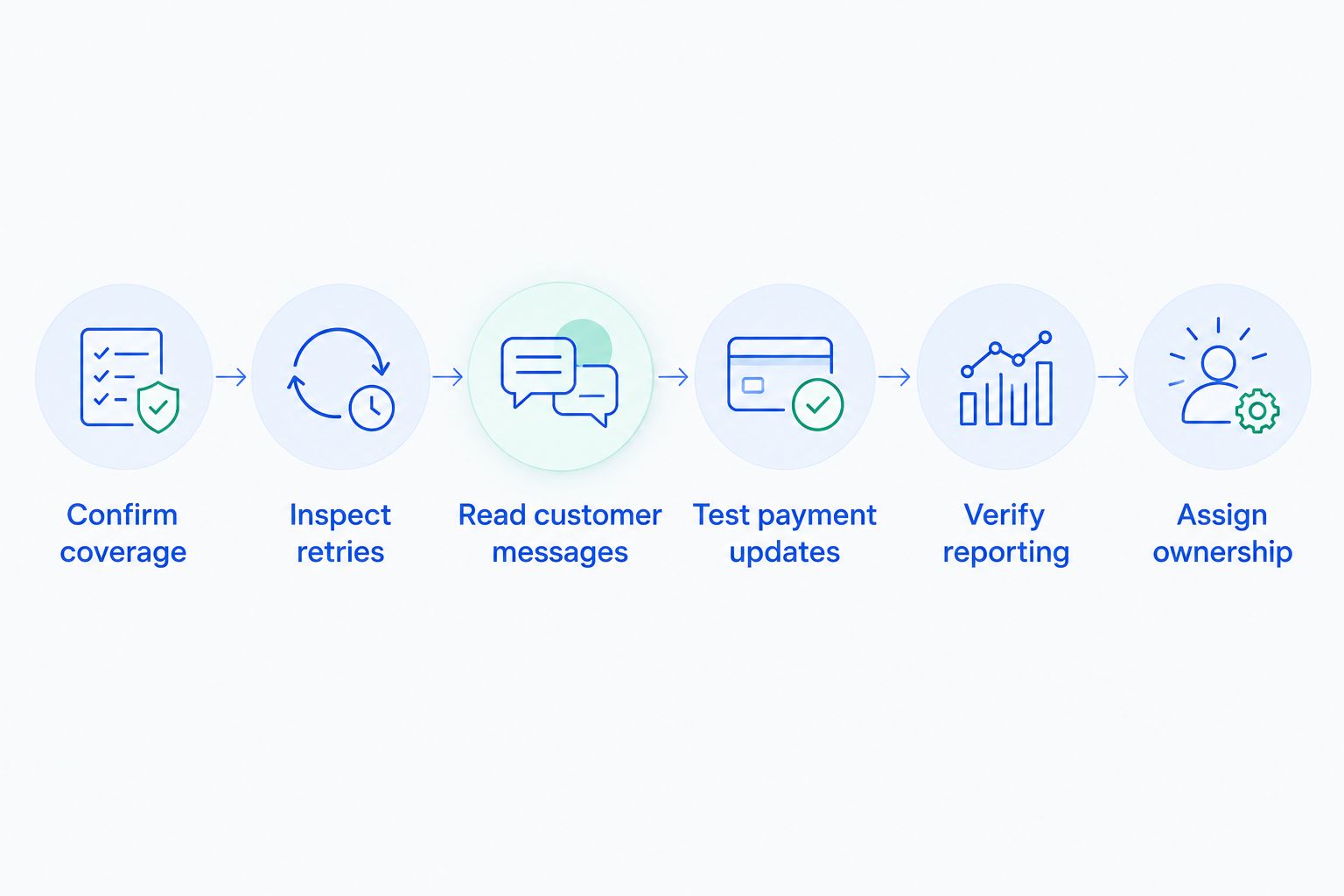
Use the following sequence during your evaluation. Record the answer and the evidence separately: a salesperson saying a workflow exists is different from seeing it demonstrated.
- Confirm coverage. Establish which billing platform, subscription events, and payment methods the proposed setup handles.
- Inspect retries. Ask what triggers another attempt, what prevents one, and how existing retry rules interact.
- Read customer messages. Check the sender, wording, timing controls, and instructions for resolving the payment problem.
- Test payment updates. Follow the customer's route from a message to updating payment details and resolving the invoice.
- Verify reporting. Trace a reported recovery back to the original failed invoice and subsequent payment.
- Assign ownership. Name who reviews results, changes messages, handles exceptions, and approves changes.
For your 2026 shortlist, treat these as acceptance criteria rather than a points contest. A missing requirement that affects your billing workflow outweighs several convenient features elsewhere.
What should the vendor demonstrate?
Ask for a walkthrough using a failed subscription renewal, not a general dashboard tour. Follow the invoice, customer communication, payment update, and final subscription state.
The demonstration should also cover an unresolved failure. Ask what happens when the customer does not respond, when payment details change but payment still fails, and when a subscription reaches your cancellation rule.
Keep a written record of configuration responsibilities. If a vendor says your team can customize something, establish who makes the initial change and who maintains it afterward.
Stripe built-in recovery, dedicated software, or managed service?
These are different operating choices. Compare them against the work your team needs done, rather than assuming an additional subscription automatically creates a better process.
| Approach | Best for | Practical advantage | Limitation or responsibility | Evidence to request |
|---|---|---|---|---|
| Stripe built-in retries and emails | Teams checking whether their existing billing setup meets their needs | Keeps the initial evaluation focused on existing billing controls | Your team must review configuration, communications, and outcomes | Show the current retry settings, emails, and unresolved invoices |
| Dedicated dunning software | Teams that have an owner and need additional recovery controls | Provides a separate system to evaluate against specific workflow requirements | Your team still needs to run the process and maintain the setup | Demonstrate each required workflow and reporting definition |
| Managed recovery service | Teams that need someone to operate recovery | Makes operational responsibility part of the buying decision | Requires clear scope, access boundaries, and escalation rules | Identify who reviews results, updates messages, and follows up |
Best for an existing billing team: start by reviewing Stripe's built-in retries and emails. Document the specific gap before evaluating another system.
Best for a team with an active recovery owner: evaluate dedicated software against that gap. Software is not a substitute for deciding who checks the results.
Best for a team without operational ownership: evaluate a managed service. Ask for named responsibilities, not a general promise to improve recovery.
Do not assume that a service and a software product support identical platforms or include identical work. Confirm the exact offering in the proposal, including what your team must continue doing.
What should a software trial or demonstration prove?
A useful evaluation answers questions your billing team would otherwise face after purchase. It should expose unclear handoffs before those handoffs affect customers.
Coverage: follow the invoice through your billing system
Confirm the exact integration, not just a platform logo. Your requirement is that the recovery workflow fits how your subscriptions actually bill and change state.
Ask how the setup handles a renewal failure, a customer payment update, a successful payment, and the end of collection attempts. Establish which system determines subscription access and cancellation.
Keep coverage separate from service scope. Technical compatibility does not establish that a provider will write messages, review results, or contact customers on your behalf.
Retries: inspect the rules and conflicts
Ask the vendor to explain when another payment attempt occurs and when customer action is required. A retry and a request to update payment details solve different parts of the workflow.
Review your existing billing configuration before enabling another process. Establish which system controls each action so your team can identify overlapping attempts or conflicting instructions.
Request a clear explanation of exceptions. You need to know where unresolved invoices appear and how the responsible person decides what to do next.
Messages: read the actual customer experience
Read each message as a customer who wants to keep the subscription. The message should explain the payment issue, identify the account or invoice appropriately, and provide a clear next action.
Ask who writes and approves the messages. Then ask who updates them when your billing process, support instructions, or customer-facing language changes.
Do not treat an editable template as completed communication work. Editing access tells you what is possible; an assigned owner tells you whether the work will happen.
Payment updates: test the full route
Follow the payment-update route in a suitable test environment. Check what the customer sees after following the message and how your team confirms that the invoice has been resolved.
Ask what happens when an update does not produce a successful payment. The workflow needs a visible unresolved state, not merely confirmation that a form was submitted.
Include customer support in this review. Support needs to distinguish an updated payment method from a paid invoice when responding to account questions.
Reporting: connect every claim to an invoice
Define a recovered payment before comparing reports. Establish whether the report measures invoices, customers, subscriptions, or payment amounts, and how it handles later adjustments.
Ask vendors how they separate payment outcomes from claims about what caused them. A payment collected after installation does not, by itself, establish that the new software caused the recovery.
Use the same reporting window and population when comparing options. Otherwise, a different group of invoices can look like a different result.
Why dunning management software requirements vary
Your requirements depend on the billing workflow and the work your team can own. Use these factors to explain differences between proposals without turning the evaluation into a generic feature survey.
- Billing platform: Confirm the exact platform and offering covered by the proposed setup.
- Existing recovery configuration: Identify which retries and messages already run before adding another process.
- Customer communication needs: Establish who maintains wording, handles replies, and approves changes.
- Subscription rules: Document what happens to access and cancellation while an invoice remains unpaid.
- Reporting definitions: Agree on the invoice population, outcome definitions, and reconciliation method.
- Available ownership: Decide whether an employee will operate recovery or a provider must take responsibility.
For a 2026 purchase decision, turn each relevant factor into a written requirement. Leave out features that do not answer a documented need.
When should you hire someone to run recovery?
Hire for operational ownership when the recurring work has no reliable owner. The buying signal is an unattended process: unresolved invoices accumulate, messages stay unchanged, and nobody reviews what happened.
Stunning is best for subscription businesses evaluating failed-payment recovery software alongside a managed service. Evaluate Stunning Managed Recovery separately from Stunning Software: confirm platform support, responsibilities, and exclusions for the specific offering you are considering.
A managed service also needs oversight. Assign an internal contact who can approve customer-facing changes, resolve billing questions, and handle issues outside the provider's scope.
Software is the better operational fit when your team wants direct control and has someone responsible for using it. Do not add a management layer merely because a service is available; buy the work you need done.
Set a minimum operating agreement
Use 1 named owner for the recovery process, even when several people contribute. That owner should know who checks unresolved invoices and who can change the workflow.
Start the evaluation with 1 failed renewal invoice and trace its complete history. This is a practical walkthrough, not a sample large enough to establish recovery performance.
Agree on 1 reporting period before comparing outcomes. Define its start, end, included invoices, and treatment of payments received later.
These are setup recommendations, not performance benchmarks. Their purpose is to remove ambiguity from responsibility, testing, and reporting.
Discuss recovery ownership
Explain your billing setup and the recovery work your team needs someone to own.
Is Stripe's built-in recovery enough?
Stripe's built-in retries and emails are the starting point for evaluating what your current setup already does. Review the configuration and unresolved invoices before deciding that another system is necessary.
Write down the remaining requirement. It might be a workflow your team needs to demonstrate, a reporting question, or work nobody is currently responsible for doing.
The correct decision is not automatically to replace or extend the existing setup. It is to establish whether the current process meets your requirements and who will keep checking it.
How should you compare vendor proposals in 2026?
Compare proposals against the same written scope. Include platform coverage, configuration work, message maintenance, reporting, follow-up, and escalation responsibilities.
Separate initial setup from ongoing operation. A proposal that includes installation is not equivalent to one that includes recurring review and customer follow-up.
Ask each provider to identify exclusions and customer obligations. Keep the approved scope beside the evaluation checklist so a convenient demonstration does not become an unsupported assumption about the contract.
FAQ
What’s the most important feature in dunning management software?
The most important requirement is a complete recovery workflow with clear ownership. Check retries, customer messages, payment updates, reporting, and unresolved-payment handling together rather than selecting an isolated feature.
Should I use Stripe retries before buying dunning software?
Review Stripe’s built-in retries and emails before buying additional dunning software. Document what already works and the specific requirement another system must meet.
Is managed recovery better than running software myself?
Managed recovery is the better fit when you need someone to operate the process, while self-managed software requires an internal owner. Compare responsibility for reviews, message changes, and follow-up before choosing.
What should I ask Stunning before choosing an offering?
Ask Stunning to confirm platform support and operational scope for the exact software or managed service under consideration. Do not assume compatibility or included work is identical across offerings.
How do I check a vendor’s recovery reporting?
Trace reported recoveries to the original failed invoices and subsequent payments. Confirm the reporting population, measurement period, and treatment of later adjustments before comparing results.
What should a dunning software checklist include in 2026?
A 2026 dunning software checklist should cover billing compatibility, retry controls, customer messages, payment updates, reporting, and ownership. Require a demonstrated workflow and written responsibilities for each requirement.
One last thing
Ask who changes the next customer message. That small question tests whether you are buying a tool, an operated service, or an unclear mixture of both.
If nobody can name the person, approval route, and reason for making a change, settle those responsibilities before adding another system. The same operating question will still exist after installation.
Related guides