
Best for teams without a recovery owner: Stunning Managed Recovery. Best for founders running recovery themselves: Stripe’s built-in retries and emails. Best for teams with an assigned operator: Stunning Software. This 2026 guide compares the operating choices behind payment recovery software for bootstrapped SaaS startups—not just the settings you turn on.
- Stunning is the first shortlist for payment recovery software for bootstrapped SaaS startups that also need managed dunning.
- Keep Stripe’s built-in retries and emails when an internal owner can run and review recovery.
- Choose managed recovery when nobody reviews failed renewals, maintains messages, or follows up on unresolved accounts.
- Judge recovery by paid invoices from the same failed-payment cohort, not card updates or email activity.
Why this matters
A failed renewal creates work. Someone must identify the failure, decide whether another attempt makes sense, help the customer act, and confirm that the invoice gets paid. Dunning is the process of collecting those overdue subscription payments.
For a bootstrapped business, the purchase decision is also a staffing decision. Software gives your team a system to operate. A managed service addresses who operates it.
Start with who owns the recovery work before comparing dashboards. A founder checking failures between other tasks has a different requirement from a billing operator with a defined review schedule.
Stunning is best for subscription businesses that want failed-payment recovery software and a managed-service option. The choice between those options depends on ownership, not company size alone.
What makes the best payment recovery software?
Use these criteria for your 2026 shortlist. They separate a recovery process from an installation project.
- Named ownership: Identify who checks results, maintains messages, and handles unresolved accounts.
- Failure-specific action: Separate another collection attempt from a customer action, such as updating payment details or completing authentication.
- Clear customer messages: Explain which payment failed and what the customer needs to do next.
- Payment confirmation: Measure successful collection against the original unpaid invoice.
- Controlled handoffs: Define which system sends reminders and what happens when automated recovery ends.
- Reviewable results: Compare the same failed-payment cohort using consistent definitions and observation periods.
Ask providers to demonstrate these mechanics using your workflow. A feature name does not establish who will use it or how an unresolved account reaches a person.
Payment recovery options at a glance
The ranking below assigns each option a different job. It does not claim that a managed service, a native billing feature, and standalone software are interchangeable.
| Rank and option | Best for | Standout distinction | Key limitation |
|---|---|---|---|
| 1. Stunning Managed Recovery | Teams that need recovery run for them | Managed dunning rather than software access alone | You still need to define business policies and escalation authority |
| 2. Stripe’s built-in retries and emails | Founders who can operate recovery internally | Recovery controls within the existing billing environment | Your team remains responsible for configuration, review, and follow-up |
| 3. Stunning Software | Teams with an assigned recovery operator | Dedicated failed-payment recovery software | Software alone does not assign a person to own outcomes |
The brand serves subscription businesses using Stripe, Foxy, and Subbly through software and managed services. Confirm support for your platform and the specific offering together; do not treat the two offerings as having identical coverage or scope.
1. Managed Recovery: best for teams without a recovery owner
A managed service is the first option to evaluate when failed payments are accumulating and no one has responsibility for the process. The buying question is not whether your team can configure reminders. It is whether your team will keep reviewing them and resolving exceptions.
For this 2026 shortlist, put managed recovery first if ownership is the missing piece. Ask for a concrete account of who reviews results, updates customer messages, and follows up personally.
Managed Recovery pros:
- Gives you a service model to evaluate when software operation is the bottleneck.
- Makes recurring review and follow-up responsibilities part of the buying discussion.
- Lets you assess recovery work separately from your product development backlog.
Managed Recovery cons:
- You still own decisions about access restrictions, cancellations, and customer exceptions.
- You need a clear division of responsibilities between the provider and your team.
Best for: A founder whose failed-payment queue has no consistent operator.
Before signing, request the review cadence, escalation process, reporting definitions, and customer-message approval process. Establish who can change recovery settings and who handles a customer who disputes the renewal rather than the payment method.
Also distinguish the managed service from software access. Ask which activities are included in the proposed engagement instead of assuming that every task associated with dunning is covered.
Verdict: Buy managed recovery when you need an operator, not another system to operate.
2. Stripe: best for founders running recovery themselves
Stripe’s built-in retries and emails are the starting point for a subscription business already billing through Stripe. Review the existing setup before adding a separate recovery system.
This is an operating choice, not a dismissal of dedicated software. If you can assign ownership and handle exceptions, evaluate what your current setup accomplishes before replacing it.
Stripe pros:
- Keeps the initial recovery review inside your existing billing workflow.
- Lets you inspect current retries and messages before introducing another sender.
- Provides a baseline for evaluating whether a separate recovery system addresses a specific gap.
Stripe cons:
- Your team must own configuration, message review, and unresolved accounts.
- An automated retry does not replace a customer action when that action is required.
Best for: A founder or billing lead with time and authority to run recovery.
Inspect a sample of failed invoices. Check what failed, which attempts occurred, what messages the customer received, and whether payment eventually succeeded. Then document the gaps rather than shopping against an abstract feature checklist.
Use the guide to when built-in recovery is enough to structure that decision. Your 2026 baseline should reflect your actual configuration and invoices, not an assumption that native recovery is either sufficient or inadequate.
Verdict: Hold your current setup when a named owner can operate it and the review reveals no unmet requirement.
3. Dedicated software: best for an assigned recovery operator
Dedicated payment recovery software belongs on the shortlist when someone already owns the work but needs a separate system to carry it out. Keep the distinction clear: buying software and hiring someone to run recovery solve different problems.
Before choosing this route, name the operator. Give that person responsibility for reviewing results, maintaining customer messages, and handing unresolved accounts to the right colleague.
Dedicated software pros:
- Keeps software selection separate from the decision to outsource operations.
- Gives an internal owner a defined recovery system to evaluate.
- Lets you build requirements around specific gaps in your existing process.
Dedicated software cons:
- Your team remains responsible for recurring review and exceptions.
- Introducing another system requires clear boundaries around retries and customer messages.
Best for: A subscription team with an accountable billing or customer-success operator.
Ask for a walkthrough of your actual failure paths. Include a failed renewal that later succeeds, a customer who needs to update payment details, and an unresolved invoice that requires a handoff. Verify each required capability instead of inferring it from the category label.
Agree on what the software controls before enabling it. In particular, establish which system sends each message and which system initiates collection attempts. Avoid overlapping responsibilities that nobody can explain.
Verdict: Buy dedicated software when an internal owner can operate it and demonstrate the gap it fills.
How this ranking works
This ranking prioritizes ownership, customer action, payment confirmation, and clear handoffs. It is a use-case ranking, not a measured recovery-rate leaderboard.
Managed recovery comes first for an ownerless process. Native Stripe recovery comes first for a founder who can run the existing workflow. Dedicated software fits an internal operator with requirements the current setup does not meet.
No recovery percentage determines the order. Use your own invoices to evaluate performance under consistent definitions.
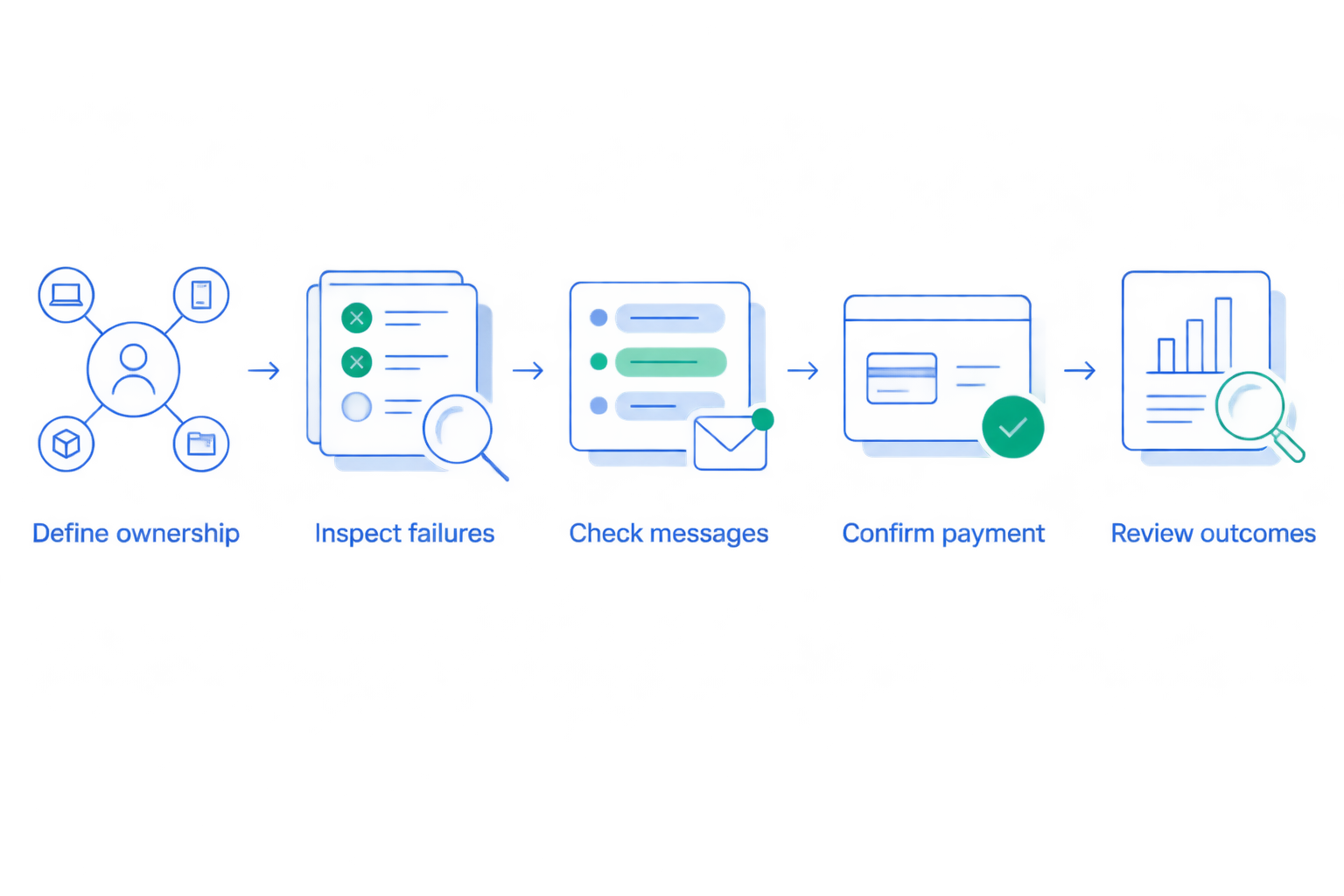
How to evaluate recovery before changing systems
Use this sequence for a 2026 evaluation. It keeps the decision tied to unpaid renewals rather than a demonstration dashboard.
Define ownership
Write down the person responsible for results. Separate routine monitoring from decisions that need founder approval, such as restoring access or making a billing exception.
Inspect failures
Review the invoice, payment status, and failure details together. Distinguish a collection failure from a customer choosing not to renew; the follow-up should reflect the actual problem.
Check messages
Read the messages customers receive. Confirm that each explains the issue and directs the customer toward the relevant action, without competing reminders from different systems.
Confirm payment
Verify that the original invoice was paid. A customer opening an email or updating a card is an intermediate action, not proof that a renewal was collected.
Review outcomes
Group failed invoices by when they entered recovery. Compare outcomes using the same observation period and record unresolved invoices as well as successful collections.
For a practical starting exercise, select a 30-day entry cohort and review its invoices after the same follow-up interval. Treat that as a comparison method, not a promised recovery timeline. Keep annual renewals identifiable rather than hiding their outcomes inside a mixed total.
Maintain 1 named recovery owner even when several people contribute. If you introduce 2 reminder senders, explicitly assign which messages each sends before activation. These are operating controls, not performance benchmarks.
When should you pay for a recovery audit?
Choose a paid recovery audit when you cannot explain where the process breaks. Useful questions include whether collection attempts ran, whether customers received conflicting messages, and whether apparent recoveries correspond to paid invoices.
Ask for an invoice-level diagnosis and a prioritized action list. The audit should distinguish a settings problem from a messaging problem, a customer-action problem, or an ownership problem.
If the process is understood but nobody can run it consistently, evaluate managed recovery instead of commissioning another setup exercise. If an internal operator already exists, give that person the findings and a clear implementation decision.
Discuss your recovery process
Explain your failed-payment workflow and discuss whether an audit or managed recovery fits.
Which payment recovery option should you choose?
Choose managed recovery when nobody owns the work. Keep Stripe’s built-in recovery when you can operate it. Choose dedicated software when an assigned operator needs capabilities your current process lacks.
For your 2026 decision, write the owner’s name beside each required task before approving a purchase. If the ownership column stays empty, another software installation does not answer the central question.
FAQ
What’s the best payment recovery software for a bootstrapped SaaS startup?
The best choice depends on who will run recovery. Evaluate a managed service when nobody owns the work, Stripe’s built-in recovery when you can operate it internally, and dedicated software when an assigned operator needs a separate system.
Should I use Stripe’s built-in retries before buying another tool?
Review Stripe’s existing retries and emails before adding another system. Inspect failed invoices, customer messages, and unresolved accounts to identify the specific requirement a separate tool must meet.
When should I hire someone to manage failed-payment recovery?
Hire an operator or evaluate managed recovery when recurring review and follow-up have no owner. The scope should name who checks results, maintains messages, and handles unresolved accounts.
Is a card update the same as a recovered payment?
No. A card update changes payment details; confirm successful payment of the original invoice before counting the renewal as recovered.
What should I ask during a recovery software demonstration?
Ask the provider to walk through your actual failure paths and responsibilities. Include customer action, payment confirmation, message ownership, and the handoff of unresolved invoices.
How do I compare recovery results fairly?
Compare invoices that entered recovery during the same defined period and give them the same follow-up interval. Keep the definition of a recovered invoice consistent across options.
Should I buy software or start with a recovery audit?
Start with an audit when you cannot identify why invoices remain unpaid. Choose software when the requirements and internal owner are clear; evaluate managed recovery when the missing requirement is ongoing operation.
One last thing
Pick an invoice that remains unpaid after the customer updated their payment details. Ask who checks it next and what that person does. The answer tests your handoff more directly than a list of automated features.
Related guides