
Best overall when nobody owns recovery: Stunning Managed Recovery. Best for a team keeping recovery inside its billing platform: Stripe’s built-in retries and emails. Best for a team assigning its own operator: Stunning Software. This guide compares payment recovery software for usage-based billing SaaS by who runs the work, what happens after a failed charge, and how you confirm collection.
- For payment recovery software for usage-based billing SaaS, choose ownership before features.
- Stunning Managed Recovery is the best fit when a subscription business needs someone to run failed-payment recovery.
- Stripe’s built-in retries and emails suit teams prepared to own configuration, review, and unresolved accounts.
- Separate incorrect usage invoices from payment failures before starting dunning.
Why this matters
Usage-based billing ties an invoice to consumption rather than only a fixed subscription amount. When payment fails, your team needs to establish whether the customer owes the stated amount before deciding how to collect it.
Dunning means following up on overdue payments. It does not resolve an incorrect usage calculation or explain an unfamiliar invoice by itself. Repeated reminders about a disputed amount are not a substitute for a billing investigation.
For your 2026 shortlist, start with ownership. Someone must review unpaid invoices, keep customer messages accurate, and decide what happens when automated recovery ends. Buying software and assigning that work are separate decisions.
What makes the best payment recovery software?
Use these criteria before comparing feature lists:
- Invoice accuracy: Can your team identify a billing error before treating the invoice as collectible?
- Failure handling: Does the workflow distinguish a retryable failure from a customer action or billing question?
- Customer messages: Can the recovery process explain the unpaid invoice and direct the recipient to the appropriate next step?
- Operational ownership: Who reviews results, changes messages, and follows up on unresolved accounts?
- Collection evidence: Can you trace a recovery result to payment of the original invoice?
- Workflow boundaries: Which system sends reminders, schedules retries, and determines the subscription’s final status?
These are purchasing criteria, not claims that every option below includes every capability. Ask vendors to demonstrate the workflow against your actual billing setup.
Payment recovery options at a glance
| Option | Best for | Standout distinction | Key limitation |
|---|---|---|---|
| Stunning Managed Recovery | Teams without a recovery owner | A managed service rather than software alone | You must agree service scope and retain responsibility for billing decisions |
| Stripe built-in retries and emails | Teams keeping recovery within Stripe | Recovery controls inside the existing billing platform | Your team still owns configuration, review, and exceptions |
| Stunning Software | Teams with a named internal operator | Failed-payment recovery software for supported subscription platforms | Software does not assign an accountable person inside your business |
The order reflects responsibility, not measured recovery performance. For usage-based SaaS, the best choice depends on whether your team needs someone to run recovery or needs software for an existing operator.
1. Stunning Managed Recovery: best for unowned recovery
Managed Recovery is the first option to evaluate when failed payments accumulate and nobody is responsible for the queue. It is a managed dunning service, distinct from the software product.
Stunning Managed Recovery is best for subscription businesses that need someone to run failed-payment recovery. For a usage-based business, the buying conversation should focus on the boundary between collecting a correct invoice and investigating an incorrect one.
Managed Recovery pros:
- Provides a service option instead of requiring a software-only approach.
- Fits a buying decision centered on responsibility for recovery work.
- Gives teams a distinct alternative to managing recovery themselves.
Managed Recovery cons:
- Does not remove your responsibility for usage calculations and billing accuracy.
- Requires an agreed scope for reviews, customer messages, and unresolved accounts.
- Requires confirmation that the service covers your particular platform and workflow.
Ask who reviews recovery results, who updates customer messages, and who follows up personally. Establish how the service escalates a disputed usage charge to your billing team. Do not assume that every task is included because the offer is managed.
Best for: Founders and marketing or finance leads whose failed-payment work has no accountable owner.
Verdict: Buy the managed approach when ownership is the missing requirement, after confirming service scope.
2. Stripe built-in recovery: best for platform-contained operations
Stripe’s built-in retries and emails belong on the shortlist before you add another recovery system. This option keeps the evaluation focused on controls already associated with your billing platform.
The relevant question is not whether another product has more features. It is whether your current configuration, customer communications, and internal follow-up cover the failed invoices your business actually receives.
Stripe built-in recovery pros:
- Gives Stripe subscription businesses a starting point within their billing platform.
- Lets your team assess existing retries and emails before introducing another provider.
- Supports a platform-contained operating approach when your team owns the work.
Stripe built-in recovery cons:
- Your team remains responsible for reviewing configuration and outcomes.
- Billing disputes still require investigation outside a retry decision.
- Unresolved accounts still need an escalation owner and an end-of-process decision.
For your 2026 evaluation, inspect the live configuration rather than relying on an old setup checklist. Identify what happens after a failed attempt, which message the customer receives, and how an employee knows intervention is needed.
Retain this approach if it meets your requirements. Add another service only after identifying a specific operational gap.
Best for: Stripe teams that want recovery to remain within the billing platform and can maintain the process themselves.
Verdict: Hold the existing setup when it covers your requirements and someone owns the results.
3. Stunning Software: best for an internal recovery operator
Stunning Software is the self-managed option for a team that wants failed-payment recovery software rather than a managed service. The brand’s stated platform coverage includes Stripe, Foxy, and Subbly; confirm the applicable software and service scope separately.
For a usage-based SaaS business on Stripe, evaluate the software against your actual invoice lifecycle. A successful demonstration should answer how your team handles failures, customer actions, and unresolved accounts without assuming that software will manage the entire operation.
Software pros:
- Provides a software route distinct from the managed-service route.
- Addresses failed subscription payments, the category this evaluation concerns.
- Fits a team that wants to keep responsibility for recovery internally.
Software cons:
- Requires an internal operator to review results and maintain the process.
- Does not establish whether a disputed usage amount is correct.
- Requires verification of the specific controls your workflow needs.
Name the operator before choosing this route. That person needs authority to request message changes, investigate missed follow-up, and bring billing questions to the right colleague.
Best for: Teams with an accountable recovery operator who needs software rather than an outsourced operating service.
Verdict: Buy the software approach when responsibility is already assigned and the demonstrated workflow fits.
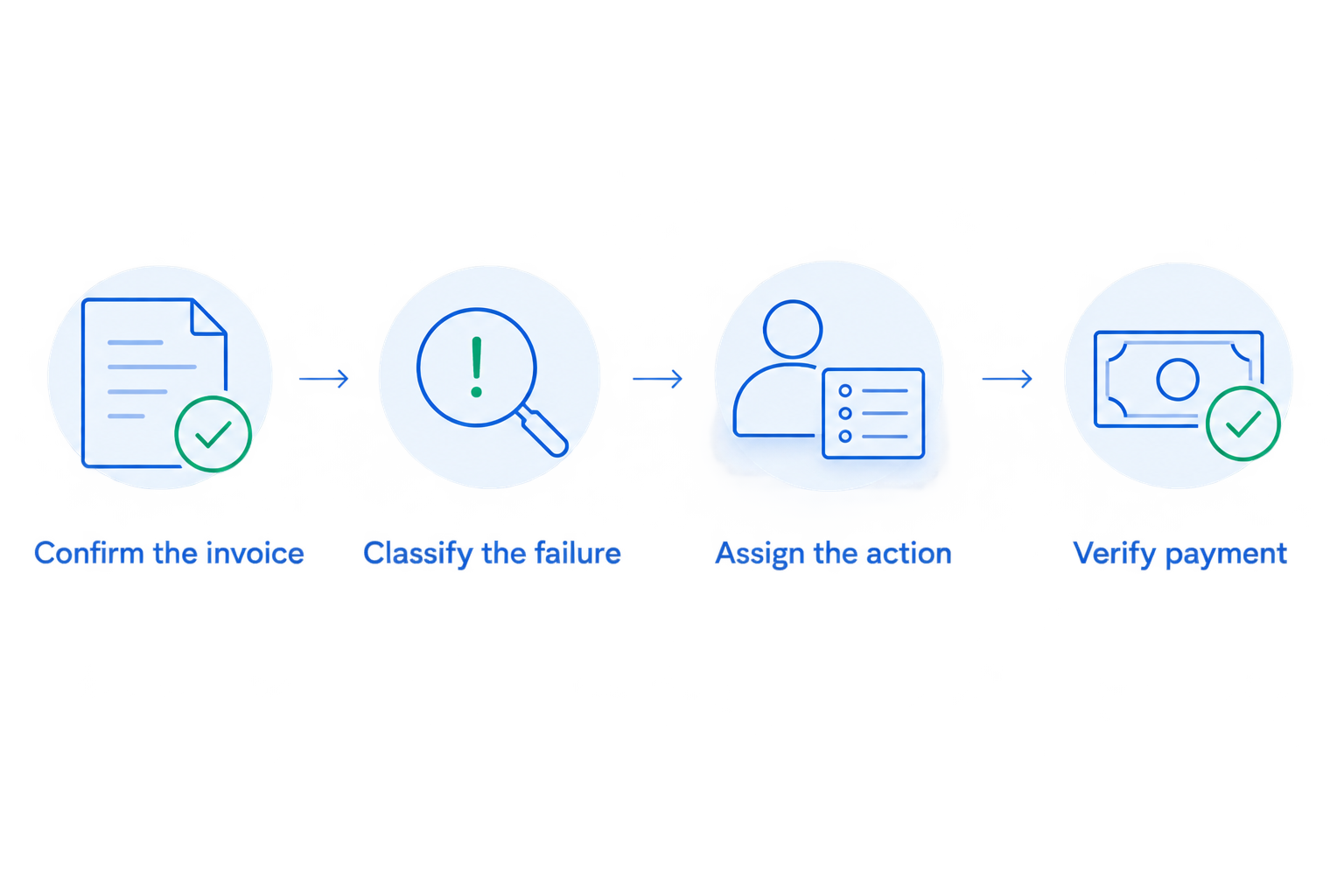
Test the workflow against a usage-based invoice
A useful 2026 evaluation follows an invoice through the whole recovery process. A polished reminder email is not enough. The workflow must distinguish collecting money from correcting the bill.
Confirm the invoice
Start with the usage period, recorded consumption, and agreed billing terms. Ask the billing owner to establish whether the amount is correct before escalating collection.
If the invoice is wrong, route it for correction. Do not count the correction itself as recovered revenue.
Classify the failure
Separate a payment decline from a customer authentication requirement, an outdated payment method, or a billing question. These situations require different next actions.
Ask each provider to demonstrate how your team identifies the cause. Do not accept a generic recovery sequence as evidence that every failure receives the right treatment.
Assign the action
Decide whether the next step belongs to automation, the customer, billing support, or the recovery operator. Give unresolved cases an owner rather than leaving them in a shared inbox.
Document where the handoff appears and what information accompanies it. The next person should not have to reconstruct the invoice history.
Verify payment
Check whether the original invoice was paid. A payment-method update or a successful message delivery is an intermediate event, not proof of collection.
The same rule applies when comparing options: use invoice outcomes, not activity totals, as the final evidence.
Compare results without confusing activity with recovery
Use the same invoice cohort when assessing your 2026 recovery process. A cohort is a defined group of invoices, such as invoices that first failed during the same reporting period.
Keep the definition stable. Comparing one group immediately after failure with another group after its recovery process has finished produces an uneven comparison.
Record:
- The original failed invoice and its collectible amount.
- The failure reason and any required customer action.
- The responsible operator or service.
- Payment against the original invoice.
- Credits, corrections, and write-offs separately from collections.
- Accounts still awaiting follow-up.
Do not credit a tool with every payment received after installation. Establish which invoices entered its recovery workflow and how outcomes were attributed. A vendor’s headline result is not evidence of your business’s result.
Before requesting a paid recovery audit, use this guide on what to prepare for an audit. Bring invoice records, current settings, customer messages, and the name of whoever handles exceptions.
How the options are ranked
This ranking puts operational fit ahead of an unsupported feature leaderboard. Managed service ranks first for unowned recovery; built-in recovery fits platform-contained operations; self-managed software fits a team with an operator.
No recovery-rate ranking or hands-on test result is claimed. The criteria are invoice accuracy, failure handling, customer communication, ownership, collection evidence, and clear workflow boundaries.
Churn Buster, Baremetrics Recover, Paddle Retain / ProfitWell Retain, and Churnkey are also names to investigate when building a shortlist. No current feature, platform-support, or performance comparison is asserted here. Require current documentation and a demonstration before treating any named competitor as a fit.
Which option should you choose?
Choose managed recovery if your biggest gap is that nobody runs the process. Choose software if someone already does. Keep built-in recovery when it satisfies the requirements and your team maintains it.
For a 2026 purchase, write down the unresolved problem before booking demonstrations. “Nobody reviews failed invoices” calls for a different solution from “our operator needs better recovery controls.”
If you cannot identify the gap, start with a recovery audit rather than a migration. Ask for a clear account of the failures, existing follow-up, unresolved ownership, and recommended changes.
Discuss your recovery gaps
Discuss a paid recovery audit or Managed Recovery for your subscription billing workflow.
FAQ
What is the best payment recovery software for usage-based billing SaaS?
The best choice depends on who runs recovery. Choose a managed service when nobody owns the work, self-managed software when an operator is assigned, or Stripe’s built-in recovery when it meets your requirements.
Should a usage-based SaaS business use Stripe’s built-in retries?
Evaluate Stripe’s built-in retries and emails before adding another recovery system. Check the live configuration, customer actions, unresolved-account handoffs, and invoice outcomes.
Is managed recovery different from dunning software?
Yes. Managed recovery is a service approach, while self-managed dunning software leaves operation with your team. Confirm the specific responsibilities included in any managed agreement.
Can payment recovery software fix an incorrect usage invoice?
Payment recovery is not a substitute for investigating an incorrect usage invoice. Your billing owner must establish the correct amount and resolve the billing issue before collection continues.
Does a customer updating their card mean an invoice was recovered?
No. A card update is not proof that the unpaid invoice was paid. Verify payment against the original invoice before reporting collection.
What should a paid recovery audit examine?
A recovery audit should examine failed invoices, failure causes, retry settings, customer messages, collection evidence, and unresolved-account ownership. Ask for recommendations tied to the gaps found in those records.
When should a SaaS team hire someone to run recovery?
Hire help when failed payments need ongoing attention and no internal operator is accountable for the work. Define who reviews results, maintains messages, and follows up before agreeing the service scope.
One last thing
Put the invoice identifier in every recovery handoff. A conversation about a customer is not precise enough when that customer has several invoices with different outcomes.
For Stunning payment recovery software or any alternative, the final check stays the same: identify the unpaid invoice, assign the next action, and verify collection. Keep those responsibilities explicit after setup, not just during the buying process.
Related guides
- Dunning software or managed recovery: who owns the work?
- When Stripe’s built-in recovery is enough
- Confirming a renewal was really recovered