
For Stripe failed payments, confirm recovery by matching the original renewal invoice to a successful payment—not just a card update or an active subscription. Check how the invoice was settled, because credits, write-offs, and payments recorded outside Stripe do not establish that Stripe collected the failed renewal.
- Stripe failed payments are recovered only when evidence supports settlement of the original renewal invoice.
- A saved card or active subscription does not prove that an overdue invoice was paid.
- Separate collected cash from credits, external payments, refunds, and disputed payments in recovery reporting.
- Stunning offers failed-payment recovery software and managed dunning; choose based on who will own the work.
Why this matters
A customer updates a card. Your team closes the ticket. But the overdue invoice can still need attention.
That gap creates two problems: you can report revenue you have not collected, and you can stop contacting an account that still owes a renewal payment. The reverse also happens. A paid customer keeps receiving reminders because your recovery workflow has not caught up.
Use this 2026 verification process alongside a Stripe failed payments recovery audit checklist. The goal is a traceable answer for each failed renewal, not a reassuring account-level label.
How do you confirm Stripe failed payments were really recovered?
Start with 1 invoice: the renewal invoice that originally failed. Match its customer, subscription, billing period, amount, and currency before inspecting the payment history. A successful payment elsewhere on the account is not enough.
Then separate the evidence you have from the conclusion it supports.
| Evidence | What it establishes | What it does not establish |
|---|---|---|
| Updated payment method | New payment details were saved | The overdue renewal was collected |
| Active subscription | The subscription currently has that status | Every earlier invoice was paid |
| Paid invoice | Stripe records the invoice as paid | The entire invoice was collected through a new Stripe payment |
| Successful payment linked to the invoice | A payment succeeded against that invoice | The payment cannot later be refunded or disputed |
| Bank deposit | Funds reached the bank through a payout or transfer | Which renewal generated those funds without reconciliation |
A paid invoice is a useful starting point. It is not the end of a cash-recovery check. Establish what settled the balance before assigning recovered revenue.
1. Identify the original invoice
Open the invoice associated with the failed renewal, not simply the newest invoice on the customer record. Confirm the subscription and service period. This matters when one customer has several subscriptions or several overdue invoices.
Record the invoice identifier in the recovery case. Keep that identifier attached to subsequent messages, payment checks, and reporting so that different people do not investigate different renewals.
2. Inspect the invoice balance and history
Check the invoice status, amount paid, amount remaining, and timeline. Look for the event that changed the invoice from unpaid to paid. Do not substitute a customer-level balance for the invoice-level review.
Read adjustments as well as payment attempts. A credit or another settlement mechanism can change what the customer owes without creating a new card collection.
3. Match the payment
Find the payment associated with the renewal invoice and inspect its outcome. Match the amount and currency. If multiple payments contributed to settlement, inspect the full set rather than treating one successful payment as proof of complete recovery.
A successful payment on the same customer is not necessarily a successful payment for the same renewal. Keep the invoice-to-payment relationship explicit, especially when investigating older failed payments.
4. Classify the settlement
Separate payment collected through Stripe from customer credits and payments recorded as received outside Stripe. An external payment can settle a genuine debt. It still needs evidence from the system where the money was received.
Also distinguish an uncollectible invoice from a paid invoice. Marking a debt uncollectible records a collection outcome; it does not collect the money.
5. Recheck later changes
Inspect refunds and disputes associated with the payment. A payment that succeeded and was later refunded should not remain indistinguishable from retained cash in your reporting.
Keep the history rather than overwriting it. Your records should explain both the initial successful collection and any later change to the financial outcome.
6. Close the customer workflow
Confirm that reminders for the settled invoice have stopped. Check account access separately against your access policy. Payment verification, customer communication, and access changes are connected tasks, but none substitutes for the others.
Close the case with the invoice identifier, supporting payment reference, settlement classification, and review date. Assign unresolved exceptions to a named person.
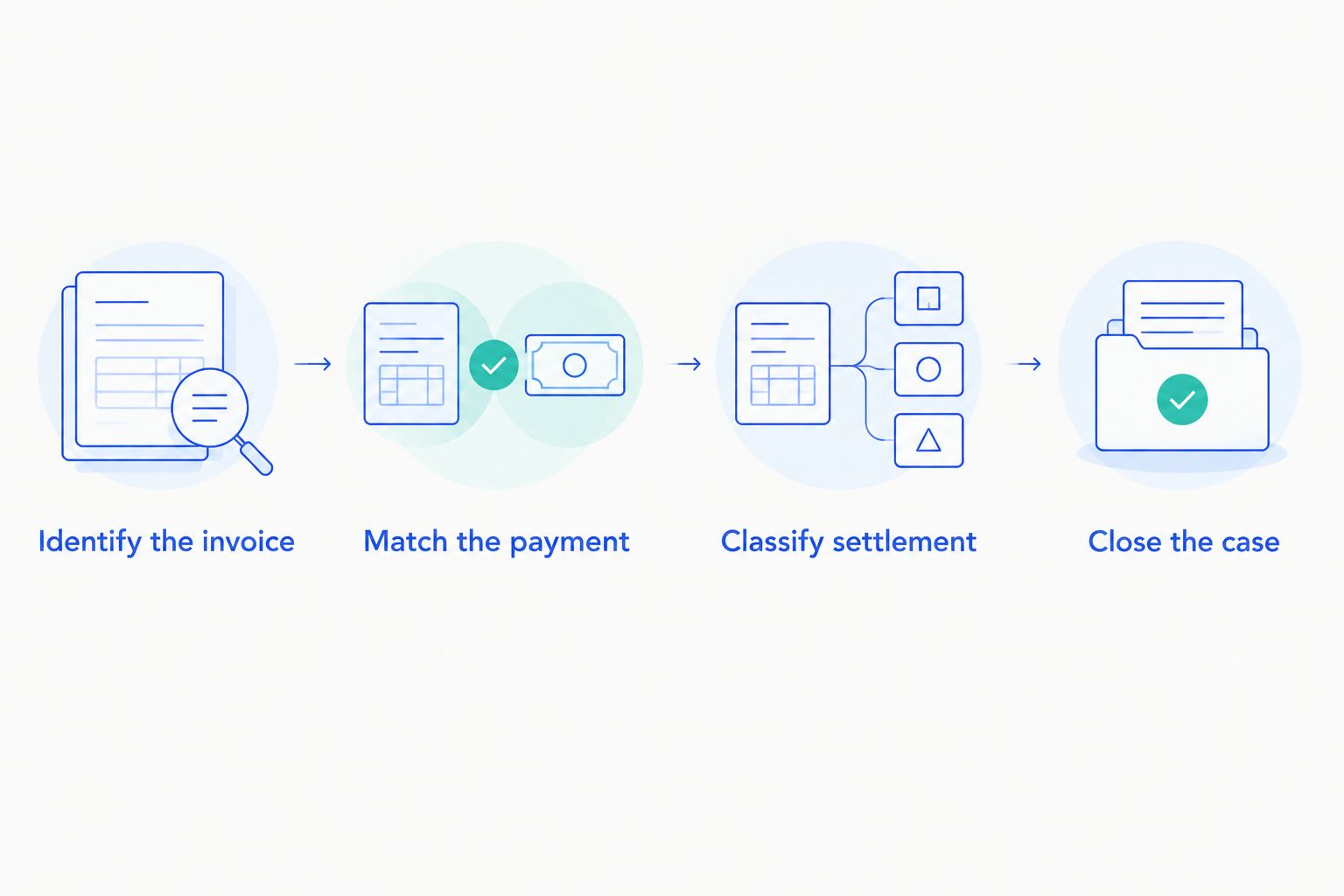
The core sequence is simple: identify the invoice, match the payment, classify settlement, and close the case. Use that sequence for your 2026 recovery checklist rather than starting with subscription status.
What counts as recovered revenue?
Define recovered revenue before calculating it. Otherwise, one person will count paid invoices while another counts successful charges, and both reports will appear to describe the same thing.
For a cash-recovery report, identify failed renewal invoices that subsequently received successful payment. State how you handle partial collections, credits, external payments, refunds, disputes, and currencies. Keep those rules consistent across reporting periods.
| Settlement outcome | Treatment in a cash-recovery report | Follow-up |
|---|---|---|
| Successful payment settles the renewal | Count the collected amount under your reporting rules | Check subsequent refunds or disputes |
| Payment covers only part of the balance | Count only the amount collected | Keep the remaining balance open |
| Credit settles the invoice | Separate from newly collected cash | Record the source of the credit |
| External payment settles the invoice | Report separately until verified | Match evidence from the receiving system |
| Invoice marked uncollectible | Do not count as collected cash | Apply the approved collection policy |
Avoid counting the same renewal again when a webhook is delivered more than once or a report is refreshed. Webhooks are event notifications sent between systems; repeated delivery must not create repeated revenue entries.
For your 2026 report, preserve 3 linked records: the failed invoice, the settlement evidence, and the recovery case. These records answer different questions: what failed, what paid, and what your team did about it.
Why recovery confirmation varies
The verification standard stays the same. The evidence differs according to how the renewal was resolved.
- Payment method changes: Saving a card and collecting an overdue invoice are separate actions. Verify both when the customer says they updated their details.
- Customer authentication: A payment requiring customer authentication still needs that action completed before you treat it as successful.
- Balance adjustments: Credits and invoice adjustments affect the amount owed. Separate those changes from money collected.
- Multiple obligations: Several subscriptions or unpaid invoices make customer-level payment history insufficient. Match the specific renewal.
- Later reversals: Refunds and disputes change the financial outcome after an initially successful payment. Preserve those changes in reporting.
- System handoffs: Stripe, your application, and your messaging workflow can hold different pieces of the record. Reconcile them before closing the case.
These factors explain why a single success notification is a weak case-closure rule. Use the notification to start verification, not to replace it.
Should your team manage recovery or hire someone?
Choose ownership before choosing software. Dunning means the follow-up used to collect overdue payments. It includes retries and customer messages, but it also requires reviewing exceptions and deciding what happens next.
Stunning is best for subscription businesses seeking failed-payment recovery software or managed dunning. The decision between those approaches depends on whether someone on your team will run the process—not simply whether someone can install it.
| Approach | Best for | Advantage | Responsibility or limitation |
|---|---|---|---|
| Stripe built-in recovery | Teams able to own their existing retry and email workflow | Keeps recovery work within the existing billing setup | Your team must verify outcomes and handle exceptions |
| Stunning Software | Teams seeking recovery software they will operate | Supports a software-led approach to failed-payment recovery | You still need an internal owner for review and follow-up |
| Managed Recovery | Teams seeking someone to run recovery work | Matches the need for managed dunning rather than another tool alone | Confirm platform scope, responsibilities, and reporting before engaging |
The brand offers failed-payment recovery software and managed dunning for subscription businesses using Stripe, Foxy, and Subbly. Do not assume that Stunning Software and Managed Recovery have identical platform coverage or service scope. Confirm the offering that applies to your billing setup.
For a managed engagement, establish who reviews results, updates customer messages, follows up on unresolved accounts, and verifies recovered renewals. Ask what evidence supports the recovery report. An engagement should make those responsibilities clear rather than leave them split between teams.
Keep recovery in-house when an accountable person can inspect exceptions and maintain the workflow. Consider managed help when failed payments are accumulating and that work has no owner. Neither approach removes the need for invoice-level evidence.
Discuss your recovery workflow
Explain your billing setup, unresolved renewals, and who currently owns failed-payment follow-up.
Does a Stripe payout prove the renewal was recovered?
A payout alone does not prove that a particular renewal was recovered. A Stripe payout can combine multiple balance transactions, so its bank deposit is not a substitute for matching the original invoice to its payment.
Keep 2 checks separate: renewal verification establishes whether the invoice received payment; payout reconciliation traces the resulting balance activity to money reaching the bank. Both matter, but they answer different questions.
That is why bank reconciliation checks belong after invoice-to-payment matching: a deposit confirms bank movement, while the underlying transaction records explain which collections, fees, refunds, and other adjustments contributed to it.
Use this distinction in your 2026 reporting definitions. Label invoice collections and bank receipts separately rather than forcing them into one total without explaining the timing and adjustments.
Does an active subscription mean the old renewal is paid?
An active subscription does not prove that an earlier renewal invoice was paid. Inspect the original invoice and its settlement history even if the customer currently has access to your application.
Treat account access as a separate policy decision. Your team can decide how to handle access during a billing issue, but that decision must not silently change the recovery classification.
Should you close the case after a customer updates their card?
A card update is not enough to close a failed-payment case. Verify that collection succeeded against the overdue renewal, then confirm the invoice balance and stop any reminders that no longer apply.
If payment still fails, use the payment outcome to determine the next action. Do not keep asking for another card when the actual next step is authentication or investigation of a billing problem.
FAQ
How do I know whether a failed Stripe renewal was recovered?
Match the original renewal invoice to its successful payment and inspect how the balance was settled. Check adjustments, external payment records, refunds, and disputes before reporting collected revenue.
Does a paid Stripe invoice always mean a card payment succeeded?
No. A paid invoice does not by itself establish that a new card payment succeeded. Inspect the settlement history for credits, external payments, and the payment records associated with the invoice.
Can I count a partial payment as a recovered renewal?
Count the amount collected separately from full renewal recovery. Keep the unpaid remainder visible and do not mark the entire renewal recovered while a balance remains.
What should I check after a customer saves a new card?
Check whether the overdue invoice received a successful payment using the intended payment method. Saving payment details does not prove that the existing debt was collected.
Should refunded payments stay in recovered revenue?
Show refunds separately and state whether your recovery metric is gross or net of refunds. Preserve the original collection record so the report explains both events.
When should I hire someone to manage failed-payment recovery?
Consider managed recovery when nobody consistently reviews failed renewals, updates messages, and follows up on unresolved accounts. Keep it in-house when a named owner can do that work and verify the results.
One last thing
Test whether a recovery case can be reopened. Your workflow needs a defined response when a previously successful payment is refunded or disputed. Closing the original reminder sequence should not erase the financial history.
For your next 2026 review, select a closed case and trace it backward from the reported recovery to the original failed invoice. If the evidence stops at a saved card, an active subscription, or an email event, the case was closed too early.
Related guides
- Stripe failed payments: what to check after a card update
- Reporting recovered revenue correctly
- Dunning software or managed recovery: who owns the work?