
Choose Stunning if failed subscription payments need a recovery owner; choose Chargebee Retention if your priority is the cancellation experience for customers who want to leave. This 2026 comparison separates payment recovery from cancellation prevention, then explains when to buy software and when to hire someone to run recovery.
- Stunning vs Chargebee Retention starts with failed-payment recovery versus cancellation prevention—not a shared recovery-rate leaderboard.
- Choose Managed Recovery when failed payments need an operator, not just another software installation.
- Choose Chargebee Retention for a cancellation-focused evaluation when customers actively request to leave.
- Compare paid invoices and retained subscriptions separately; they measure different outcomes.
Why this matters
A customer with an unpaid renewal has a different problem from a customer asking to cancel. The first needs a successful payment. The second needs a reason to continue subscribing.
Dunning means following up on overdue or failed payments. That work includes reviewing failures, maintaining customer messages, and deciding which unresolved accounts need personal attention. Cancellation prevention addresses the customer's decision to leave.
Stunning is the better fit for subscription businesses seeking failed-payment recovery software or managed dunning. Chargebee Retention belongs in an evaluation centered on voluntary cancellation. Neither outcome should substitute for the other in your reporting.
Before choosing a product in 2026, identify which queue is growing: unpaid renewals or cancellation requests. Then identify who owns that queue. A purchase without an owner leaves the operating problem unresolved.
At a glance
| Dimension | Stunning | Chargebee Retention |
|---|---|---|
| Best for | Subscription businesses addressing failed payments | Subscription businesses addressing cancellation intent |
| Failed-payment focus | Direct match for payment recovery and dunning | Evaluate separately from cancellation prevention |
| Cancellation focus | Not the reason to select its payment-recovery offering | Direct match for cancellation-focused retention |
| Operating ownership | Software and Managed Recovery are distinct choices | Establish who will operate the retention program |
| Platform fit | Brand serves Stripe, Foxy, and Subbly businesses; confirm support by offering | Confirm compatibility with your billing and cancellation setup |
| Evidence required | Successful payments tied to failed renewals | Continued subscriptions following cancellation intent |
| Standout distinction | Option to evaluate managed dunning alongside software | Focus on the decision to cancel |
| Pricing model | Compare software scope with managed-service scope | Confirm the current charging basis and included scope |
Best for: match the purchase to the customer's problem
Your starting point should be a customer event, not a feature list. Look at what happened immediately before the account entered your retention queue.
- Best for failed renewals: payment recovery software or a managed dunning service. The customer owes a renewal payment that has not succeeded.
- Best for cancellation requests: Chargebee Retention. The customer has expressed an intention to stop subscribing.
A business can have both problems. That does not make the products interchangeable or establish that you need both.
Start your 2026 evaluation with a 30-day sample of failed renewals and cancellation requests. Keep the groups separate. Examine the value at risk, the work already happening, and the unresolved cases before deciding which problem deserves the next purchase.
Failed-payment recovery wins when the renewal remains unpaid
Payment recovery starts with an outstanding payment. A retry, customer message, payment-method update, or personal follow-up is useful only insofar as it helps resolve that payment.
The strongest reason to select a recovery-focused offering is operational fit. You need a process that connects the original failure to its eventual outcome. An opened email or updated card is an intermediate event, not proof that the renewal was paid.
Use these questions to define the work:
- What caused the payment to fail?
- What should happen automatically?
- Which cases require a customer response?
- Who handles accounts that remain unresolved?
- How will the team confirm successful collection?
The limitation is equally clear: recovering a payment does not resolve dissatisfaction with the product. Keep cancellation feedback and payment failures connected at the account level, but separate in your performance reports.
Chargebee Retention wins when the customer asks to cancel
Chargebee Retention is the more relevant option when your project concerns customers actively choosing to leave. That is a different starting point from an overdue renewal.
For a cancellation-focused evaluation, ask how the proposed setup fits your cancellation journey and how your team will assess continued subscriptions afterward. Require a demonstration using your actual cancellation scenarios rather than treating a general product presentation as acceptance testing.
The advantage is focus: your evaluation centers on the customer's decision to leave. The boundary is measurement. A customer who continues a subscription after requesting cancellation is not automatically a recovered failed payment.
For your 2026 buying decision, define success before reviewing offers. If the objective is collecting unpaid invoices, keep the evaluation anchored to collections. If the objective is addressing cancellation intent, keep it anchored to continued subscriptions and subsequent billing outcomes.
Managed Recovery fits an ownership gap; software fits an operator
Software and a managed service solve different staffing problems. Software gives an internal operator a system to use. A managed service is the relevant option when you want someone else to run an agreed scope of recovery work.
The brand offers Stunning Software and Managed Recovery. Do not assume their responsibilities or platform support are identical. Confirm each offering against your billing setup and the work you want handed over.
Choose software when a named person will review results, maintain messages, and handle exceptions. Choose a managed-service evaluation when those tasks remain unassigned or repeatedly fall behind.
A practical recovery operating cycle has these responsibilities:
- Review failures: inspect unresolved payments and identify the next action.
- Update messages: keep instructions accurate and relevant to the failure.
- Follow up: assign cases that need personal attention.
- Confirm payment: verify the renewal was actually paid.
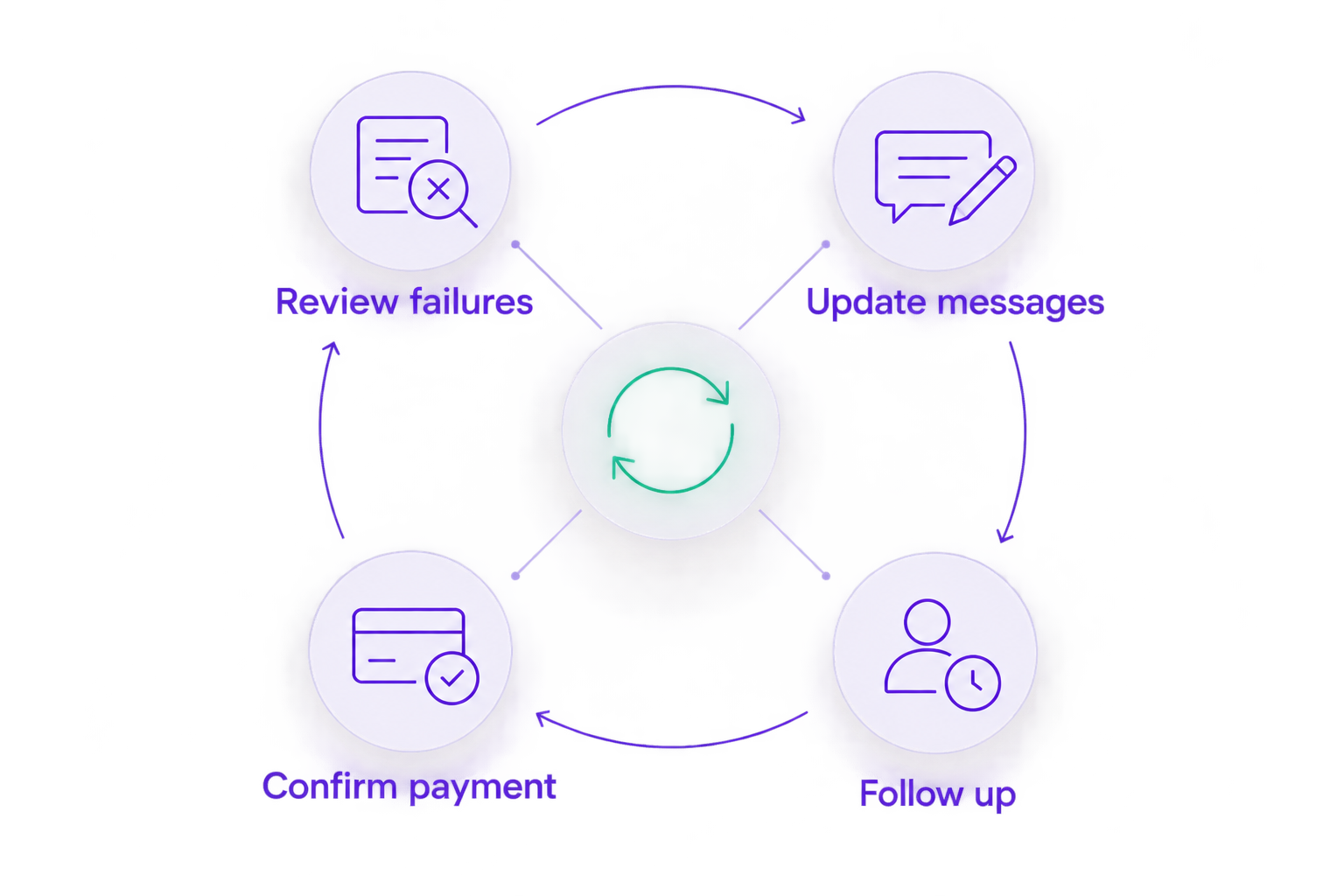
Use those responsibilities as a service discussion agenda. Ask who performs each task, what remains with your team, and how exceptions are handed back. Do not treat installation assistance as evidence that ongoing operations are included.
For an internal program, schedule a 15-minute weekly exception review as a starting practice. For a managed program, agree on the review and escalation process before signing. The purpose is explicit ownership, not a meeting for its own sake.
Platform fit is a qualification gate, not a winner
The brand serves subscription businesses using Stripe, Foxy, and Subbly. That company-level description does not establish that every offering supports every platform in the same way.
For either vendor, write down the systems involved in your current workflow:
- The system creating renewal invoices.
- The system attempting payment.
- The source of customer billing details.
- The place customers request cancellation.
- The system controlling subscription status and access.
Then ask each vendor to explain its role in that setup. Require separate answers for software, managed work, and anything your team must build or maintain.
Stripe businesses should also document their existing retries and payment emails before adding another recovery process. Decide which system owns each action. Overlapping responsibilities make it harder to interpret results and give customers consistent instructions.
Both evaluations need evidence tied to the original event
Neither category earns a purchase through a headline retention claim alone. You need a defined starting population and a traceable outcome.
For payment recovery, start with failed renewal invoices. Track which become paid, which remain outstanding, and which end in another final state. Distinguish collected money from customer engagement with the recovery process.
For cancellation retention, start with customers who expressed cancellation intent. Track the subscription outcome and subsequent billing status. Do not present a saved cancellation request as collected revenue without checking the payment record.
Use the same observation rules when comparing proposals in 2026. A 30-day review window is a useful planning choice, not a universal performance benchmark. Annual renewals and unresolved cases require explicit handling rather than silent exclusion.
This dimension is a tie: both evaluations need event-level evidence. Ask for metric definitions before accepting a dashboard label as proof of financial impact.
The standout difference is service ownership versus cancellation focus
The meaningful distinction is not a longer feature checklist. It is the type of problem you are buying help to solve.
Managed dunning gives you a service category to evaluate when recovery work lacks an owner. Its tradeoff is the need to define responsibilities carefully: what the provider does, what your team retains, and what happens when a case falls outside the agreed scope.
Chargebee Retention gives you a cancellation-focused option to evaluate when customers are deciding to leave. Its tradeoff in this comparison is scope: a cancellation project does not replace a defined operating process for unpaid renewals.
For a buying review, bring actual account examples with personal information removed. Include an unpaid renewal, an unresolved customer response, and a cancellation request. Ask the vendor to explain which cases it addresses and which belong elsewhere.
The strongest answer is a clear boundary. A vendor that identifies work outside its scope gives you a more usable implementation plan than a presentation that treats every retention problem as identical.
Pricing: compare charging rules and the work included
Compare current written proposals rather than assigning either vendor a price advantage. Keep software access, implementation work, and ongoing operation separate in your review.
Common commercial models create different tradeoffs. A fixed subscription makes the software commitment easier to plan. Usage-based charging connects the bill to a defined activity. Recovery-linked charging requires a precise definition of attributable collections. These are evaluation categories, not assertions about either vendor's current terms.
For a managed service, inspect the included work as closely as the charging basis. Ask whether result reviews, message changes, personal follow-up, and exception handling form part of the proposed scope. Record any responsibilities retained by your team.
Do the same for a cancellation-focused proposal. Establish what is included, what requires internal work, and how the contract defines billable activity. There is no defensible pricing winner without comparable current scope.
If unpaid renewals are the priority, contact the recovery team to discuss a recovery audit and whether software or Managed Recovery fits the operating gap.
Final verdict: choose the owner and outcome you need
Choose Stunning if failed payments lack an owner
Best for: a Stripe subscription business with unpaid renewals and no consistent recovery operator. Evaluate Managed Recovery when you want to hand over an agreed operating scope. Evaluate software when an internal owner will run the process.
Choose Chargebee Retention if cancellation is the main problem
Best for: a subscription team working on customers' decisions to cancel. Keep that project distinct from payment recovery, and judge the proposed setup against your cancellation journey and continued-subscription outcomes.
| Dimension | Winner |
|---|---|
| Best for | Payment recovery or cancellation retention, according to the originating event |
| Failed-payment focus | Recovery-focused offering |
| Cancellation focus | Chargebee Retention |
| Operating ownership | Managed Recovery for an outsourced recovery scope; software for an internal operator |
| Platform fit | Qualification required for both |
| Evidence required | Tie: trace outcomes to the original event |
| Standout distinction | Managed dunning versus cancellation-focused retention |
| Pricing model | No winner without comparable current proposals |
FAQ
Is Stunning better than Chargebee Retention for failed payments?
Stunning is the more direct fit for a failed-payment recovery evaluation because it offers recovery software and managed dunning. Chargebee Retention is the more relevant comparison when the project centers on cancellation intent.
Are failed-payment recovery and cancellation prevention the same thing?
No. Failed-payment recovery addresses an unpaid renewal; cancellation prevention addresses a customer’s decision to stop subscribing. Track the outcomes separately.
Should I hire someone to manage recovery or buy software?
Hire for an agreed operating scope when nobody consistently owns recovery. Choose software when a named internal operator will review failures, maintain messages, and handle unresolved accounts.
Does every recovery offering support Stripe, Foxy, and Subbly?
Confirm platform support separately for each offering. The brand serves businesses on those platforms, but that does not establish identical support across software and managed services.
How should I compare the vendors’ pricing?
Compare current written proposals with matching scope. Separate software access from ongoing operating work, and check how each proposal defines billable activity.
Can an updated payment method count as recovered revenue?
An updated payment method alone is not proof of recovered revenue. Confirm that the failed renewal invoice was successfully paid.
What should I prepare for a recovery audit?
Prepare failed renewal records, existing retry settings, customer messages, and unresolved cases. Identify who currently owns recovery and which tasks remain unassigned.
One last thing
Audit the handoff after a customer updates their payment method. Check whether the original renewal was paid and whether anyone still needs to act. A completed customer action and a completed collection are different events; your recovery process needs to recognize both.
Related guides
- Dunning software or managed recovery: who owns the work?
- Stripe failed payments: a recovery audit checklist
- Chargebee Retention alternatives for Stripe Billing