
Chargebee Retention focuses on cancellation experiences and understanding why subscribers leave. That is a different job from recovering a renewal that failed in Stripe. The best Chargebee Retention alternative in 2026 is Stunning if you need failed-payment recovery software or managed dunning; Stripe’s built-in retries and emails are the first option to assess if your team will own recovery.
- Compare Chargebee Retention alternatives by the problem: cancellation intent or failed subscription payments.
- Stunning is the best fit here for teams evaluating failed-payment recovery software versus managed dunning.
- Assess Stripe’s built-in retries and emails before adding another recovery system.
- Choose an owner for results, customer messages, and unresolved accounts—not just a tool.
Why this matters
A subscriber choosing to cancel and a subscriber whose renewal payment fails need different responses. The first needs a cancellation experience. The second needs a successful payment, sometimes with action from the customer.
Dunning means following up on overdue payments. It includes payment retries, customer messages, and handling accounts that remain unpaid. Involuntary churn means losing a subscriber because payment failed rather than because the subscriber chose to leave.
For a Stripe subscription business evaluating options in 2026, start with the unpaid invoice. Identify what happened, what the customer needs to do, and who handles the next step. A cancellation offer does not resolve a payment that requires a different card.
The central buying decision is ownership. Software gives your team a system to operate; a managed service puts defined recovery work in someone else’s hands. Neither decision removes the need to agree on responsibilities.
Chargebee Retention alternatives at a glance
This comparison separates cancellation retention from failed-payment recovery. It does not rank unrelated features as though they solve the same problem.
| Option | Best for | Main focus | Difference from Chargebee Retention | Main trade-off |
|---|---|---|---|---|
| Chargebee Retention | Teams addressing customers who choose to cancel | Cancellation experiences and cancellation insights | The benchmark for cancellation-focused retention | Evaluate failed-payment recovery separately |
| Stunning | Subscription businesses choosing recovery software or managed dunning | Failed subscription payment recovery | Addresses unpaid renewals rather than cancellation intent | You must choose the operating model and confirm its scope |
| Stripe built-in retries and emails | Stripe teams that will run recovery internally | Payment retries and payment-related customer communication | Starts with payment failure inside the billing workflow | Your team remains responsible for review and follow-up |
Best for describes the task each option fits, not a claim that one product replaces every function of another. If you need both cancellation retention and payment recovery, evaluate both workflows.
1. Stunning: best for failed-payment recovery ownership
Stunning offers failed-payment recovery software and managed dunning services for subscription businesses. Its stated platform scope includes Stripe, Foxy, and Subbly. For this comparison, the relevant starting point is your Stripe billing workflow.
The important distinction is between Stunning Software and Managed Recovery. Choose software when your team wants to operate recovery. Evaluate the managed service when you want to assign that work rather than add another system nobody reviews.
Where the approach shines
- It focuses the decision on failed subscription payments rather than cancellation intent.
- It gives you software and managed-service models to evaluate against your staffing needs.
- It makes recovery ownership a buying question, not a task to resolve after installation.
Where the approach falls short
- A failed-payment recovery engagement is not a substitute for a cancellation-retention strategy.
- Software still needs an internal owner for settings, customer messages, and unresolved accounts.
- A managed-service decision requires a clear agreement about responsibilities and escalation.
Ask for the exact platform support of the option you are buying. The brand’s overall platform coverage does not establish that every software feature and managed-service task applies identically across Stripe, Foxy, and Subbly.
Managed Recovery versus software
Choose software when a named person will run the process. That person needs time to review outcomes, adjust messages, and investigate accounts that remain unpaid. Installation is only the beginning of that work.
Evaluate Managed Recovery when failed payments are accumulating without an owner. Before signing, agree who reviews results, who updates customer messages, and who follows up personally. Also define which exceptions return to your billing or support team.
A useful service scope answers practical questions. Who handles a customer who says the card was updated but the invoice remains open? Who decides whether another reminder is appropriate? Who confirms that a payment actually settled the renewal?
| Dimension | Recovery software or managed dunning | Chargebee Retention |
|---|---|---|
| Starting problem | A subscription payment failed | A subscriber is considering cancellation |
| Customer action | Resolve the payment problem when action is needed | Complete or reconsider cancellation |
| Outcome to examine | The failed renewal was paid | The cancellation experience and retention outcome |
| Ownership question | Who operates recovery and handles exceptions? | Who owns the cancellation experience? |
For your 2026 evaluation, ask for a walkthrough using your actual recovery responsibilities. A feature demonstration is less useful than a clear explanation of who handles each unresolved account.
Best for: Stripe subscription businesses deciding whether to run failed-payment recovery themselves or hire someone to manage it.
Verdict: Buy the operating model you can sustain—not software by default.
2. Stripe built-in recovery: best for an internal owner
Stripe provides built-in payment retries and payment-related customer emails. Assess those capabilities before introducing another recovery system. Your billing team needs to understand the existing setup either way.
The strongest reason to start here is directness. You can review the billing workflow already handling the subscription and decide whether the real problem is configuration, customer action, or unassigned work.
Where Stripe’s built-in approach shines
- It gives Stripe users an existing recovery workflow to inspect before adding another provider.
- It suits teams that want to keep responsibility for configuration and customer communication internally.
- It provides a baseline against which to assess a separate recovery service.
Where the approach falls short
- Built-in automation does not assign someone to investigate unresolved accounts.
- Your team must review messages, settings, and payment outcomes.
- A retry cannot replace customer action when the payment requires authentication or a different payment method.
Do not assume every failed payment needs another retry. Read the payment failure and identify the required action. A customer who needs to authenticate a payment needs a different instruction from a customer who needs to replace a card.
| Dimension | Stripe built-in recovery | Chargebee Retention |
|---|---|---|
| Starting point | Failed payment in the billing workflow | Customer cancellation journey |
| Primary mechanics | Retries and payment-related emails | Cancellation experiences |
| Internal responsibility | Configure, review, and follow up | Manage cancellation experience and outcomes |
| Evaluation question | Does the current recovery process cover your needs? | Does the cancellation process address your retention needs? |
Start by checking active retries and emails, then inspect what happens after those steps end. If the setup meets your requirements and someone owns the exceptions, another system needs a specific justification.
Best for: Stripe subscription businesses with an internal recovery owner and requirements their current configuration meets.
Verdict: Hold off on another recovery purchase until you understand the built-in workflow.
Why people switch from Chargebee Retention
The defensible reason to choose a different category is a different job to be done. These are decision criteria, not claims about Chargebee customer behavior or product failures.
The problem is unpaid renewals
If your immediate concern is failed Stripe payments, evaluate the path from payment failure to payment resolution. Cancellation feedback does not tell you whether a renewal invoice was paid.
Keep the categories separate in your reporting, too. A customer who abandons a cancellation and a customer who pays an overdue invoice represent different outcomes.
Nobody owns unresolved accounts
If billing assumes support is following up and support assumes automation will finish the job, changing software does not resolve the handoff. Assign responsibility explicitly.
Use the guide to route Stripe payment failures to a recovery owner to frame that discussion. Decide who receives the case, what information accompanies it, and when the case is closed.
You want to delegate ongoing work
A team can understand recovery and still lack time to run it. That is the reason to compare a managed service with software—not an assumption that another dashboard will fix the workload.
In 2026, evaluate the work being transferred. Ask about result reviews, message maintenance, personal follow-up, and the boundary between the service and your team.
Make the decision with an invoice review
Before replacing anything, use a recommended 30-day review window and inspect 10 failed invoices as a starting sample. These are working instructions, not industry benchmarks. Assign 1 recovery owner to coordinate the review.
Use these steps in order:
- Inspect failures. Record why each payment failed and whether customer action was required.
- Map messages. Identify which system sent each reminder and what the customer was asked to do.
- Assign ownership. Name the person responsible for unresolved accounts and escalations.
- Verify payment. Check whether the renewal invoice was paid, not merely whether a card changed.
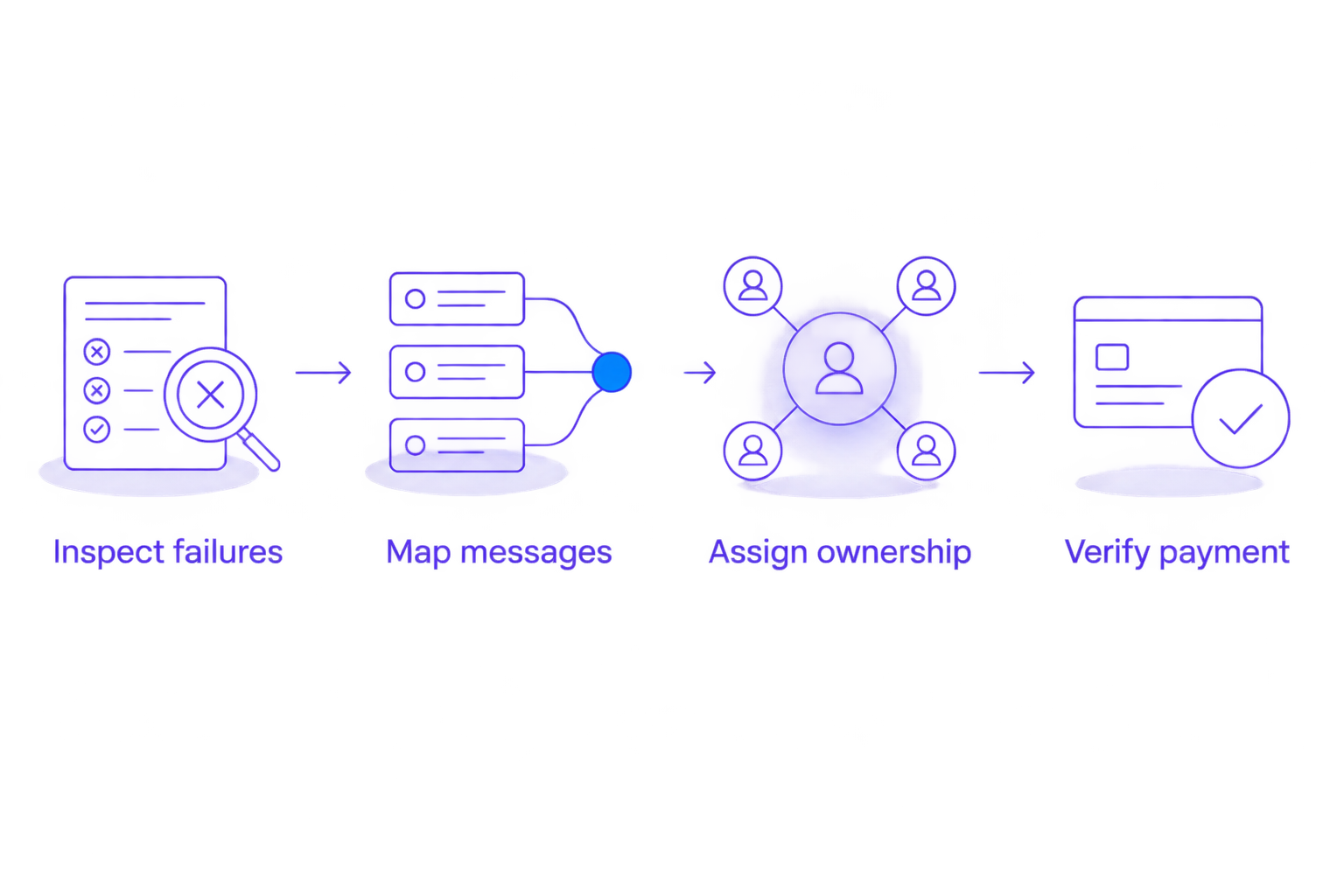
A small invoice review is a starting point, not proof of a recovery rate. Extend the review when the sample does not cover your important failure types, billing intervals, or customer situations.
Use the findings to choose the next move. Fix configuration when the workflow is wrong. Assign an owner when the work is unassigned. Evaluate managed help when the team cannot maintain the process.
For a 2026 purchasing decision, request a written scope tied to those findings. Compare the responsibilities transferred, the work retained internally, and how outcomes will be reported.
Discuss a paid recovery audit
Start with failed payments, current messages, and who owns unresolved accounts.
When staying with Chargebee Retention makes sense
Stay with Chargebee Retention when your priority is the cancellation experience and it meets that requirement. A failed-payment recovery product is not a like-for-like replacement for cancellation-focused retention.
You do not need to turn this into a single-winner decision. Define the cancellation workflow and payment-recovery workflow separately, then assess their responsibilities and interactions. Before activating another system, check for overlapping messages and conflicting account actions.
FAQ
What are the best Chargebee Retention alternatives for Stripe billing?
Stunning is the best fit in this comparison for businesses choosing failed-payment recovery software or managed dunning. Stripe’s built-in retries and emails are the first option to assess when an internal team will operate recovery. Neither is a like-for-like replacement for a cancellation experience.
Is Chargebee Retention the same as failed-payment recovery?
No. Chargebee Retention focuses on cancellation experiences, while failed-payment recovery addresses unpaid renewals. Start by identifying which problem you need to solve.
Should I use Stripe’s built-in recovery before buying another tool?
Assess Stripe’s existing retries and emails before adding another recovery system. Review the configuration, customer instructions, unresolved accounts, and internal ownership. Buy additional help against a defined requirement.
When should I hire someone to manage dunning?
Evaluate managed dunning when your team cannot consistently review results, maintain messages, and follow up on unresolved accounts. Agree on those responsibilities in the service scope. Keep an internal contact for decisions and escalations.
Does a customer updating a card mean the failed payment is recovered?
No. A card update changes payment information; recovery requires checking whether the relevant invoice was paid. Verify the payment outcome before reporting recovered revenue.
Can cancellation retention and payment recovery work together?
Yes. They address different reasons a subscription ends. Define their separate responsibilities and check for overlapping customer communication before changing your setup.
What should a failed-payment recovery audit examine?
A recovery audit should examine payment failures, retries, customer messages, payment outcomes, and ownership of unresolved accounts. Use actual invoices to connect each failure with the actions taken. Turn the findings into assigned changes.
One last thing
A card update is not a recovered renewal. Before choosing among Chargebee Retention alternatives in 2026, pick an unpaid invoice and trace it through to a paid outcome or a documented unresolved status.
If nobody can explain that path, start with a recovery audit and an owner. Choosing the next tool comes after understanding the work.
Related guides
- Dunning software or managed recovery: who owns the work?
- Stripe failed payments: a recovery audit checklist
- How to test dunning software before switching it on