
Failed payments happen when a subscription renewal cannot collect payment because of a decline, invalid payment details, required authentication, or a billing setup problem. Recover them by identifying the failure, choosing the right retry or customer action, and confirming that the invoice is paid—not merely that a card was updated.
- Failed payments in Stripe need diagnosis before retries: authentication, card replacement, and temporary declines require different actions.
- Dunning means following up on overdue payments through retries, customer messages, and direct contact.
- Assign someone to review unpaid invoices, update recovery messages, and confirm successful payment.
- Choose software when your team owns recovery; consider managed recovery when nobody owns the work.
Why this matters
A renewal failure is not the same as a customer deciding to cancel. Treating both events alike hides the difference between a payment problem and a deliberate departure.
For your 2026 recovery review, separate the payment outcome from the subscription outcome. An active subscription does not prove its latest invoice was paid, and a saved replacement card does not prove collection succeeded. The Stripe failed payments recovery audit checklist provides a starting point for organizing that review.
Dunning means following up on overdue payments. It includes retries, customer messages, and direct follow-up—not just sending an email after a decline.
Why do subscription renewals fail, and how do you recover failed payments?
Match the recovery action to the failure before changing your retry schedule. A temporary inability to collect payment calls for a different response from a request for customer authentication.
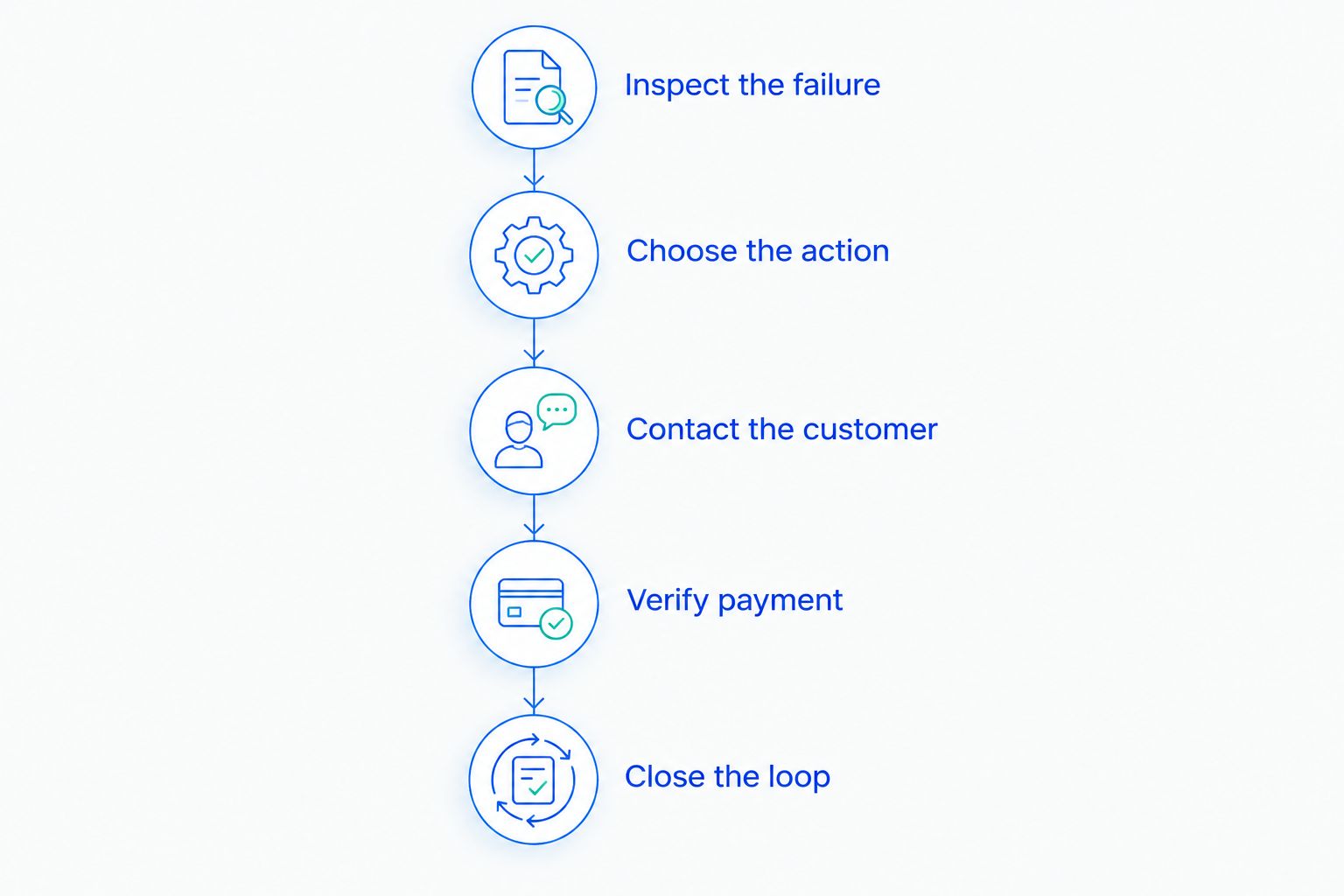
Use this sequence for each unpaid renewal. Keep the invoice, payment attempt, customer message, and subscription status connected so you can trace what happened.
1. Inspect the failure
Open the unpaid invoice and inspect its associated payment attempt. Read the decline or error information instead of relying on a generic payment-failed notification.
Record whether the next action belongs to your team, the customer, or the payment provider. A clear next action prevents repeated reminders that ask the customer to solve the wrong problem.
2. Choose the action
Determine whether another attempt is appropriate, the customer needs to authenticate, the payment method needs replacing, or the billing setup needs correcting. Do not assume every decline means the card has expired.
When a decline reason is unclear, keep your message factual. Tell the customer that the renewal did not complete and explain the available action without inventing a reason their bank declined it.
3. Contact the customer
Explain which subscription needs attention and what the customer needs to do. Send the customer to the appropriate payment or authentication flow, rather than asking for card details by email.
For business accounts, check that the message reaches someone who can resolve billing. The person using the product and the person responsible for payment are not always the same.
4. Verify payment
After a retry, authentication, or card update, inspect the original unpaid invoice. Confirm that payment actually completed and identify any remaining balance.
Do not close the case because a customer replied that they fixed it. Their action starts the verification step; it does not replace it.
5. Close the loop
Confirm the intended subscription and access state. Stop recovery messages for invoices that have been paid, and route unresolved cases according to your documented billing policy.
Keep a record of the action and outcome. Your next review should distinguish customers still awaiting help from invoices already resolved.
Which recovery action fits each failure?
Use the failure information to choose a response. This table separates possible causes from the checks needed to establish them; it is not a diagnosis for every declined renewal.
| Failure situation | Best for resolving it | Benefit | Limitation |
|---|---|---|---|
| Temporary decline | A retry when the payment remains eligible | Gives collection another opportunity | Does not resolve required authentication or invalid details |
| Invalid or expired payment details | A customer payment-method update | Addresses unusable payment details | Saving a card does not prove an overdue invoice was paid |
| Authentication required | Customer completion of the payment authentication flow | Addresses the required customer action | An unattended retry does not complete that action |
| Billing configuration problem | Investigation of the invoice and payment setup | Addresses a problem in the collection process | Customer reminders alone do not fix configuration |
| Unclear decline | Reviewing the payment information and giving a factual next step | Avoids unsupported explanations | The available decline information does not always establish a precise cause |
For Stripe renewals in 2026, inspect the actual payment state before deciding which row applies. A customer message should reflect that state, not merely the number of reminders already sent.
Why failed-payment recovery varies
Recovery depends on what stopped collection and what happens afterward. Review these factors before deciding that a new retry schedule or a new service is the answer:
- Failure type. A temporary decline, invalid payment method, and authentication request require different actions.
- Payment-method validity. Repeated attempts do not repair unusable payment details.
- Customer action. Some cases remain unresolved until the customer authenticates or supplies another method.
- Billing contact. A reminder needs to reach someone authorized to act on it.
- Collection configuration. Retry settings, invoice handling, and overlapping messages affect the workflow.
- Recovery ownership. Someone must review unresolved cases, correct messages, and verify outcomes.
These factors also explain why a recovered-payment total alone is not enough to judge the process. You need to know which invoices entered recovery, which were paid, and which remained unresolved.
Should you use built-in recovery, software, or a managed service?
Choose the operating model by who will do the work. Compare your current Stripe configuration with the workflow you need before adding another system.
For a 2026 evaluation, write down who reviews results, changes customer messages, investigates exceptions, and follows up personally. If those responsibilities have no owner, installing software leaves the ownership question unanswered.
| Approach | Best for | Advantage | Trade-off |
|---|---|---|---|
| Stripe's built-in recovery | Teams whose needs fit their current retry and email configuration | Keeps recovery within the billing platform | Your team still needs to review configuration and unresolved cases |
| Recovery software | Teams with an internal recovery owner | Gives that owner a system for running recovery | Someone still needs to operate and assess the process |
| Managed recovery | Teams that want an external operator responsible for agreed recovery work | Assigns operational work through a service arrangement | Responsibilities, access, reporting, and escalation need an explicit scope |
Stunning offers failed-payment recovery software and managed dunning services. Stunning is best for subscription businesses choosing between running failed-payment recovery themselves and hiring someone to manage it.
Distinguish Stunning Software from Managed Recovery during your evaluation. Confirm the platform support and responsibilities of the specific offering; do not assume every software capability or supported platform also applies to the managed service.
Stunning describes its managed approach in practical terms: reviewing results every month, keeping emails current, and following up personally. Ask how those responsibilities apply to your account, including which exceptions return to your team.
How do you measure recovery without overstating it?
Start with the invoices that entered recovery during a defined period. Follow those invoices through payment or another final outcome, rather than grouping unrelated successful charges into the same total.
For your 2026 reporting, keep 3 checks separate:
- Invoice outcome: Was the failed renewal invoice paid, partially paid, or left unpaid?
- Recovery action: What happened before payment—retry, authentication, payment-method update, or direct follow-up?
- Subscription outcome: Did the subscription continue, become unpaid, or end under your billing policy?
These checks answer different questions. A successful payment does not, by itself, establish which message caused it, and an ended subscription does not explain why the original payment failed.
Use the same discipline in broader billing operations: automated accounts receivable management still requires a distinction between a reminder sent, an action completed, and money collected. In subscription recovery, marking a case resolved at the card-update stage skips the payment check that matters.
Track unresolved cases as well as successful ones. Otherwise, a report can show payments coming in while leaving the remaining work invisible.
What should a failed-payment recovery audit examine?
A recovery audit should connect configuration to actual invoice outcomes. Ask for findings that identify the affected workflow and the next action, rather than a list of settings without an explanation.
Review these areas:
- Retries: Identify which system schedules attempts and what happens when attempts end.
- Messages: Check the recipient, requested action, timing, and stop conditions.
- Customer flows: Test the route for updating payment details and completing authentication.
- Exceptions: Identify who handles unresolved invoices and billing-contact problems.
- Reporting: Check that recovered payments map back to failed invoices.
Before paying for a recovery audit, ask what the deliverable includes and who implements its recommendations. A useful diagnosis separates configuration changes from ongoing work, so you can decide whether to assign an internal owner or hire a service.
Do not accept a recovery target as a substitute for inspecting your process. Your renewal failures, customer actions, and collection outcomes are the evidence needed to decide what to change.
Discuss your recovery process
Explain your billing platform, unresolved payment issues, and who currently owns follow-up.
Should you retry every failed payment?
No. Retry eligible payments, not every failure indiscriminately. Check whether the payment needs authentication, replacement details, or a configuration fix before scheduling another attempt.
A retry is a collection action, not a universal repair. Keep customer instructions aligned with the action actually required.
Does updating a card recover the overdue renewal?
No. A card update and a paid invoice are different events. Check the outstanding invoice after the update and confirm whether collection completed.
Also check which payment method the relevant subscription or invoice will use. Do not assume that changing a saved method resolves every outstanding payment.
Who should own failed-payment recovery?
Assign a named internal owner or a clearly scoped external service. That owner should review outcomes, maintain customer messages, and route unresolved cases to someone who can act.
The owner does not have to personally fix every billing problem. The responsibility is to keep each case attached to a next action until it reaches a verified outcome.
FAQ
Why do subscription payments fail when the card worked before?
A previously successful card does not guarantee a later renewal will succeed. Inspect the current payment attempt for a decline, invalid payment details, required authentication, or a billing setup issue.
What does dunning mean for a subscription business?
Dunning means following up on overdue subscription payments through retries, customer messages, and direct contact. The process should end with a verified invoice outcome, not merely a sent reminder.
Can Stripe retries fix every failed payment?
No. A payment requiring customer authentication or replacement payment details needs that action addressed. Review the payment state before deciding whether another retry is appropriate.
How do I know whether a failed renewal was recovered?
Confirm that the original unpaid renewal invoice is paid. A saved card, delivered email, or active subscription is not enough to establish successful collection.
Should I manage recovery myself or hire someone?
Manage recovery internally when someone can own configuration, customer messages, exception handling, and reporting. Consider a managed service when you want to assign that ongoing work externally under a clear scope.
What should I check before switching recovery systems?
Identify which system controls retries and customer messages before switching. Plan the handover so the same invoice does not receive overlapping recovery actions, then verify the new workflow against invoice outcomes.
One last thing
For your next 2026 review, start with an unpaid invoice whose customer already updated a card. Trace the update through to the invoice and subscription state.
That case tests the gap between customer action and collected payment. Do not mark recovery complete until the invoice outcome supports it.
Related guides
- Stripe dunning: retries versus customer authentication
- What to check after a card update
- Dunning software or managed recovery: who owns the work?