
Why Customer Churn Is Silently Killing Your Business

It’s easy to get caught up in the excitement of growth metrics—new sign-ups, lead generation, and customer acquisition. We celebrate every new customer that comes on board. But what about the ones who are quietly leaving? Customer churn is more than just a number on a dashboard; it’s a silent financial leak that can undermine your growth long before you spot the problem.
While you’re busy pouring money into acquiring new customers, churn is systematically eroding your revenue base and inflating the real cost of that new business.
Think about it this way: when a customer leaves, you don’t just lose their subscription payment for that month. You lose their entire potential customer lifetime value (LTV). A single $50/month subscription that cancels after only three months isn’t just a $50 loss. It’s the loss of the potential $600 they might have paid over the next year, not to mention any upsells or valuable referrals they could have provided. This is how a seemingly minor 5% monthly churn rate can compound into losing over half of your customer base within a single year.
The True Cost: More Than Just Lost Revenue
When you zoom out, the financial damage from churn is substantial. In the U.S. alone, businesses lose an estimated $136.8 billion each year to avoidable churn. A huge chunk of this is a direct result of poor customer experiences. In fact, studies show that 67% of consumers will jump to a competitor after just one negative interaction. This reveals a tough but crucial lesson: failing to prevent customer churn isn’t just a business mistake; it’s practically handing your revenue over to the competition. You can explore more of these customer retention statistics and their financial impact.
This financial drain creates a ripple effect throughout your entire company. It stretches resources thin and affects everything from product development to team morale. The constant need to replace lost customers forces a reactive, short-term mindset, pulling focus away from innovation and long-term planning.
The table below breaks down the often-overlooked costs of churn, showing how it quietly impacts different parts of your business.
Hidden Costs of Customer Churn by Business Function
Breakdown of direct and indirect costs across different departments when customers leave
| Business Function | Direct Costs | Indirect Costs | Long-term Impact |
|---|---|---|---|
| Marketing & Sales | Increased customer acquisition costs (CAC) | Wasted marketing spend on users who leave | Lower overall return on investment (ROI) and brand equity |
| Customer Support | Time spent on offboarding, exit interviews | Reduced capacity for proactive, positive support | Negative word-of-mouth, damage to brand reputation |
| Product & Engineering | Lost user feedback for future improvements | Resources diverted to fixing churn-causing bugs | Stalled innovation and a slower-moving product roadmap |
| Finance & Operations | Unpredictable revenue forecasting | Lower company valuation and investor confidence | Difficulty securing funding or planning for sustainable growth |
As you can see, the consequences of a customer leaving go far beyond the initial lost sale. It forces your marketing team to work harder just to stand still, pulls your support team into damage control, and stalls your product’s progress, creating a cycle that can be difficult to escape.
Spotting the Warning Signs Before It’s Too Late
The best moment to stop a customer from churning isn’t when they’re on the cancellation page. It’s actually weeks, or even months, before that thought ever crosses their mind. Churn almost never happens out of the blue. It’s a slow fade, marked by subtle shifts in behavior and a quiet decline in engagement. Your job is to learn how to pick up on these whispers before they turn into a deafening silence.
It’s easy to get sidetracked by vanity metrics, like daily logins. A customer might log in every day from sheer habit, but if they aren’t touching the core features that deliver real value, they are a huge churn risk. The key is to watch the right behaviors, not just any activity.
Moving Beyond Obvious Red Flags
Everyone knows that a missed payment or a frustrated support ticket is a bad sign. While you absolutely need to address these, they are often lagging indicators—the final gasp before a customer gives up. To really get ahead of churn, you need to monitor the quieter, more predictive signals. Think of it like a doctor checking for subtle changes in a patient’s vitals, not waiting for a major health crisis to erupt.
Here are the patterns that successful retention teams pay close attention to:
- Declining Core Feature Adoption: If a customer used to live in your main reporting tool but now only glances at their dashboard, their perceived value of your product is dropping.
- Reduced Session Duration: Shorter and less frequent visits often signal that a customer is no longer deeply invested or might be exploring other solutions.
- Ignoring New Feature Announcements: You roll out an exciting new tool, but a chunk of your users doesn’t even click to see what it is. This can mean they’ve already mentally checked out.
- Changes in Support Behavior: A sudden silence from a once-active user can be more alarming than a complaint. It often means they’ve stopped looking for solutions within your product.
Understanding Engagement in the SaaS World
For subscription businesses, especially in the Software as a Service (SaaS) world, these engagement metrics are vital. Achieving product-market fit isn’t a one-and-done deal; it’s something you have to prove to your users over and over again. The data tells a compelling story: a recent report on user retention benchmarks found that, on average, only 39% of users are still active one month after signing up. This figure dips to about 30% by the three-month mark.
With the average monthly churn rate for B2B SaaS companies sitting around 3.5%, simply hoping for the best isn’t a strategy. You need to build systems that actively alert you to these subtle shifts. A great starting point is to create a simple customer health score. This score combines several key metrics—like feature usage, support ticket frequency, and login patterns—into a single, easy-to-understand number. This lets your team quickly spot at-risk accounts and step in with helpful, targeted outreach, turning a potential churn story into a retention success.
Designing Experiences That Make Customers Want to Stay
To get a real handle on preventing customer churn, you need to shift your mindset from simply satisfying customers to actively delighting them. This involves creating an entire experience so smooth and valuable that the idea of leaving your service feels like a major step down. It starts with mapping out the whole customer journey, from their very first click to their daily use of your product, specifically looking for friction points. Where do people get stuck? What parts of your product are confusing? Finding the answers to these questions shows you exactly where you can build stronger connections.
I once saw a small software company struggling with a big drop-off after the first 30 days. Instead of just sending a generic “we miss you” email, they dug into user behavior data. They discovered that customers who failed to integrate a specific third-party app were the ones most likely to cancel. Armed with this insight, they completely redesigned their onboarding process to highlight this integration, demonstrating its value right from the start. The result? Their 30-day retention shot up almost immediately. This kind of proactive work makes customers feel seen and understood.
Creating Stickiness Through Value and Support
Making your product “sticky” isn’t about trapping customers; it’s about making your service so essential they can’t imagine working without it. This requires a genuine understanding of what they’re trying to accomplish.
Here are a few ways to make your service indispensable:
- Proactive Education: Don’t just wait for a help ticket to come in. Offer webinars, create useful guides, and send out tips related to the features your customers are already using.
- Consistent Value Delivery: Regularly release meaningful updates and improvements that address real user problems. This constantly reminds them why they chose you in the first place.
- Building an Emotional Connection: Personalization goes beyond using a first name in an email. Acknowledge their milestones, celebrate their wins with your product, and treat them like a true partner in their success.
Focusing on the customer experience isn’t just a feel-good strategy; it directly affects your revenue. Investing in better service can decrease churn by 15%. However, patience for poor service varies. Research shows that a staggering 44% of Baby Boomers will walk away after just one bad interaction, compared to 30% of Millennials. This difference shows just how important consistently great support is. For more data, you can check out these insights on customer service and retention.
Remember, your brand’s overall reputation matters, too. It might be worth looking into online reputation management services to ensure that what people say about you publicly encourages loyalty. When you design experiences that customers genuinely love, you build a strong defense against churn.
Mastering the Art of Customer Rescue Missions
When you see signs that a customer might be about to leave, the natural reaction is to jump into action. But there’s a big difference between a well-timed rescue mission and a desperate, last-minute plea. The best retention strategies focus on strategic conversations that rebuild value and remind customers why they chose you in the first place, rather than just throwing discounts at the problem.
This kind of intervention is a delicate process. It’s all about the right timing, the right tone, and offering the right kind of support. For instance, if you see a customer has stopped using a key feature they once relied on, a generic “We miss you!” email is probably going to be ignored. A far better move is a personalized message: “Hey [Customer Name], I noticed you haven’t used our reporting tool lately. We just rolled out an update that makes [a specific task] much faster. Would a quick 10-minute walkthrough be helpful?” This feels like genuine support, not a sales pitch.
Balancing Automation With a Human Touch
While automated systems are great for flagging at-risk behaviors, the actual intervention often needs a human touch. A personal email from a customer success manager can achieve what an automated message can’t: reopening a dialogue. Your initial outreach should be about understanding their situation, not just trying to save the sale.
Ask open-ended questions like, “What’s changed in your workflow recently?” or “Is there a specific goal you’re struggling to hit with our tool?” This reframes the conversation from a company trying to save a subscription to a partner invested in solving a problem.
The infographic below illustrates how churn rates can differ across customer segments, showing where your high-touch efforts might have the biggest impact.
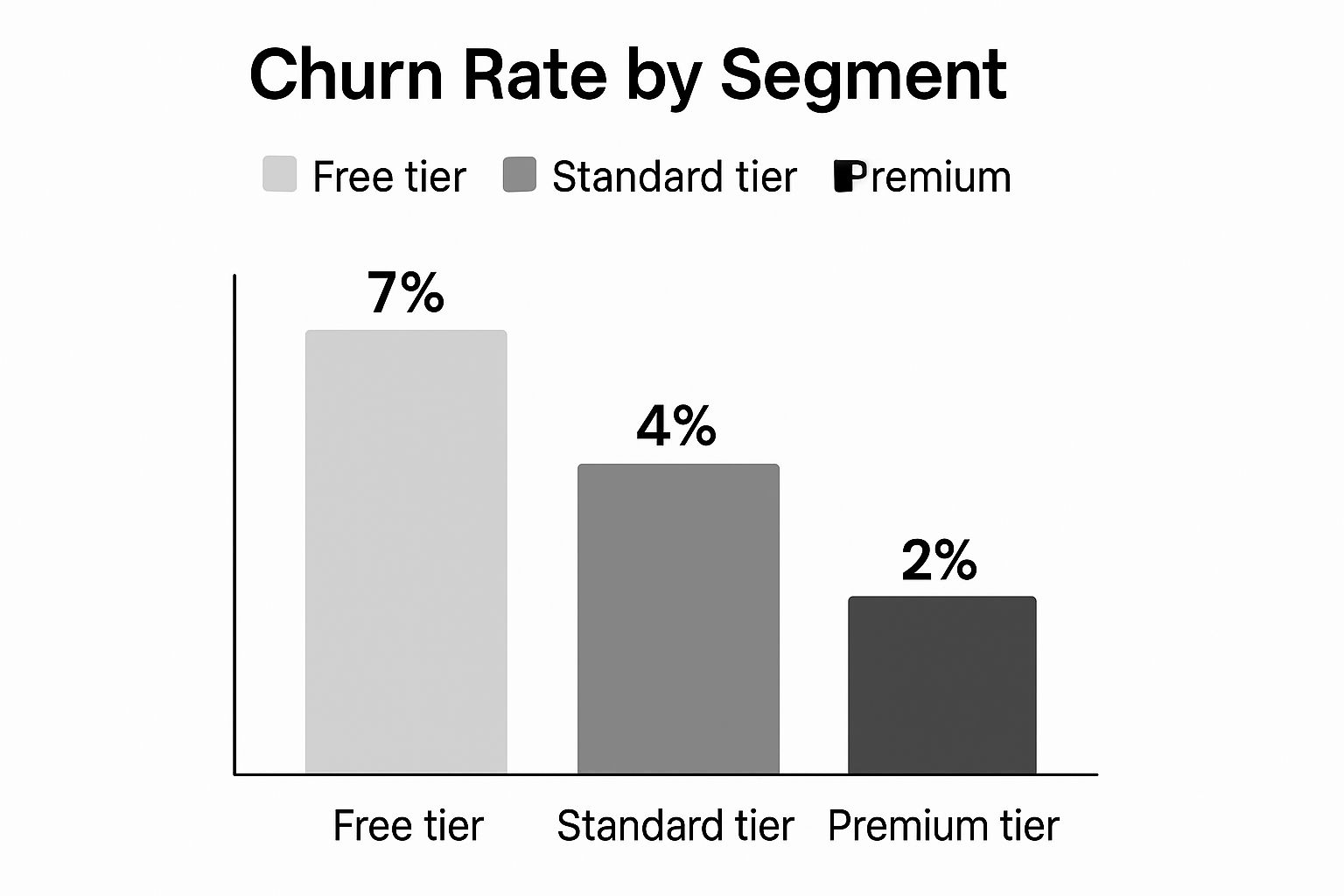
As the data suggests, customers on premium tiers, who typically have higher value, tend to churn less. This makes them perfect candidates for personalized rescue missions where the return on your time and effort is highest.
Effective Intervention Tactics
Not every at-risk customer requires a phone call. The secret is to match the intensity of your intervention to the customer’s risk level and their value to your business.
Before we dive into specific tactics, let’s look at a structured approach. The table below outlines different intervention strategies based on how likely a customer is to churn, along with what you can expect in terms of success and resources.
| Risk Level | Intervention Type | Timeline | Success Rate | Resources Required |
|---|---|---|---|---|
| Low | Automated In-App Message/Email | Immediate (Automated Trigger) | 20-30% | Low (One-time setup) |
| Medium | Personalized Email/SMS | Within 24-48 hours | 35-50% | Medium (CSM time, SMS platform) |
| High | Personal Call or Video Meeting | Within 24 hours | 50-70% | High (Senior CSM/Account Manager time) |
This table shows a clear progression: as the risk level increases, so should the personalization and effort of your intervention.
Here are a few proven tactics broken down by risk level:
- For Low-Risk Users: A simple, automated in-app message or a brief email can work wonders. Point them toward a new feature or a helpful guide related to what they were last doing in your app. The goal is a gentle nudge back to value.
- For Medium-Risk Users: It’s time for a real person to step in. A personal email from a dedicated team member offering help can be very effective. For SaaS businesses, using text messages for timely check-ins can also be a game-changer. You can find some great ideas in this guide on how to use SMS to retain SaaS customers.
- For High-Risk/High-Value Users: This is where you bring out the big guns. Schedule a call, offer a strategic account review, or set up a one-on-one training session. The goal is to demonstrate indispensable value and show them you’re a true partner in their success.
By tailoring your response to the situation, you can effectively prevent customer churn without exhausting your team or coming across as desperate. It’s all about delivering the right help at exactly the right moment.
Turning Customer Data Into Retention Gold

Data without action is just an expensive report. We’ve all seen beautiful dashboards that look amazing but don’t actually lead to any meaningful change. To truly prevent customer churn, you have to transform the information you collect into real, tangible retention strategies. This means going beyond surface-level metrics and digging into the data that reveals why customers are thinking about leaving. The goal isn’t just to track numbers; it’s to find the stories they tell about your customers’ experiences.
One of the best ways to do this is through customer segmentation. Not all customers churn for the same reasons. By grouping them based on behavior, subscription plan, or how engaged they are, you can uncover patterns that a one-size-fits-all approach would completely miss. For instance, you might discover that users on your basic plan leave because a key feature is missing, while enterprise clients churn due to slow support response times. This insight is gold because it lets you tailor your outreach instead of sending generic, ineffective messages.
From Analysis to Actionable Insights
Once you’ve segmented your audience, the next move is to apply practical analytics that give you clear direction, not just more charts. It’s easy to get stuck in “analysis paralysis.” Instead, focus on a few key methods that are known to drive results.
Here’s how top-performing teams stay ahead of churn:
- Cohort Analysis: This method groups customers by their sign-up date and tracks their behavior over time. It’s fantastic for seeing if changes to your onboarding or product updates actually improve long-term retention. Did the group from March, who saw the new onboarding flow, stick around longer than the one from February? Cohort analysis answers that question directly.
- Behavioral Tracking: Look beyond simple logins. Track how often customers use your “sticky” features—those core functions that deliver the most value. A customer who consistently uses these features is far less likely to leave. You can even set up alerts for when a user’s engagement with these key features drops, giving you an effective early warning.
- Predictive Modeling: While it sounds complicated, the basic idea is simple: use past data to predict future behavior. By analyzing the traits of customers who have churned before, you can create a customer health score. This score can flag at-risk accounts, allowing your success team to step in proactively long before a customer even thinks about canceling. For example, a drop in usage frequency combined with an ignored feature announcement could trigger a high-risk alert.
These data-focused approaches help you shift from being reactive to proactive, turning your customer information into your most valuable weapon in the fight against churn.
What Retention Champions Do Differently
Ever wonder why some companies seem to have a magnetic pull on their customers while others are constantly fighting churn? It’s not just luck; it’s by design. The companies that master retention—the champions of the industry—think and act differently. They don’t just sell a product or service; they weave themselves into their customers’ daily successes.
This proactive approach becomes clear when you look at industry leaders. Customer retention rates can vary wildly, but the top performers have cracked a code. For instance, the media and professional services sectors boast an impressive 84% average customer retention rate, making them joint leaders in keeping customers loyal. These industries succeed because they consistently deliver value and build relationships that go far beyond simple transactions. You can find a deeper breakdown of these industry retention rate findings to see how others stack up.
The Champion’s Playbook
So, what are these top-performing companies actually doing? Their strategies often revolve around two core ideas: becoming an indispensable partner and obsessing over the customer’s end goal. Instead of just highlighting their own product features, they focus on what the customer is ultimately trying to accomplish.
Think about a B2B company that sells marketing automation tools. A struggling business might just offer the software and call it a day. A retention champion, however, provides strategic guidance. Their customer success teams act more like consultants, helping clients build better campaigns and make sense of their results. This transforms their role from a simple vendor into a vital growth partner, making the idea of switching to a competitor feel like a huge step backward.
Structure and Strategy
The way these companies structure their teams and measure success is also fundamentally different. Their customer success teams aren’t just a rebranded support department; they are a revenue-driving force focused on adoption, expansion, and advocacy.
Here’s a glimpse into their operational mindset:
- Deep Customer Integration: They aim to be so integrated into a client’s workflow that removing their tool would cause significant disruption.
- Value-Based Metrics: Success isn’t measured by how many support tickets are closed, but by their clients’ achievements and growth.
- Proactive Relationship Building: They don’t wait for a problem to pop up. They schedule regular strategic reviews to make sure the customer is getting the most value possible.
These are just a few of the core concepts, but if you’re ready to go deeper, you might want to check out some advanced retention strategies that you’re probably not using. By adopting this champion’s mindset, you can shift from simply trying to prevent customer churn to building a business that customers genuinely never want to leave.
Your Complete Churn Prevention Action Plan
It’s time to put all this theory into practice and start seeing some real results. Creating a plan to prevent customer churn isn’t about launching one giant, overwhelming project. Instead, it’s about building a series of smart, sustainable habits across your entire company. This roadmap is designed to get you moving, with the goal of seeing noticeable improvements within the first business quarter.
Laying the Groundwork (Weeks 1-4)
Your first month is all about getting your tracking in place and your team on the same page. After all, you can’t improve what you don’t measure.
- Establish Health Scoring: Start by defining what a “healthy” customer actually looks like for your business. Is it someone who logs in daily? Someone who uses a specific, sticky feature? Create a simple health score based on 2-3 key engagement metrics you can easily track.
- Set Up Proactive Alerts: Once you have a score, automate it. Create alerts that notify your customer success team the moment a customer’s health score dips below a certain point. This transforms raw data into an immediate, actionable task for a real person.
- Train the Team: Get everyone together for a kickoff meeting. The goal here isn’t just to throw data at them, but to build a shared sense of ownership. Go over the common churn warning signs you’ve identified and create a clear protocol: who responds to an alert, and what’s the first thing they do?
Launching Quick-Win Interventions (Weeks 5-8)
With your foundation set, it’s time to focus on high-impact, low-effort tactics. A great place to start is with your medium-risk segment—these are customers who are starting to drift away but haven’t completely given up yet.
- Send a Personalized Check-in: Have your team send a personal, human email to flagged accounts. This is crucial: it’s not a sales pitch. It’s a simple, “Hey [Customer Name], I noticed you haven’t used [Feature X] in a while. Is everything okay?” or “Just wanted to check in and see if you needed any help getting the most out of our platform.”
- Collect Feedback from Churned Customers: For customers who do end up leaving, set up an automated exit survey. Keep it incredibly simple. Ask one critical question: “What was the primary reason you decided to cancel?” The answers you get are pure gold for shaping your future strategy.
Building a Culture of Retention (Weeks 9-12)
Now, the focus shifts from specific actions to making retention a core part of your company’s DNA. This is about long-term change.
- Celebrate the Wins: When a team member successfully “rescues” a customer who was at risk of churning, celebrate it! Share the story in your company’s Slack channel or at a team meeting. This reinforces the right behaviors and demonstrates the real-world value of everyone’s effort.
- Refine Your Strategy: Take a step back and look at the data from your first interventions and exit surveys. Are there common themes? Are customers consistently getting stuck in the same place? Use these insights to tweak your approach for the next quarter. If you need more ideas on this front, we’ve created a guide on building a customer success strategy to increase retention.
One of the most common—and preventable—reasons for churn is something as simple as a failed payment. Let Stunning handle that headache for you, freeing up your team to focus on what they do best: building great relationships with your customers, not chasing down expired credit cards.