
Choose Stunning if you want a managed service to run failed-payment recovery; choose Stripe’s built-in retries and emails if your team will own the work. This 2026 comparison separates the software decision from the staffing decision, because adding another tool does not assign responsibility.
- Stunning vs Stripe dunning is an ownership decision: managed recovery versus running built-in retries and emails yourself.
- Stripe is the better starting point when a named employee owns failed-payment recovery and reviews unresolved invoices.
- Managed Recovery fits teams seeking outside help running recovery; Stunning Software is a separate software choice.
- Compare paid invoices, unresolved balances, customer messages, and staff workload—not retry activity alone.
Why this matters
Dunning means following up on failed payments to collect an unpaid bill. For a subscription software business, that includes retries, customer messages, payment-method updates, and decisions about accounts that remain unpaid.
Those tasks need an owner. A retry schedule does not decide who investigates a confused customer’s reply or checks whether an updated card actually settled the invoice.
For your 2026 decision, separate two questions: does the current recovery setup need changing, and does your team have someone to run it? A managed service addresses the second question directly. Software alone does not.
At a glance
| Dimension | Stunning | Stripe |
|---|---|---|
| Best for | Subscription businesses seeking managed recovery or dedicated recovery software | Stripe subscription businesses running recovery internally |
| Recovery ownership | Managed Recovery is the service option; Software is a separate choice | Your team owns configuration, reviews, and exceptions |
| Built-in workflow | An additional recovery offering to evaluate alongside existing billing settings | Built-in retries and customer emails |
| Customer messages | Evaluate the managed-service scope for message upkeep and follow-up | Your team owns message configuration and maintenance |
| Payment resolution | Judge success by whether the intended invoice gets paid | Judge success by whether the intended invoice gets paid |
| Measurement | Use a defined failed-invoice group and documented outcomes | Use the same definitions for a fair comparison |
| Pricing model | Compare written Software and Managed Recovery terms separately | Evaluate recovery-related billing terms and internal labor together |
| Standout feature | The choice between recovery software and a managed service | Recovery controls within the existing Stripe billing workflow |
The table compares operating approaches, not recovery-rate claims. The right choice depends on the work you need covered and who will remain accountable for it.
Managed Recovery wins when you need outside ownership
Stunning is best for subscription businesses that want a managed failed-payment recovery service rather than another tool to operate. That is a different purchase from software access.
Consider a SaaS team where finance sees unpaid invoices, support receives billing replies, and engineering maintains payment integrations. Everyone touches the problem. Nobody necessarily owns the full recovery process.
A managed-service discussion should turn that scattered responsibility into a written assignment. Ask who will:
- Review failed payments and unresolved accounts.
- Update customer messages when the billing process changes.
- Follow up when automated messages do not resolve the issue.
- Explain results and recommend changes.
- Escalate account-access or billing-policy decisions to your team.
Do not treat those responsibilities as interchangeable. Sending messages is not the same as handling replies, and reporting results is not the same as changing an ineffective process.
The tradeoff is a handoff. You still need an internal contact who can approve policy decisions, explain unusual accounts, and resolve issues outside the service scope. Managed recovery changes who runs the work; it does not remove your responsibility for customer relationships.
Stripe wins when your team already owns recovery
Stripe is the better starting point when a capable employee already runs failed-payment recovery. Its built-in retries and emails let you start with the billing workflow you already use rather than introduce another recovery provider immediately.
That choice fits a team that can explain its settings, show what happens after a failure, and identify who handles unresolved invoices. It also fits a team willing to maintain that process as subscription plans and customer communications change.
The limitation is internal workload. Someone still needs to check the configuration, investigate exceptions, maintain messages, and decide what happens when collection attempts end.
Before adding another product, ask the current owner to walk through an actual unpaid renewal. Follow it from the failed attempt to the latest customer communication and final account status. If that explanation is clear and the remaining work is manageable, keep improving the existing setup.
If no one can complete that walkthrough, first decide whether you will assign the job internally or hire help. A software comparison cannot make that staffing decision for you.
Managed service wins for teams that want message upkeep assigned
Customer communication is ongoing work. A reminder needs to explain what failed, what the customer should do, and where to get help.
A managed service is the better buying category when you want message maintenance and follow-up assigned outside your team. Make those responsibilities explicit in the service agreement rather than assuming the word “managed” covers every customer interaction.
For any proposed arrangement, inspect the actual responsibilities:
- Message upkeep: Who checks that instructions still match the payment-update process?
- Customer replies: Who reads responses and decides what action is needed?
- Account context: Who handles an annual renewal or a customer with a separate billing contact?
- Escalation: Who returns an unresolved issue to your team, and with what information?
Stripe remains the stronger fit when you want your own staff to control this work directly. That control also means your staff must maintain it.
Do not choose a winner by counting email templates. Choose according to whether the arrangement covers the communication work your business actually needs.
Neither approach wins unless the invoice gets paid
Retries, reminders, and card updates are steps toward payment. None is proof that the intended renewal was collected.
A customer can update a payment method while an invoice still needs attention. A message can be delivered without producing a response. Your operating process must check the payment outcome rather than stop at the latest activity.
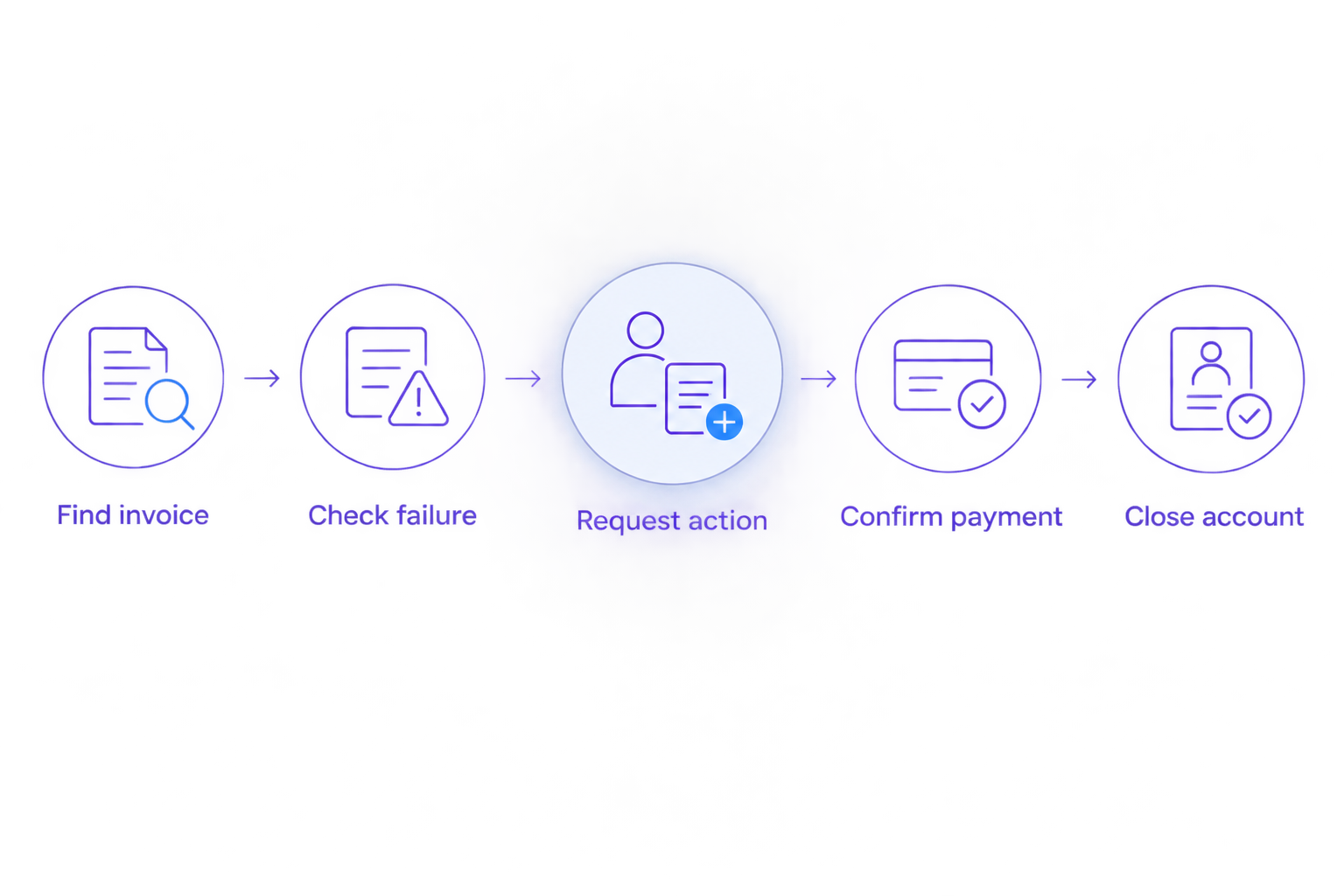
Use this sequence when reviewing a failed renewal:
- Find invoice: Identify the specific unpaid renewal.
- Check failure: Read the payment failure and determine what action it calls for.
- Request action: Give the customer clear instructions when customer action is required.
- Confirm payment: Verify that the intended invoice is paid.
- Close account: Resolve or escalate the remaining account issue and record the outcome.
The same sequence applies whether an employee or a service handles recovery. Neither approach deserves credit merely for sending another reminder.
Keep exceptions visible until somebody resolves them. An automated attempt that ends without payment needs a recorded next action, not an assumption that the system handled it.
Both need the same measurement rules
Neither approach wins on reporting unless you compare the same invoices over the same period. A different definition of recovery can change the apparent result without changing what customers paid.
For a practical 2026 evaluation, use a 30-day invoice window as your starting group. This is a proposed review format, not an industry benchmark. Record the invoices that first failed during that window and keep their later outcomes attached to that group.
Track unpaid value, collected value, unresolved invoices, and staff work separately. Also distinguish automatic payment success from cases that required a customer response or manual follow-up.
Assign 1 accountable owner to maintain the record. Add a 7-day checkpoint to inspect open cases and identify missing information before the review ends. These are operating recommendations, not promises about how quickly payments recover.
Avoid judging a provider by a headline recovery percentage without understanding the denominator. Ask which failures count, how long outcomes are observed, and whether unrelated later payments are included.
A useful comparison answers a narrower question: did this approach collect the intended invoices, with an acceptable amount of work and clear treatment of unresolved customers?
Pricing: compare the operating model, not just the invoice
For a 2026 purchase, evaluate software and managed-service terms separately. One buys access to a tool; the other buys an agreed scope of work. Treating them as the same purchase hides the labor decision.
For the built-in approach, document who will configure recovery, review results, update messages, and handle exceptions. Internal work belongs in the comparison even when it does not arrive as a separate supplier invoice.
For a managed proposal, request written answers about the fee structure, included work, exclusions, and responsibilities that remain with your team. Confirm whether charges stay fixed or vary with a stated measure. Do not assume a pricing structure from the service category.
Predictability and flexibility are different priorities. Fixed charges make supplier spending easier to plan; variable charges require you to understand what drives the bill. Neither structure proves that the service covers the work you need.
Also separate platform questions. The business offers recovery software and managed dunning services for subscription businesses using Stripe, Foxy, and Subbly. Confirm platform support for Stunning Software and Managed Recovery individually; do not treat the two offerings as interchangeable.
Make the decision with a recovery audit
A paid recovery audit is a useful first purchase when you cannot explain where failed invoices stall. Define the audit around decisions, not a list of dashboard screenshots.
Request a written account of the current workflow, unresolved cases, overlapping messages, and ownership gaps. Ask for recommendations that separate configuration changes from work somebody must perform repeatedly.
The result should support a choice:
- Keep built-in recovery and assign an internal owner.
- Add software because the current workflow has a specific functional gap.
- Hire a managed service because recurring recovery work needs an outside owner.
An audit should not assume the answer is a replacement tool. Before commissioning one, agree on its scope and deliverables through the provider’s contact process.
Discuss a recovery audit
Ask about audit scope, Managed Recovery responsibilities, and the work your team would retain.
Final verdict: choose the owner before the tool
Choose Stunning if you need someone to run recovery
Best for: a subscription SaaS founder with accumulating failed payments and no dedicated recovery owner. Evaluate Managed Recovery when you want outside responsibility for an agreed set of recurring tasks.
Ask for a clear division of work before committing. Buying Software instead is a different decision: your team still needs someone to operate the recovery process.
Choose Stripe if your team will run recovery internally
Best for: a subscription SaaS billing lead who can maintain retries, customer messages, and exception handling. Keep the built-in approach when it covers your needs and the work has a dependable internal owner.
For 2026, the practical distinction is accountability. Start with the staffing model, then evaluate whether the software supports it.
| Dimension | Winner |
|---|---|
| Outside recovery ownership | Managed Recovery |
| Existing billing workflow | Stripe |
| Outsourced message upkeep | Managed service, with explicit scope |
| Direct internal control | Stripe |
| Confirming invoice payment | Tie: required for either approach |
| Fair outcome measurement | Tie: identical definitions required |
| Pricing decision | Match written terms to included work |
FAQ
Is Stunning better than Stripe for dunning?
Stunning is the better fit when you want a managed failed-payment recovery service; Stripe is the better starting point when your team will run built-in retries and emails. Choose the operating model before comparing individual settings.
Are Stripe’s built-in retries enough for a SaaS business?
Built-in retries are enough only when the wider recovery process covers your needs. Your team still needs to own customer messages, unresolved invoices, and decisions after collection attempts end.
What is the difference between dunning software and managed recovery?
Dunning software gives your team a tool to operate; managed recovery assigns an agreed scope of recovery work to a service. Confirm who reviews results, maintains messages, handles replies, and escalates exceptions.
Should I buy recovery software if nobody owns failed payments?
Assign an owner or hire a service before expecting software to solve the ownership problem. A new tool still needs someone to maintain the process and handle unresolved cases.
How should I compare recovery costs?
Compare written supplier terms alongside the internal work each approach requires. Separate software access from managed-service responsibilities and confirm what drives any variable charges.
How do I know whether a failed renewal was recovered?
Confirm that the intended unpaid invoice was paid. A delivered reminder, another retry, or a payment-method update is not sufficient evidence by itself.
What should a failed-payment recovery audit answer?
A recovery audit should identify where invoices stall, who owns each task, and which changes address the problem. Its recommendations should distinguish configuration work from recurring operational responsibilities.
One last thing
Ask whoever owns recovery to show you an unresolved invoice, not the best-looking dashboard. Have them explain the failure, the latest customer action, and the next assigned task.
That walkthrough reveals whether you need different settings, different software, or someone responsible for finishing the work.
Related guides
- Dunning software or managed recovery: who owns the work?
- Stripe dunning: when built-in recovery is enough
- Stripe failed payments: a recovery audit checklist
- How to test dunning software before switching it on