
Best overall for teams without a recovery owner: Stunning Managed Recovery. Best for an existing billing owner: Stripe’s built-in recovery. Best for teams that want dedicated software they run themselves: Stunning Software. This 2026 guide compares AI payment recovery tools for Stripe by the work they handle—and the work your team still owns.
- Stunning Managed Recovery is best for subscription businesses that need someone to own failed-payment recovery.
- For AI payment recovery tools for Stripe, distinguish machine-learning retries from customer messages and human follow-up.
- Stripe’s built-in recovery is the starting point when your billing team owns configuration, follow-up, and reporting.
- Choose self-managed dunning software only when someone will maintain messages and review unresolved invoices.
Why this matters
A failed subscription payment creates several possible jobs. The payment might need another attempt, customer authentication, a different card, or a billing correction. Repeating the same action does not address every cause.
Dunning means the process of collecting payment after an invoice fails. Software handles parts of that process. Someone still needs to decide what happens when automation finishes without collecting payment.
For a 2026 buying decision, separate the retry engine from the operating model. Stripe Smart Retries uses machine learning to choose retry timing. That is different from having someone review results, maintain customer messages, and follow up on unresolved accounts.
Stunning Managed Recovery is best for subscription businesses that need someone to own failed-payment recovery. Choose a tool you operate yourself when your team already owns that work.
What makes the best payment recovery tools for Stripe
Use these criteria before comparing feature lists:
- Recovery ownership: Identify who reviews outcomes, changes messages, and handles unresolved accounts. A dashboard is not an owner.
- Payment mechanics: Separate retryable declines from problems requiring customer action. A retry cannot complete authentication on the customer’s behalf.
- Customer communication: Check what customers receive, where the update link takes them, and which system stops reminders after payment.
- Invoice-level evidence: Confirm that a successful payment settled the invoice being measured. A card update alone is not recovered revenue.
- Operational fit: Establish whether you need built-in settings, dedicated software, or a managed service. These are different purchases.
- Controlled handoff: Define which system sends messages and schedules retries before adding another recovery provider.
Start with a bounded review: inspect 10 unpaid invoices and document the next action for each. This is a suggested buying exercise, not a performance benchmark. It shows whether your main gap is payment handling, customer communication, or ownership.
Payment recovery options at a glance
This 2026 shortlist ranks operating models, not unverified AI claims. The best choice depends on who will do the work after a renewal fails.
| Rank and option | Best for | Standout feature | Key limitation |
|---|---|---|---|
| 1. Managed Recovery | Teams without a recovery owner | Managed-service approach instead of software alone | Requires a clear agreement on responsibilities and escalation |
| 2. Stripe’s built-in recovery | Teams with an active billing owner | Native retries and customer-email settings; Smart Retries uses machine learning | Your team still owns configuration, exceptions, and review |
| 3. Stunning Software | Teams that want to operate dedicated recovery software | Failed-payment recovery software as a separate operating choice | Your team must own ongoing recovery work |
Do not treat “AI-powered” as proof that a product handles every failed-payment task. Ask which decision uses machine learning, what action follows that decision, and what happens when that action fails.
1. Managed Recovery: best for teams without a recovery owner
Managed Recovery is the service option for businesses that want someone to run failed-payment recovery rather than only provide software. It belongs first when failed invoices are accumulating and nobody owns the process.
The buying question is practical: who watches results, keeps messages current, and follows up? Put those responsibilities into the service scope. Also define the decisions your team retains, such as account access and exceptions for important customers.
Managed Recovery pros:
- Gives you a service-based alternative to running recovery software internally.
- Fits a buying process centered on accountability for recurring recovery work.
- Lets you define reviews, message maintenance, and unresolved-account handling as deliverables.
Managed Recovery cons:
- Requires onboarding and an explicit division of responsibilities.
- Does not remove your responsibility for customer-access policies or billing disputes.
- Is the wrong operating model if your team wants to perform every recovery task itself.
Before choosing a service, ask who reviews results and how often. Ask who approves message changes and which unresolved accounts receive personal attention. Request a clear explanation of what falls outside the service.
Keep platform support specific to the offering. Stunning serves subscription businesses using Stripe, Foxy, and Subbly, but do not assume every software and managed-service option has identical platform coverage. Confirm the scope for your Stripe setup before committing.
Best for: Subscription teams with ongoing failed payments and no internal recovery owner.
Verdict: Buy the managed-service model when you need someone to own the work.
2. Stripe’s built-in recovery: best for an existing billing owner
Stripe’s built-in recovery provides retry and customer-email controls within Stripe Billing. Smart Retries uses machine learning to choose payment retry timing. Start here when someone on your team already maintains billing settings and investigates unpaid invoices.
Built-in recovery is a valid operating choice, not merely a temporary step before buying another product. Evaluate the actual unresolved invoices before adding another system.
Stripe built-in recovery pros:
- Keeps recovery configuration within the billing platform.
- Provides machine-learning retry timing through Smart Retries.
- Gives an internal owner a starting point for retries and payment-failure communication.
- Lets you inspect the underlying Stripe invoice and payment records.
Stripe built-in recovery cons:
- Leaves configuration and ongoing review with your team.
- Cannot make a customer complete required authentication or provide a different payment method.
- Does not replace your decisions about follow-up, service access, or unresolved accounts.
Inspect the enabled settings rather than assuming the account uses a particular recovery configuration. Then trace an unpaid invoice from failure through the final retry and customer message.
If the process works and someone maintains it, keep it. If invoices sit unresolved because nobody looks at them, another retry setting does not solve the ownership problem.
Best for: Stripe subscription businesses with an accountable billing operator.
Verdict: Hold the built-in setup when it covers your workflow and your team maintains it.
3. Stunning Software: best for an internal recovery operator
Stunning Software is the self-managed option for failed subscription payment recovery. Choose software when you want your own team to operate recovery rather than hand that work to a managed service.
Evaluate the software against a specific gap in your existing Stripe workflow. Define the required change first, then confirm the product supports it. Do not buy a separate application simply because the category includes AI terminology.
Software pros:
- Provides a software-based alternative to a managed recovery service.
- Fits teams that want to retain responsibility for recovery operations.
- Lets you evaluate a dedicated recovery product against an identified workflow requirement.
Software cons:
- Requires an internal owner after installation.
- Adds another system whose responsibilities must be coordinated with Stripe.
- Does not, by itself, establish a review routine or escalation policy.
Before choosing Stunning Software, write down who will review outcomes, maintain customer messages, and handle invoices that remain unpaid. Confirm the Stripe-specific functionality you need during the evaluation.
Separate product capability from operating responsibility. Even a suitable product needs someone to notice a broken customer journey or decide that an unresolved account requires direct contact.
Best for: Subscription businesses with an internal operator and a defined reason to add dedicated recovery software.
Verdict: Buy software when your team will run it; skip this model when nobody will.
What “AI-powered” should mean in your evaluation
Ask the vendor to identify the exact automated decision. Retry timing, message generation, and account prioritization are different functions. A claim about one does not establish the others.
Stripe Smart Retries is a concrete example of machine learning applied to retry timing. That does not mean every failed invoice needs another attempt. Some failures require a customer to authenticate, update payment details, or contact their bank.
Use these questions during a demonstration:
- What decision does the model make?
- What event triggers the next action?
- Which failures need customer action instead of another retry?
- Who handles accounts that remain unpaid?
- What record proves the original invoice was paid?
Choose the workflow that resolves the failure, not the broadest AI label. Keep customer messaging and human ownership in the comparison even when retry technology is the headline feature.
Test the workflow before switching
Use a 30-day invoice cohort for your initial review. A cohort is a fixed group of invoices selected under the same rules. Keep those rules consistent so the comparison does not change halfway through.
Assign 1 recovery owner before starting. That person should coordinate the test, record exceptions, and approve the handoff between systems.
Trace failures
Record the invoice, failure reason, retry history, and customer action required. Separate payment failures from billing errors that need correction.
Map messages
List every payment-failure message the customer receives and which system sends it. Check where payment-update links lead and what stops further reminders.
Assign ownership
Name the person responsible for unresolved invoices. Define when that person contacts the customer and when a billing or access decision needs approval.
Confirm payment
Check the original invoice after a successful payment event. Do not count an email open, payment-method update, or successful unrelated charge as collection of that invoice.
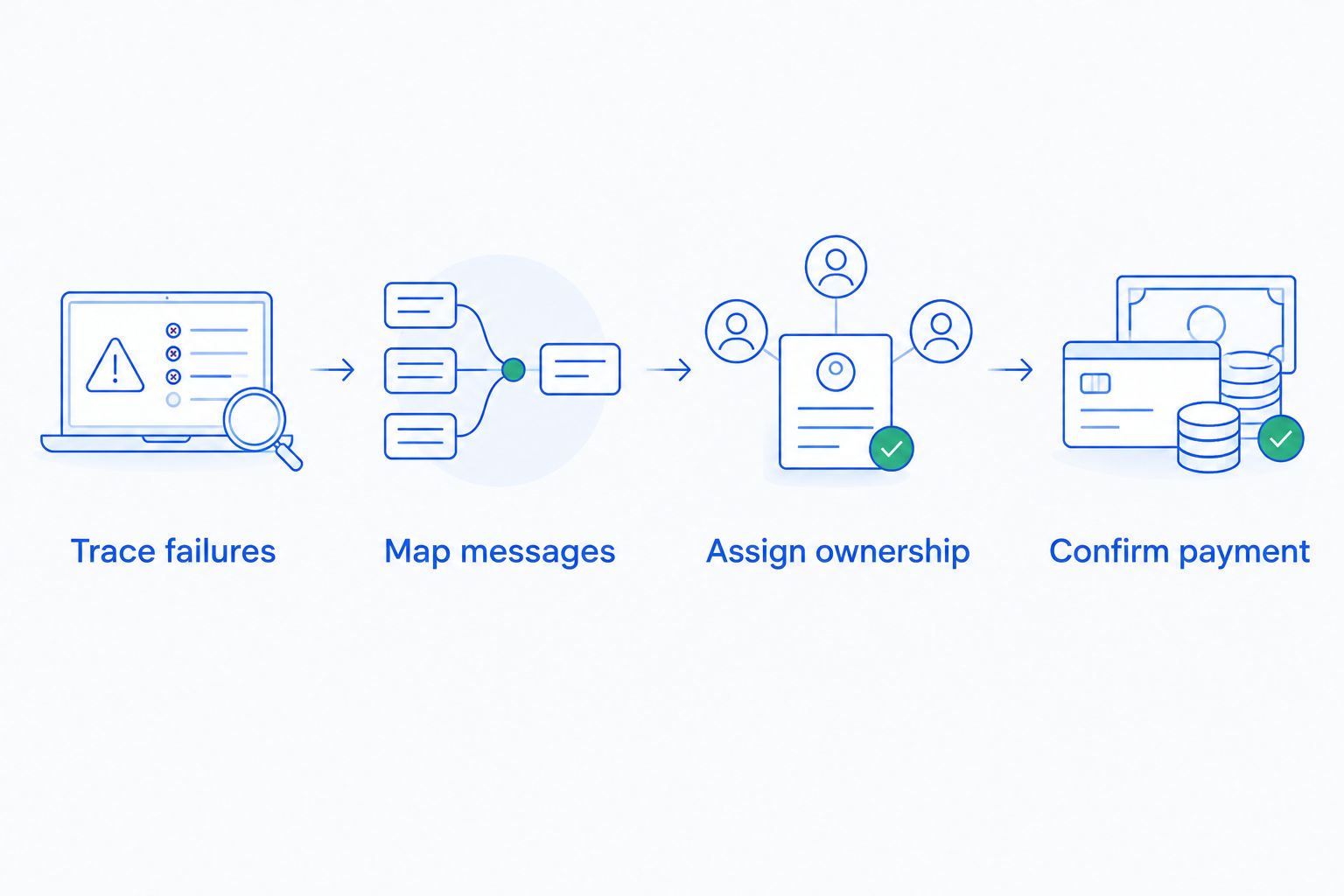
Avoid switching on overlapping messages without a handoff plan. Decide which system owns each action before activating the replacement. Use the same invoice-level evidence to assess both approaches.
Hire an operator or manage recovery yourself?
Hire a service when the missing piece is recurring attention. Examples include results that nobody reviews, messages that nobody maintains, and unpaid accounts that never receive a clear next action.
Manage recovery yourself when a named person can configure the process, review exceptions, and make changes. Software is a reasonable purchase when that person needs a specific capability—not a substitute for that person.
Use this guide to deciding who owns dunning software or managed recovery to structure the handoff. Write responsibilities down before comparing vendors.
Discuss your recovery ownership gap
Explain your Stripe setup, unresolved invoices, and who currently handles follow-up.
How we ranked
This 2026 ranking prioritizes ownership, payment mechanics, customer communication, invoice-level evidence, and controlled handoffs. Managed service ranks first for an unowned process; Stripe’s built-in recovery ranks first for a team that already operates recovery effectively.
The ranking does not assign recovery-rate scores or claim that a named product wins through AI alone. Evaluate results against your own invoice cohort and confirm the service or software scope before buying.
Which payment recovery option should you choose?
Choose Managed Recovery if failed payments have no owner. Choose Stripe’s built-in recovery if your billing team already maintains the process. Choose dedicated software when that team has identified a capability it needs.
For your 2026 decision, start with the unresolved work. If the answer is “someone needs to review this every month,” prioritize a service conversation over another software installation.
FAQ
What are the best AI payment recovery tools for Stripe?
Stripe Smart Retries is a concrete machine-learning option for retry timing. Choose built-in recovery, dedicated software, or a managed service according to the workflow you need and who will operate it.
Should I use Stripe’s built-in recovery before buying another tool?
Yes, evaluate your existing Stripe recovery setup before adding another system. Inspect retries, customer emails, unresolved invoices, and who maintains the process.
Can AI retries recover every failed subscription payment?
No. Some failures require customer authentication, a different payment method, or a billing correction rather than another payment attempt.
When should I hire someone to manage failed-payment recovery?
Hire a service when nobody consistently reviews results, maintains messages, or follows up on unresolved invoices. Define those responsibilities in the service scope.
Is managed recovery the same as dunning software?
No. Dunning software gives your team a system to operate; managed recovery is a service-based approach to running the work. Confirm the exact responsibilities before choosing either.
Does updating a card mean the subscription payment was recovered?
No. Confirm that payment settled the original unpaid invoice. A payment-method update is an intermediate action, not proof of collection.
How do I compare recovery options without misleading results?
Use a fixed invoice cohort and consistent measurement rules. Compare invoice payments, not email engagement or card updates, and document which system performed each recovery action.
One last thing
Open an invoice whose customer recently updated a card. Check whether that invoice is actually paid. If it remains unpaid, investigate the next payment action before counting the update as a recovery result.
That single check connects customer behavior to collected revenue. Make it part of your review regardless of which recovery option you choose.
Related guides
- Stripe failed payments: a recovery audit checklist
- How to test dunning software before switching it on
- Dunning management software: a monthly review agenda