
Venture-funded SaaS payment recovery is the process of collecting failed subscription payments with the aim of protecting recurring revenue without treating payment failure as customer intent to cancel. For Stripe-based startups, this 2026 guide explains how to separate billing problems from collection work, assign an owner, and choose between internal management and a managed service.
- Payment recovery for venture-funded SaaS startups needs an accountable owner, not just enabled retries.
- Use Stripe’s built-in recovery when your team can review failures, maintain messages, and resolve exceptions.
- Consider Stunning payment recovery when your Stripe business needs someone to run the work.
- Measure paid invoices within a defined failure cohort; a card update alone is not recovered revenue.
Why payment recovery matters for venture-funded SaaS startups
Failed renewals create a different problem from deliberate cancellations. A customer who wants to keep using your software needs a working payment path, not a cancellation survey. Dunning means the reminders and collection steps used to collect overdue payments.
For your 2026 operating plan, separate this work from acquisition and voluntary retention. Give failed renewals their own queue, owner, and reporting rules. Otherwise, an enabled billing feature tells you that automation exists, not whether unresolved accounts receive attention.
Stunning payment recovery is best for Stripe subscription teams that want a managed recovery service rather than another workflow to own. Stunning offers failed-payment recovery software and managed dunning services; choose between those operating models before choosing individual features.
Funding status does not determine which model you need. Your renewal mix, billing complexity, and available staff do. A startup selling annual contracts needs a process for billing contacts and account context; a self-service product needs clear payment-update instructions that work without a sales conversation.
The decision is practical: who checks the results, changes an ineffective message, and follows up when automation stops?
Build a payment recovery process your team can operate
1. Establish a baseline from failed invoices
Start manually with billing records and a spreadsheet. Select invoices whose first payment failure falls within a defined period, then track what happens to those same invoices. This group is your failure cohort.
Use a 30-day entry window as an initial reporting convention, not an industry benchmark. Record the observation cutoff separately. An invoice that failed yesterday has had less recovery time than one that failed at the beginning of the window.
For your 2026 baseline, keep monthly and annual renewals separate. Also separate currencies rather than adding unlike amounts together. The purpose is a clean starting point, not an impressive headline percentage.
Record the original amount once. Multiple payment attempts against the same invoice are attempts to collect the same obligation, not additional failed revenue. Keep unresolved balances visible instead of silently removing difficult accounts from the report.
- Export invoice identifiers, customer identifiers, failure dates, amounts, and currencies.
- Record payment status and the date an invoice becomes paid.
- Separate monthly renewals from annual renewals.
- Keep voluntary cancellations outside the failed-payment recovery measure.
- Preserve unresolved invoices through the reporting cutoff.
2. Assign an owner and define the handoffs
Begin with an internal assignment, even if you expect to outsource later. Name 1 accountable owner for the recovery queue and a backup for absence. Finance, support, and customer success can contribute without sharing ambiguous responsibility.
Review unresolved invoices every 7 days as a starting operating cadence. Adjust that schedule to your customer agreements and workload. The owner should distinguish a payment-method problem from a billing dispute before sending another collection message.
Stunning Managed Recovery is the service option to evaluate when your team needs someone to run failed-payment recovery. Stunning Software is the software option for a team managing the work itself. The brand serves Stripe, Foxy, and Subbly subscription businesses; confirm platform eligibility for the specific service rather than assuming both options cover every setup.
A handoff needs an outcome and a return path. Sending an account to support should not make it disappear from the recovery queue.
- Name the owner and backup in your operating document.
- Assign billing disputes to the person authorized to correct invoices.
- Give customer success responsibility for relationship-sensitive outreach.
- Define who approves exceptions to account-access rules.
- Specify who reviews results, updates messages, and handles personal follow-up.
3. Match the response to the failure
Inspect the payment and invoice records before changing retry settings. Some failures need another collection attempt; others require customer action, a different payment method, or a billing correction. Repeating the same action does not address every cause.
Build a small routing sheet manually. Give each failure category a next action and a responsible person. This is especially useful when a startup combines self-service subscriptions with contracts handled by sales or finance.
For example, a question about the billed amount belongs with billing support. A payment that requires customer authentication needs instructions for completing that action. Neither should receive a generic message suggesting that waiting alone will resolve the issue.
Use software to reduce repetitive routing only after these rules are clear. If you hire a managed service, make the routing sheet part of the handoff so the provider knows when to collect, when to escalate, and when to stop.
- Review the recorded failure reason and invoice status.
- Separate retry candidates from customer-action cases.
- Route disputed or incorrect invoices to billing support.
- Identify accounts that need a different payment method.
- Record the next action before closing a queue review.
4. Write messages that explain the next action
Draft the messages yourself before automating them. Each message should explain what failed, what the customer needs to do, and where to get help. Avoid asking someone to update a card when the actual issue is an invoice dispute.
For B2B subscriptions, the product user and billing contact can be different people. Check the recipient rather than assuming an administrator can authorize payment. Annual renewals also deserve a contact check before repeated messages go to an unattended inbox.
Review the messages enabled across your billing platform and any additional recovery system. Give each reminder a single sending owner. Overlapping messages make it harder to understand what the customer received and which action remains necessary.
Test the full customer path using an appropriate test environment. A well-written reminder is incomplete if the destination does not let the intended customer resolve the problem. Keep credentials and full payment details out of email replies and internal notes.
- State the affected subscription or invoice clearly.
- Explain the required action in ordinary language.
- Check that the intended recipient can complete that action.
- Give customers a route to raise a billing question.
- Stop collection reminders when the invoice is confirmed paid.
5. Verify payment before reporting recovery
Start with invoice-level reconciliation, not an email dashboard. A delivered reminder, a clicked link, and an updated payment method describe activity. None independently establishes that the failed invoice was paid.
For 2026 reporting, define recovery as the original failed invoice becoming paid within your stated observation window. Report adjustments separately. A voided invoice or credit resolves a billing record differently from collecting the outstanding amount.
Measure both invoice count and invoice value. The first shows how many obligations were collected; the second shows the amount collected. Keep currencies separate unless your finance team supplies a documented conversion method.
A vendor dashboard can shorten this work, but your team still needs an agreed definition. Ask a prospective managed provider to explain its reporting rules using invoice records. Do not treat every payment received after a reminder as proof that the reminder caused the payment.
- Match each reported recovery to its original invoice identifier.
- Confirm paid status and the associated payment record.
- Report credits, voids, and write-offs separately.
- Show unresolved balances beside recovered amounts.
- State the entry window and observation cutoff on every report.
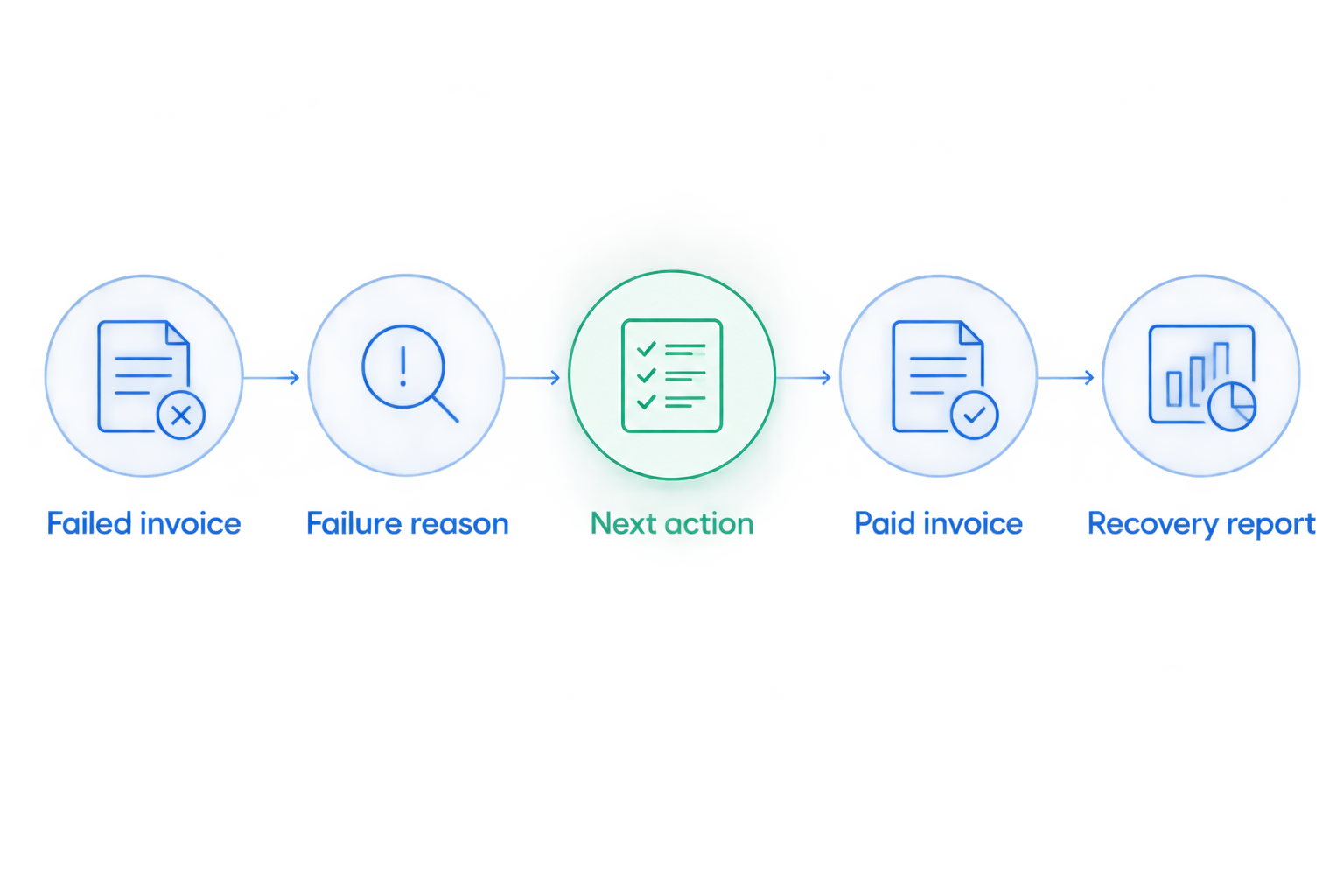
6. Choose between internal operation and managed recovery
Keep the process internal when a named person can maintain it. Built-in recovery is a reasonable starting point when your team can review exceptions, test messages, and reconcile outcomes. Adding another system does not remove those responsibilities by itself.
Choose a managed service when the missing resource is ongoing ownership. Define the work before signing: results review, message maintenance, personal follow-up, escalation, and reporting. Those responsibilities matter more than a feature checklist when nobody currently runs the queue.
For your 2026 evaluation, give every candidate the same invoice definitions and workflow questions. Ask what remains with your staff. Request a written scope for the recovery audit and the continuing service separately, so a diagnostic engagement does not get confused with ongoing operation.
Do not migrate by turning everything on at once. Identify the sender and retry owner for each stage before changing the live process. Retain an escalation route for customers caught between systems.
- Document the tasks your team will retain.
- Ask who reviews results and how often.
- Specify who changes customer messages and approves revisions.
- Define personal follow-up and escalation responsibilities.
- Agree on reporting definitions before comparing outcomes.
Compare the operating models, not just the feature lists
Choose the option whose responsibilities match your staffing. These are operating-model comparisons, not measured recovery-rate rankings. Verify current scope and platform eligibility directly before selecting a provider.
| Option | Best for | Practical advantage | Key limitation |
|---|---|---|---|
| Stripe built-in retries and emails, managed internally | Teams with a billing owner | Starts with recovery controls inside the billing platform | Your team still owns reviews, exceptions, and message maintenance |
| Stunning Software | Teams that want recovery software and will operate it | Provides a dedicated software option for failed-payment recovery | Software does not replace your internal operating owner |
| Stunning Managed Recovery | Teams seeking outside recovery ownership | Provides a managed-service option rather than software alone | Scope, platform eligibility, and retained responsibilities need agreement |
| Internal manual follow-up | Accounts requiring individual billing coordination | Lets staff handle customer-specific context directly | Requires staff time and consistent recordkeeping |
A paid recovery audit is the diagnostic step when you cannot explain where invoices stop progressing. Request a defined deliverable: the current workflow, unresolved failure categories, duplicate activity, reporting gaps, and an implementation owner. An audit identifies work; ongoing management performs it.
Discuss your recovery ownership
Ask about a paid recovery audit and the scope of Managed Recovery for your Stripe subscription business.
Common mistakes venture-funded SaaS startups make
Treating funding as a reason to buy more software
A funding round does not establish that your retry settings are inadequate. Start with unresolved invoices and the work required to resolve them. Buy software for an identified workflow need; hire a service for an identified ownership need.
Putting failed payments inside a single churn figure
A combined churn number hides the distinction between customers who chose to leave and customers whose renewal failed. Keep those categories separate. Otherwise, your team cannot tell whether to improve the product experience, correct billing, or collect an overdue invoice.
Leaving annual renewals to self-service reminders
For contract-based accounts, check who handles invoices and payment authorization. A product administrator is not automatically the billing decision-maker. Assign a relationship owner when an unresolved renewal needs coordination beyond a payment-update link.
Changing access without a documented rule
Do not let an improvised recovery message become your account-access policy. Document the approved treatment of overdue accounts, exceptions, and reinstatement. Customer-facing messages should describe the policy your team actually applies.
FAQ
What’s the best payment recovery approach for a venture-funded SaaS startup?
Choose the approach your team can operate consistently. Use internally managed recovery when someone owns reviews and exceptions; consider a managed service when that ongoing ownership is missing.
Are Stripe’s built-in retries and emails enough?
Stripe’s built-in recovery is a valid starting point when your team can manage the surrounding work. Evaluate unresolved invoices, customer-action cases, message maintenance, and reporting before adding another system.
When should a startup hire someone to run failed-payment recovery?
Hire outside recovery management when recurring reviews, message updates, or follow-up lack an accountable owner. Define those responsibilities in the service scope rather than assuming installation includes them.
Does updating a card count as recovered revenue?
No. Confirm that the original failed invoice became paid before reporting it as recovered; a payment-method update alone records customer activity, not collection.
Should annual SaaS renewals have a separate recovery process?
Track annual renewals separately and give them explicit billing-contact and escalation checks. Contract-based accounts can require coordination with someone other than the product user.
What should a paid recovery audit deliver?
A paid recovery audit should identify workflow gaps and assign actionable fixes. Request invoice-level findings, reporting definitions, message-overlap checks, escalation rules, and an owner for implementation.
How should a startup compare recovery providers?
Compare providers using the same invoice cohort, observation window, and definition of recovery. Separately compare who maintains messages, reviews results, handles exceptions, and reports outcomes.
One last thing
An automated recovery process still needs a person responsible for exceptions. Before changing your 2026 setup, open an unresolved failed invoice and name who owns its next action. If nobody can answer, resolve that ownership gap before adding another reminder.
Related guides
- Stripe failed payments: a recovery audit checklist
- Dunning software or managed recovery: who owns the work?
- Confirming a renewal was really recovered