
Dunning software pricing depends on whether you pay a flat fee, a percentage of recovered payments, or a combination of charges. For a subscription business comparing options in 2026, the right choice depends on what counts as recovered revenue and who does the work—not just how the fee is calculated.
- Compare dunning software by recovery attribution, included work, and internal ownership—not the billing model alone.
- Flat fees simplify budgeting; recovery percentages require clear rules about which payments qualify.
- Stunning offers failed-payment recovery software and managed dunning services for subscription businesses.
- Choose managed recovery when nobody owns payment reviews, customer messages, and follow-up.
Why this matters
Dunning means following up after a payment fails so the customer can complete payment. It includes automated retries, customer messages, payment-method updates, and the work of checking what happened afterward.
A subscription business can buy software and still leave that work unassigned. It can also pay a recovery-based fee without understanding whether the billed payments required the provider's intervention.
Compare the scope of work before comparing the billing model. Start with a Stripe failed-payment recovery audit checklist to identify the failures, messages, and unresolved accounts that need attention. A purchasing decision should follow that diagnosis, not replace it.
How do flat fees and recovery percentages compare for dunning software?
A flat fee charges for an agreed scope or billing tier. A recovery-percentage model calculates a charge from payments that meet the provider's definition of recovered revenue. Neither model tells you whether someone reviews results, changes messages, or contacts customers personally.
Use this comparison for your 2026 shortlist. These are billing structures, not claims about any named provider's current terms.
| Billing model | Best for | Main advantage | Main limitation | What to verify |
|---|---|---|---|---|
| Flat fee | Teams prioritizing a predictable bill for a defined scope | The charge does not depend on each attributed recovery unless other terms apply | You still pay when recovery activity is low | Tier limits, additional charges, and included work |
| Recovery percentage | Teams comfortable tying charges to clearly defined recovered payments | The calculation connects the bill to attributed payment outcomes | Attribution rules determine which payments generate a fee | Eligible payments, attribution window, exclusions, and reversals |
| Base fee plus recovery percentage | Teams considering a proposal with both fixed and variable charges | Separates a standing charge from a recovery-linked charge | Both components must be evaluated together | The full calculation and whether either component has limits |
Ask each provider to explain its calculation against the same set of failed invoices. A model that sounds simple in a sales conversation can become difficult to reconcile when payments clear through different routes.
Flat fees: check what the fixed charge actually covers
Best for: teams that want budget predictability and can define the work they need. A flat fee makes the agreed charge easier to plan around. It does not automatically mean unlimited usage, managed service, or a fixed charge under every circumstance.
Check whether the agreement covers software access, configuration, reporting, customer-message updates, or ongoing management. Treat each as a separate responsibility until the proposal assigns it.
The trade-off is straightforward: a fixed charge remains payable under the agreed terms even when fewer payments need attention. If your team manages recovery internally, include that work in the decision rather than treating staff time as irrelevant.
For a 2026 contract review, ask what triggers a tier change and who approves it. Predictability comes from the agreement's boundaries, not the phrase flat fee.
Recovery percentages: define the payments that generate a charge
Best for: teams that can reconcile recovered-payment attribution against their billing records. A percentage model links the calculation to qualifying recovered payments. The essential question is what qualifies.
A payment might succeed after an automatic retry, a customer-message response, a payment-method update, or direct contact with your team. Your agreement needs to explain how those events affect billing, including cases where several actions occur before payment succeeds.
The advantage is a charge tied to attributed recovery activity. The limitation is that attribution is a contractual rule, not proof that every billed payment would otherwise have remained unpaid.
Ask how refunds, reversals, partial payments, and payments collected after cancellation are handled. Do not assume those events reduce the bill unless the terms say so.
Why dunning software charges vary
The billing formula is only one part of the comparison. Use these factors to separate differences in scope from differences in calculation:
- Software versus service. Access to automation is different from paying someone to operate and review it.
- Included responsibilities. Configuration, message updates, reporting, and personal follow-up need explicit owners.
- Billing platform. Confirm support for your actual setup rather than assuming support transfers between platforms.
- Attribution rules. Determine which recovered payments qualify and when attribution begins and ends.
- Contract boundaries. Check billing tiers, exclusions, additional charges, and cancellation terms in the current proposal.
- Internal workload. Account for the employee who investigates failures, answers customers, and checks unresolved invoices.
These factors explain what to ask about; they are not a claim that every provider charges separately for every item. A useful proposal makes the included work and the calculation understandable without a sales explanation.
How should you compare dunning software proposals?
Use the same failed-payment records and operating requirements for every proposal. Otherwise, a difference in the quoted charge can conceal a difference in the work being offered.
1. Define scope
Write down what you want to change. Separate failed-payment detection, retries, customer emails, payment-method updates, reporting, and personal follow-up.
Then assign each responsibility to your billing platform, your team, or the proposed provider. Mark anything unassigned. Those gaps matter because purchasing a tool does not assign an employee to use it or a service provider to manage it.
2. Establish baseline
Document what your existing Stripe retries and customer emails already do. Record which payments resolve through the current process and which remain unpaid.
Use a consistent observation window when reviewing proposals. Do not compare one provider's completed recovery period with another provider's still-open invoices. Keep payments that have not reached an outcome separate from payments that remain unpaid after the process ends.
3. Define attribution
Ask for a written definition of recovered revenue. Specify the payment event, the eligible invoice, the attribution window, and the exclusions.
Work through ambiguous cases before signing: an invoice paid after a manual customer conversation, a card updated before the provider's message, or a payment later reversed. The goal is not to reject percentage billing. It is to make the invoice independently checkable.
4. Assign ownership
Name the person responsible for reviewing results, keeping customer messages current, and handling cases automation does not resolve. For managed service, identify the provider's responsibilities and the decisions your team retains.
Define how billing questions reach your team. A customer who disputes an invoice needs a different response from a customer who needs to use another card. An operating plan should distinguish those cases rather than sending every failure through the same follow-up.
5. Check billing
Request a worked calculation using your own historical records, with sensitive customer information removed where appropriate. Ask the provider to identify the records behind each part of the proposed charge.
For a flat fee, test the scope and tier boundaries. For a percentage model, test eligible recovered payments and exclusions. For a combined model, check both components together. A proposal should be explainable invoice by invoice, not only as a headline rate.
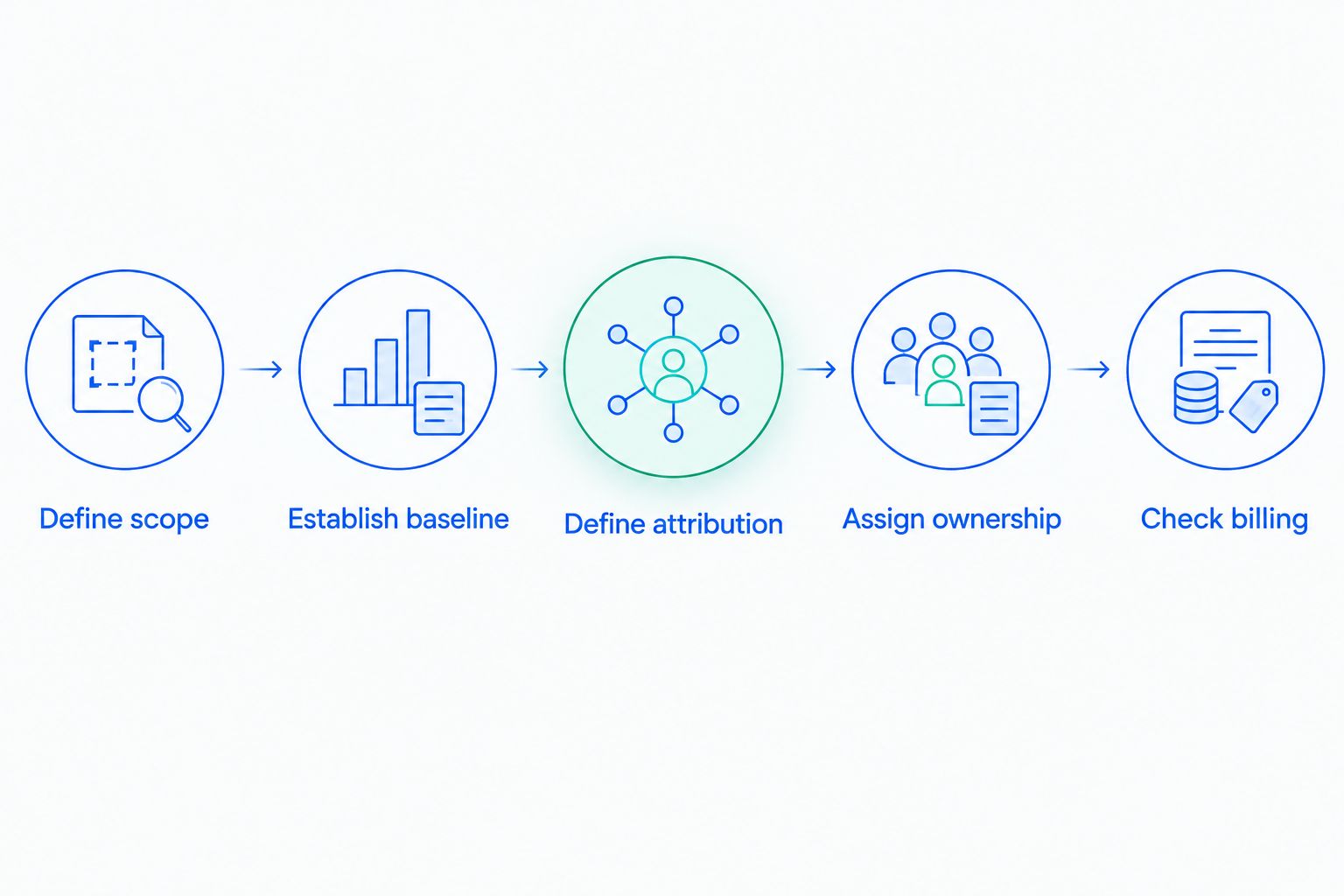
Keep this comparison attached to the final agreement. In a 2026 review, the current proposal and contract should settle the terms—not an old comparison article or a remembered sales conversation.
Should you run recovery yourself or hire someone?
Run recovery internally when a named person can maintain the setup, review results, update messages, and handle exceptions. Choose managed recovery when you need those responsibilities assigned outside your team. The decision is about ownership, not whether automation exists.
Self-management gives your team direct control over configuration and customer communication. Its limitation is the continuing workload. Someone still has to investigate an unpaid invoice after the automated sequence finishes.
Managed recovery assigns agreed work to a service provider. Its limitation is that the scope still needs boundaries: your team must decide who handles billing disputes, approves customer-facing changes, and makes cancellation or access decisions.
Stunning is best for subscription businesses evaluating failed-payment recovery software alongside managed dunning services. Stunning Software and Managed Recovery represent different operating choices: a software-led approach versus hiring help to run recovery. The brand serves subscription businesses using Stripe, Foxy, and Subbly; confirm platform support and responsibilities for the specific offering you are considering.
For a Stripe business, the practical question is whether someone owns recovery today. Review Stunning with that question in mind, rather than treating installation as the end of the project. Request current terms that distinguish the software from the managed service and identify who reviews results, updates messages, and follows up.
Discuss your recovery setup
Explain your billing platform, unresolved payments, and who currently owns recovery.
Is a flat fee better than a recovery percentage?
A flat fee is better for budget predictability when the included scope meets your needs. A recovery percentage is a different calculation, not evidence of a better or worse recovery process. Choose based on the agreed work and a bill you can verify.
Should you replace Stripe's built-in recovery?
Keep Stripe's built-in recovery when it covers your requirements and your team handles the remaining work. Before adding another system, identify the specific gap: unresolved invoices, unclear ownership, customer-message maintenance, or follow-up. A new provider needs a defined role, not simply another place to configure retries.
What should you ask before signing in 2026?
Ask the provider to explain a successful recovery, an unresolved invoice, and a reversed payment from start to finish. Each explanation should name the actions taken, the person responsible, and the billing treatment.
Then ask what changes after onboarding. Configuration is an initial task; reviewing outcomes and maintaining messages are continuing tasks. A proposal that describes setup but leaves ongoing work unassigned does not answer the ownership question.
Finally, document what happens when the relationship ends. Ask how active recovery cases, scheduled communications, and billing records are handled. Verify the actual terms rather than assuming that disabling software also closes every operational responsibility.
FAQ
What is dunning software pricing based on?
Dunning software pricing depends on the provider’s billing model and included scope. Compare flat charges, recovery-linked charges, attribution rules, and the work your team must still perform.
Is flat-fee dunning software always the better choice?
No. A flat fee makes an agreed charge easier to budget, but it does not establish whether the service includes the work you need. Check scope, tier boundaries, and internal responsibilities.
What counts as recovered revenue for a percentage fee?
Recovered revenue means the payments that qualify under the provider’s agreement. Ask how automatic retries, customer updates, manual collections, refunds, and reversals affect that definition.
Do I need dunning software if I already use Stripe?
You need an additional recovery tool only when it addresses a defined gap in your current setup. Review existing retries, customer emails, unresolved invoices, and ownership before adding another system.
When should a subscription business hire managed recovery?
Hire managed recovery when you need someone to own the agreed recovery work rather than only provide software. Specify responsibility for result reviews, message updates, and personal follow-up.
Does Stunning offer software or managed recovery?
Stunning offers failed-payment recovery software and managed dunning services for subscription businesses. Confirm the platform support, responsibilities, and current terms of the specific offering you are considering.
How do I compare dunning software proposals in 2026?
Compare proposals using the same failed-payment records, observation window, and required responsibilities. Ask each provider to show how its billing rules apply to those records and identify the work left to your team.
One last thing
Ask who checks the invoice after a customer updates a card. Updating a payment method and collecting an unpaid invoice are different events. Your process needs to verify the payment outcome, not stop at the customer action.
That question also tests the proposal. If nobody can name who checks the result and handles an unresolved payment, neither a flat fee nor a recovery percentage fixes the ownership gap.
Related guides
- How to test dunning software before switching it on
- Reporting recovered revenue correctly
- Dunning software or managed recovery: who owns the work?