
Online coaching payment recovery is the process of resolving failed subscription charges so paying clients can continue their coaching relationship without an avoidable billing interruption. This 2026 guide covers recurring coaching memberships and retainers, where payment status, session access, and personal client communication need to stay aligned.
- Payment recovery for online coaching businesses needs a named owner, accurate invoice records, and clear client messages.
- Use Stripe retries for eligible failures; request client action when retrying cannot resolve the problem.
- Stunning offers payment recovery software and managed dunning services; choose based on who will run the work.
- Confirm that the failed invoice is paid before counting revenue as recovered or restoring restricted access.
Why payment recovery matters for online coaching businesses
A failed coaching renewal is a billing problem, not proof that a client wants to leave. Treating every failure as a cancellation confuses payment collection with a decision about the coaching relationship.
Coaching also connects billing to a service commitment. Your client might have a booked session, access to a coaching community, or an ongoing program. Decide what happens to each entitlement while an invoice remains unpaid; do not leave the coach to invent that policy during a session.
Stunning payment recovery is best for subscription businesses choosing between running recovery software themselves and hiring a managed service. That choice matters when failed payments are accumulating but nobody owns the follow-up.
For your 2026 process, separate three questions: what failed, what action resolves it, and who confirms completion. Dunning—the process of following up on overdue payments—needs all three answers. Sending another email addresses only one part of the work.
Build a recovery process your coaching team can run
Start with your existing billing records and a shared worklist. Additional software should remove work from a defined process, not conceal an undefined one.
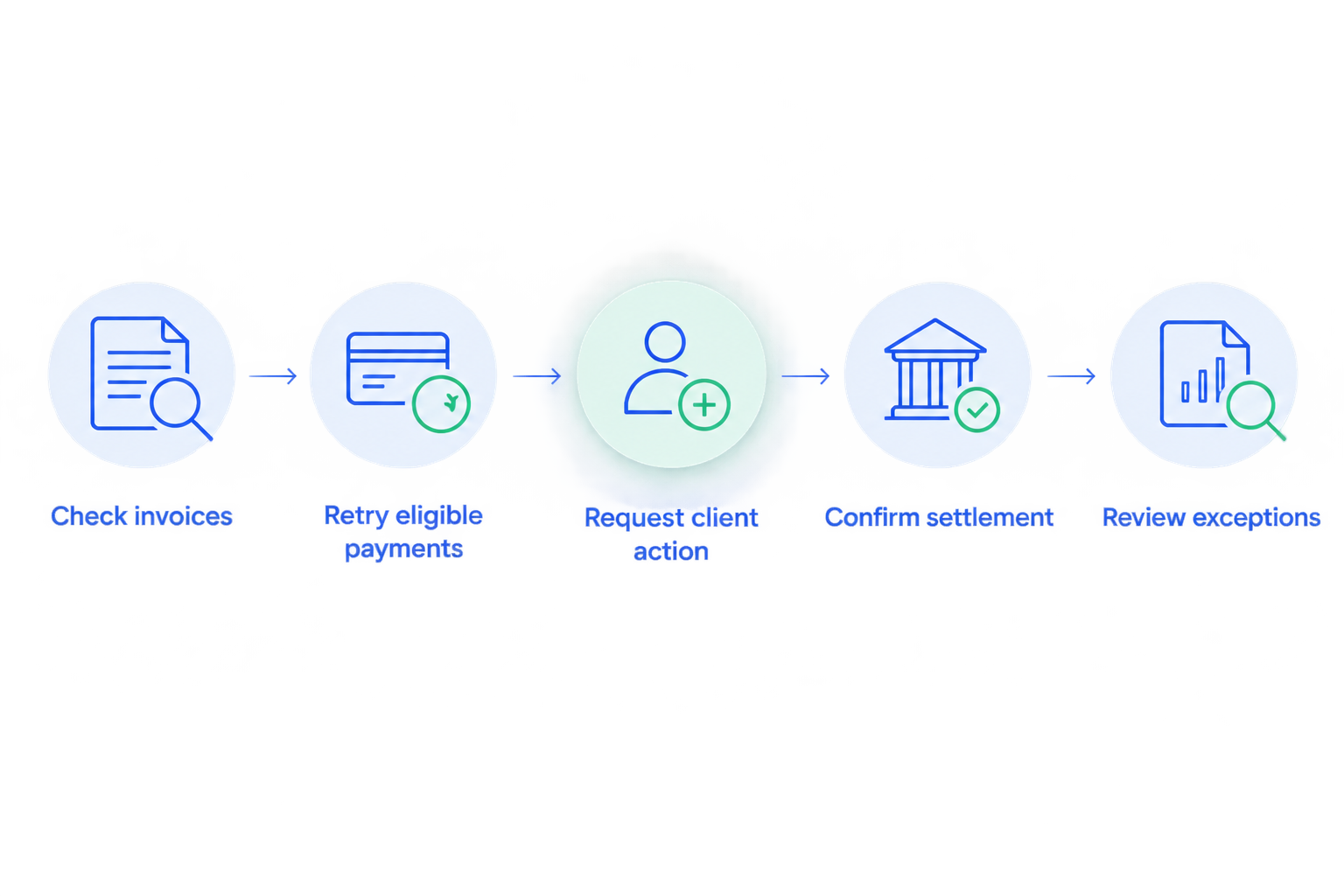
The operating sequence is Check invoices, Retry eligible payments, Request client action, Confirm settlement, and Review exceptions. Keep the invoice as the reference point throughout that sequence.
1. Assign a recovery owner and define the scope
Open your billing dashboard and create a worklist of failed recurring coaching invoices. A spreadsheet is enough to start. Record the invoice, client, amount due, failure date, current status, next action, and owner without copying sensitive payment details.
Separate subscription renewals from installment payments for a fixed coaching package. Both need collection work, but their payment obligations and service terms differ. Also distinguish failed charges from invoices that have not yet reached their due date.
Assign 1 recovery owner before changing your messages. The owner coordinates billing work; the coach handles relationship questions that require coaching context. Name a backup so an absence does not leave the queue untouched.
- List the recurring offers included in recovery.
- Separate overdue invoices from upcoming payments.
- Assign an owner and backup.
- Record the next action on each open invoice.
2. Diagnose the failure before retrying
Read the payment failure information in Stripe and check the invoice history. A temporary decline, a payment requiring authentication, and an incorrect billing setup call for different responses. Repeating the same action does not address those differences.
Check whether a retry is already scheduled before attempting another charge. Also inspect previous customer messages. A coach sending a personal reminder while an automated message is already scheduled creates unnecessary duplication.
For a client who must authenticate a payment or provide another payment method, give a specific next step. Do not tell that client simply to wait for another retry. Use Stripe's available failure information rather than guessing why the bank declined a charge.
- Read the failure details on the payment.
- Check scheduled and completed attempts.
- Identify any required customer action.
- Inspect the invoice and subscription configuration.
- Check which reminders have already been sent.
3. Separate retries from client-action messages
First, review the retries and failed-payment emails configured in your existing Stripe account. Document what is enabled, when messages are triggered, and what happens after attempts end. Keep a single coordinated sequence for each invoice.
Retries address eligible collection attempts. Messages ask clients to do something: update a payment method, authenticate a payment, or contact your team about a billing error. Write each message around the required action rather than sending the same generic overdue notice to everyone.
Stunning Software is the payment recovery software option to evaluate when your team will continue owning the process. Compare it with your current setup using actual workflow requirements, not an assumed recovery uplift. Confirm the platform connection and configuration before changing the live sequence.
- Document the existing retry settings.
- Separate retryable failures from action-required cases.
- Give each message a specific purpose.
- Remove overlapping reminders before activation.
- Test the payment-update journey before sending it.
4. Write messages that fit the coaching relationship
Draft your messages manually before automating them. Name the coaching subscription, explain that its payment did not complete, and tell the client how to resolve it through a secure payment flow. Never ask a client to email card details.
Keep the message separate from coaching advice. A billing reminder should not imply dissatisfaction with the client's progress or commitment. If an assistant handles billing, make that role clear so the client knows whom to contact.
State access consequences only when they match your actual agreement and configured process. Do not threaten to cancel a session that your team intends to deliver. Likewise, do not promise uninterrupted access unless that is your policy.
- Identify the relevant coaching subscription.
- Describe the required payment action plainly.
- Provide a secure payment-update route.
- Include a monitored reply channel.
- Match every access statement to your policy.
5. Align unpaid invoices with session and program access
Write down what an unpaid renewal means for booked sessions, new bookings, course materials, and community access. These are separate decisions. Your booking system and coaching platform need to reflect the policy rather than rely on someone remembering to check Stripe.
Test the failed-payment path and the recovery path. Confirm what happens when a payment fails, when a subscription changes status, and when the outstanding invoice is paid. A client should not remain restricted because the billing record changed but the access workflow did not.
For your 2026 access review, include a manual correction process. Someone needs authority to investigate mismatched records and communicate the outcome without silently changing the underlying payment obligation.
- Define the rule for existing bookings.
- Define the rule for new bookings.
- Check community and course access separately.
- Test access restoration after payment.
- Assign responsibility for correcting mismatches.
6. Decide whether to run recovery or hire an operator
Try a recurring, 15-minute weekly review as an operating starting point, not a performance benchmark. Review unresolved invoices, unanswered messages, access exceptions, and cases needing personal contact. Extend the review when the work requires it.
Keep recovery in-house when a named employee can maintain messages, inspect results, and finish follow-ups. Choose managed help when those tasks remain unassigned or repeatedly unfinished. The decision is about ownership, not simply adding another billing integration.
Managed Recovery is the service option to discuss when you want someone else to run failed-payment recovery. Ask who reviews results, who changes messages, and who follows up personally. Confirm platform support for the managed service separately from software support; do not assume they are identical.
- Identify the person doing each recovery task today.
- List work that remains unfinished.
- Define the service provider's responsibilities in writing.
- Confirm reporting and review frequency.
- Agree on escalation and handoff rules.
7. Measure paid invoices and review unresolved cases
Build a 30-day invoice cohort: a group of invoices whose initial payment failed during the same selected period. Track those invoices through later outcomes. Keep the observation window consistent when comparing one period with another.
Count recovery when the relevant invoice is paid, not when an email is opened or a payment method changes. Report recovered invoice value separately from the value of future coaching renewals. Those are different measures.
For your 2026 reporting, keep unresolved, voided, and otherwise closed invoices visible rather than quietly removing them from the original group. Use the recovery audit checklist to structure the investigation before changing tools.
- Define which invoices enter the cohort.
- Record the original failed invoice value.
- Confirm payment against the correct invoice.
- Separate collected money from future subscription value.
- Review unresolved cases and their next actions.
Compare recovery options for your coaching business
Choose the operating model before choosing the tool. The practical comparison is who performs the work, which tasks remain internal, and whether the arrangement fits your billing platform.
| Option | Best for | Main advantage | Key limitation |
|---|---|---|---|
| Manual recovery using billing records | Coaches establishing a recovery process | Direct control over each client conversation | Your team must track every case and complete follow-ups |
| Stripe's built-in retries and emails | Stripe businesses whose existing settings meet their requirements | Recovery starts in the existing billing account | Your team still needs to review settings, results, and exceptions |
| Stunning Software | Subscription teams that want recovery software and retain an internal owner | Provides a software route for failed-payment recovery | Software does not replace the need to assign operational responsibility |
| Stunning Managed Recovery | Subscription teams seeking managed recovery work | Provides a managed-service route rather than software alone | Scope, platform support, reporting, and handoffs require confirmation |
Ask each provider the same questions. Which payment failures require client action? Who edits messages? Who handles replies? What evidence closes a case? Compare the answers against your worklist rather than a feature list disconnected from your coaching operation.
For a 2026 buying decision, request an assessment of the current recovery process before committing to a replacement. Replacing a tool will not settle an unclear access policy or decide who should contact a client personally.
Discuss your recovery workload
Ask about a recovery audit, Managed Recovery responsibilities, and support for your billing platform.
Common mistakes online coaching businesses make
Treating a failed renewal as a cancellation request
A declined charge does not communicate the client's intention. Keep cancellation requests separate from failed-payment follow-up, and check the client's actual account history before deciding what happens next.
Letting coaches and billing staff send overlapping reminders
A personal relationship does not remove the need for coordination. Record manual outreach in the same worklist used by the recovery owner, and check scheduled messages before sending another reminder.
Mixing package installments with recurring memberships
A fixed coaching package paid in installments is not the same arrangement as an ongoing membership. Label them separately and apply the relevant agreement when discussing outstanding payments or future service.
Restoring access after a card update alone
A new payment method does not prove that the overdue invoice was paid. Confirm the invoice outcome before closing recovery work or changing restrictions tied to that invoice.
Hiring help without defining the handoff
A managed-service agreement needs operational boundaries. Specify who handles billing replies, who answers coaching questions, and who approves exceptions. Otherwise, the same unresolved client case can move between teams without an owner.
FAQ
What’s the best payment recovery setup for an online coaching business?
The best setup matches your billing platform and assigns someone to complete the recovery work. Start with existing invoice records and retry settings, then add software or managed help for a defined need.
Can I use Stripe’s built-in retries for coaching subscriptions?
You can use Stripe’s built-in recovery features for eligible Stripe subscription payments. Review your account settings and handle failures requiring authentication or another payment method separately.
Should I pause coaching sessions after a failed payment?
Follow your coaching agreement and stated access policy. Define how unpaid invoices affect existing sessions, new bookings, and program access before applying restrictions.
When should I hire someone to manage payment recovery?
Hire managed help when nobody consistently reviews failures, maintains messages, and finishes follow-ups. Define responsibilities and escalation rules before handing over the work.
Does updating a client’s card mean the payment was recovered?
No, updating a card does not establish that the failed invoice was paid. Check the invoice’s payment outcome before recording recovery or closing the case.
Does Stunning support the same platforms for software and Managed Recovery?
Confirm support for each offering separately. Stunning offers failed-payment recovery software and managed dunning services, but you should verify the exact service and platform combination before choosing.
How should I measure recovered coaching revenue?
Measure payments collected against the failed invoices in a defined cohort. Keep future renewal value separate and use a consistent observation window when comparing results.
One last thing
Test the successful recovery path, not just the failure message. Follow an overdue invoice through payment confirmation, subscription status, booking permissions, and community access. A payment can be resolved while the client experience remains broken if those records do not agree.
Make that end-to-end check part of your 2026 recovery review. The case is finished when the invoice outcome is verified and the client's access matches your policy.
Related guides
- Dunning software or managed recovery: who owns the work?
- When a Stripe customer needs a different card
- Confirming a renewal was really recovered