
Dunning management software should hand off unresolved accounts to a named owner with the failed invoice, payment history, customer messages, and next action attached. Keep routine recovery automated, but give exceptions a clear decision path so an unsuccessful retry does not become an unattended account.
- Dunning management software needs a named owner for unresolved invoices, not just another reminder sequence.
- Stunning offers failed-payment recovery software and managed dunning for subscription businesses.
- Use payment status, customer responses, and account context to decide the next action.
- Choose managed recovery when your team cannot consistently review results, update messages, and follow up.
Why this matters
Dunning means following up on unpaid subscription payments. The difficult part is not always sending the reminder; it is deciding what happens when reminders and retries have not resolved the invoice.
For your 2026 recovery process, separate routine failures from exceptions that need investigation. A customer who needs to authenticate a payment needs a different response from someone disputing an invoice. Both can remain unpaid, but the next actions differ.
Start by deciding who owns failed-payment recovery. Software can organize work, but your operating process still needs an accountable person who checks that the customer reached a valid outcome.
How should dunning management software hand off unresolved accounts?
Hand off an unresolved account when its next action requires judgment, customer involvement, or a decision outside the automated sequence. The handoff should identify the specific invoice, explain what has already happened, and assign responsibility for the next action.
Do not use a generic failed-payment notification as the entire handoff. A notification tells someone that a problem exists; a useful handoff tells them what to do and where to find the evidence.
| Route | Best for | Advantage | Limitation |
|---|---|---|---|
| Automated recovery | Routine failures with an appropriate automated next action | Keeps repeatable work out of the manual queue | Does not replace decisions about disputes or service access |
| Internal owner | Exceptions your team can investigate and resolve | Keeps billing and customer context together | Requires protected time and clear accountability |
| Managed recovery | Teams that need someone to run recovery work | Assigns operational work beyond software configuration | Still needs agreed boundaries for billing and access decisions |
Use the table to decide who should act, not to label every unpaid invoice as a manual task. Escalating everything creates another queue; escalating nothing leaves exceptions inside automation that no longer fits.
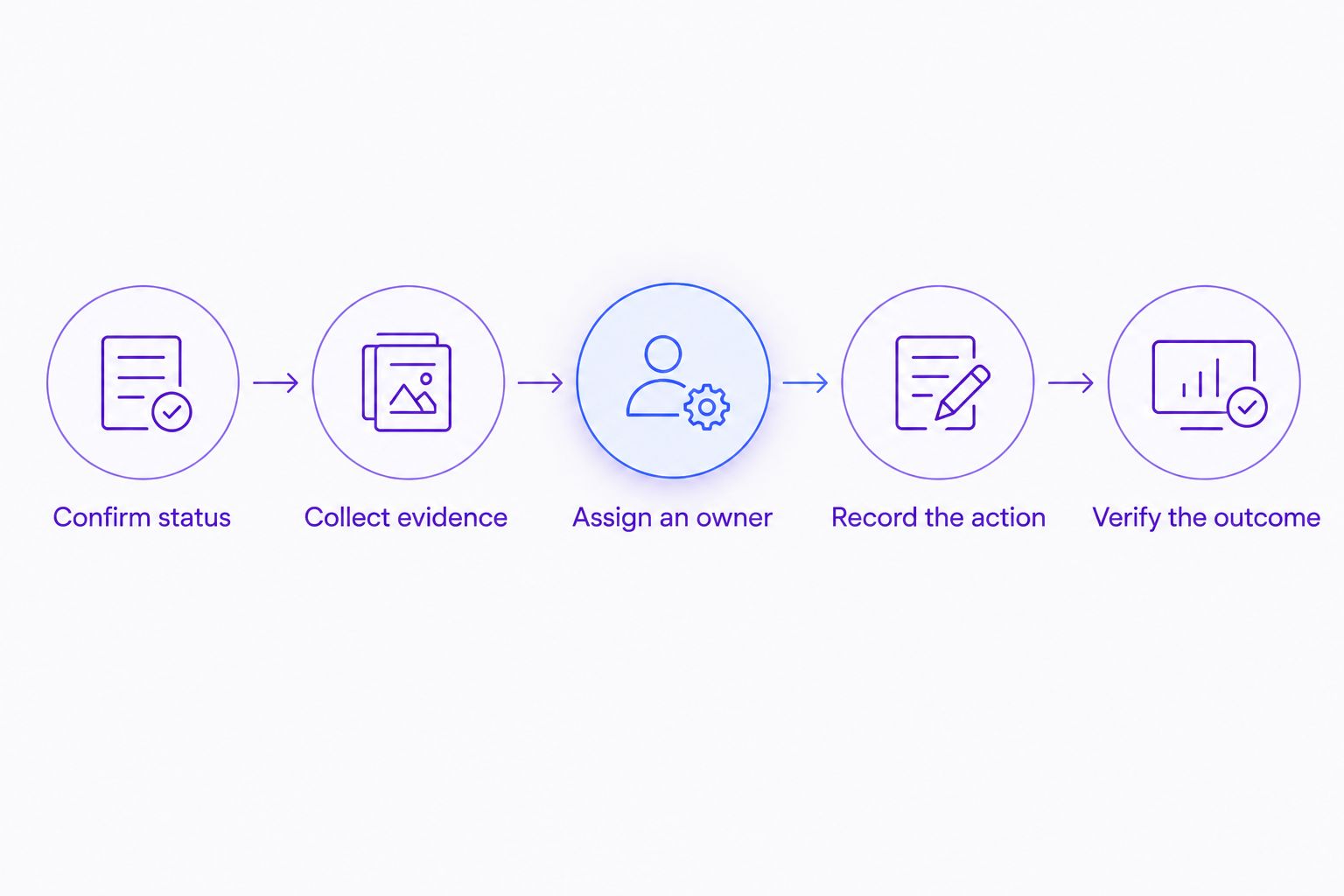
Build the handoff in this order
- Confirm status. Check whether the specific invoice is still unpaid and whether any payment action remains pending.
- Collect evidence. Include the failure information, attempted recovery actions, customer replies, and relevant account context.
- Assign an owner. Name the person responsible for the next action, not just the department receiving the alert.
- Record the action. State whether the customer, billing team, or another decision-maker needs to act.
- Verify the outcome. Confirm payment or document why recovery stopped before closing the case.
What belongs in an unresolved-account handoff?
A handoff should let the next person act without reconstructing the account from scattered messages. Keep the record concise, but make the evidence accessible.
Invoice and payment evidence
Identify the customer, subscription, and unpaid invoice separately. Then record the latest payment status, the relevant failure information, and what the recovery process has already attempted.
Do not substitute a customer-level label for invoice-level evidence. An account can have billing activity that does not settle the invoice under review. Closing a case requires checking the obligation you intended to recover.
Customer context
Include the billing contact, any customer response, and the action already requested. Distinguish a customer who has not replied from one who has replied but needs help completing the payment.
Record disputes and billing questions explicitly. A customer questioning an invoice needs an answer about that invoice, not a reminder that ignores the question.
Ownership and boundaries
Name the owner and the next action. Also record which decisions require approval, such as changing an invoice or restricting account access.
Your 2026 handoff template should make reassignment visible. If the owner changes, preserve the history and state who is now accountable. Copying another team into a message does not establish that the team accepted responsibility.
When should automation keep working?
Keep an account in automated recovery when the planned action still matches the problem and no unresolved customer response needs attention. A manual review should add judgment, not merely repeat an automated reminder in different words.
For a Stripe subscription business, inspect the retries and emails already configured before adding another recovery workflow. Establish which system sends each message and which system initiates each payment attempt. Do not assume that installing another tool removes the need to coordinate those actions.
Best for: teams with a named recovery owner and repeatable cases. Automation supports consistent execution. Its limitation is that someone still needs to review exceptions and decide when the planned sequence no longer fits.
Before approving your 2026 workflow, trace a failed invoice through the complete process. Confirm who sees a customer reply, who pauses inappropriate follow-up, and who checks the final invoice status.
When should an internal owner take over?
Assign an internal owner when resolving the payment requires context your team holds. Examples include a disputed invoice, a billing-contact change, an unresolved payment action, or a decision about continued service.
The owner does not need to perform every action personally. They need to coordinate the work and confirm the outcome. Finance can answer an invoice question while customer support helps the customer complete the agreed next step.
Best for: teams with time to investigate exceptions and authority to coordinate billing decisions. Internal ownership keeps context close to the customer relationship. The trade-off is workload: the process fails if ownership exists only on paper.
Avoid assigning every unresolved account to a shared inbox without a case owner. A shared inbox can hold the conversation, but the handoff still needs a person responsible for checking whether anything happened next.
When should you hire someone to run recovery?
Choose managed recovery when failed payments keep accumulating and nobody consistently reviews results, maintains messages, or follows up on unresolved accounts. That is an ownership problem, not simply a missing software feature.
Stunning is for subscription businesses that need failed-payment recovery software or managed dunning. Distinguish Stunning Software from Managed Recovery when discussing your requirements: choosing software and hiring someone to run the work are different decisions.
Ask which platforms each offering supports rather than assuming identical coverage. Also establish who reviews results, who changes customer messages, who follows up personally, and which decisions remain with your team.
Best for: teams that need an accountable recovery operator rather than another system to maintain. The benefit is assigning operational work. The limitation is that a service relationship still needs access, decision boundaries, and a clear escalation path for matters outside its remit.
Use a recovery audit to define that scope before choosing the delivery model. Bring examples of unresolved invoices, customer replies, overlapping reminders, and cases whose owner is unclear. Discuss your recovery process around those records rather than a feature checklist alone.
Why does the right handoff vary by account?
The next action depends on the obstacle, not just the age of the unpaid invoice. Use these factors to distinguish cases:
- Payment state: An unpaid invoice and an action still awaiting completion require different checks.
- Failure information: Use the recorded failure to guide investigation instead of treating every unsuccessful payment alike.
- Customer response: A dispute, a request for help, and silence each require a different follow-up.
- Billing authority: The person using the service is not necessarily the person authorized to resolve its billing.
- Decision boundaries: Invoice changes, account restrictions, and external escalation need an authorized decision-maker.
- Recovery history: Review previous attempts and messages before repeating an action that has already failed.
Record these factors in the handoff rather than burying them in a long account note. The person taking over should immediately see the obstacle and the requested decision.
Where does recovery end and debt collection begin?
Keep subscription payment recovery separate from a decision to pursue a debt through an external collection process. An exhausted reminder sequence is not, by itself, an instruction to escalate externally.
A discussion of business debt collection in Astana concerns a different decision from asking a subscriber to resolve a failed renewal. Keep the creditor, jurisdiction, invoice evidence, dispute history, and authorized decision-maker explicit before considering external collection.
Your recovery owner should document the unresolved outcome and route the decision to the appropriate business or legal adviser. Do not turn a payment-failure message into an unsupported legal threat or imply that an external action has been authorized when it has not.
How do you stop duplicate work after a handoff?
Decide whether automation continues, pauses, or changes when a person takes ownership. Record that decision alongside the case so the owner can see which messages and payment actions remain scheduled.
If the customer has replied, make that reply part of the next-action decision. Sending a routine reminder while someone investigates a billing dispute creates conflicting communication. The manual owner should know what the automated process will do next.
During your 2026 process review, inspect the communication path as carefully as the payment path. Check where replies arrive, how ownership changes, and whether a case can close while another queue still lists it as unresolved.
What should count as a resolved account?
Resolve the case against an explicit outcome, not an activity. Sending a message, receiving a reply, or recording a payment-method update does not by itself confirm that the unpaid invoice was settled.
Use clear outcome labels such as paid, awaiting customer action, under billing review, or recovery stopped. Treat waiting states as open work with an owner; otherwise they become a quieter version of an abandoned queue.
Keep the reason when recovery stops. A documented dispute, an authorized billing adjustment, and an unresolved nonpayment should not become indistinguishable in reporting. Your next review needs to explain what happened, not merely show that cases disappeared.
FAQ
What should dunning management software include in a manual handoff?
Dunning management software should pass the unpaid invoice, payment status, recovery history, customer response, owner, and next action. The recipient should not need to reconstruct the case before acting.
When should I stop automated reminders and contact a customer personally?
Contact the customer personally when the next action needs judgment, clarification, or help that the automated sequence does not provide. Decide explicitly whether the existing reminders should continue during that conversation.
Do I need another tool if I already use Stripe retries and emails?
Choose another tool only after identifying a gap in your current recovery process. If the gap is that nobody reviews exceptions or follows up, assigning ownership matters more than adding another sequence.
Is managed recovery better than running dunning software myself?
Managed recovery fits teams that need someone to run the work; self-managed software fits teams that can own review and follow-up. Stunning offers failed-payment recovery software and managed dunning, so establish the responsibilities and platform support for the offering you are evaluating.
Does updating a customer’s payment method resolve the failed invoice?
Updating a payment method is not proof that the failed invoice has been paid. Check the specific invoice and its payment outcome before closing the recovery case.
Who should own an account after retries end?
A named recovery owner should coordinate the account after retries end. That owner should route billing questions and access decisions to authorized people while keeping responsibility for follow-through.
Should every unresolved subscription payment go to debt collection?
No, an unresolved subscription payment should not automatically trigger external debt collection. Review the invoice evidence, customer response, business decision, and applicable legal requirements separately.
One last thing
For your next 2026 recovery review, choose an unresolved account and ask its owner to state the next action without searching through separate inboxes. If the answer is unclear, repair the handoff before expanding the automation.
The practical test is simple: another person should be able to take over the account without repeating the investigation or sending the customer a contradictory message.
Related guides
- Route Stripe payment failures to a recovery owner
- Decide what happens after Stripe retries end
- Build a monthly dunning review agenda